
Nanotechnology offers promising hope for treating genetic diseases by enabling precise delivery of gene editing tools like CRISPR, improving safety and effectiveness. Recent advances include targeted nanoparticles that reach specific tissues, high success rates in clinical trials, and innovations driven by AI. While challenges remain, such as immune responses and long-term safety, ongoing research suggests this could revolutionize healthcare. To understand whether this is hype or hope, discover more about how these cutting-edge innovations are shaping the future of medicine.
Key Takeaways
- Nanoparticles enhance gene editing precision and safety, enabling targeted treatment of genetic diseases.
- Recent clinical trials show promising results, including high protein restoration and minimal side effects.
- Advances in organ-specific targeting improve treatment efficacy while reducing off-target effects.
- AI-driven design and new delivery tools accelerate development but require further validation.
- While promising, long-term safety and large-scale effectiveness of nanotech gene therapies remain under ongoing research.

Polymer Nanoparticle Technologies for Gene Delivery and Gene Therapy (Micro and Nano Technologies)
As an affiliate, we earn on qualifying purchases.
As an affiliate, we earn on qualifying purchases.
The Promise of CRISPR and Nanotechnology Synergy

The synergy between CRISPR gene editing and nanotechnology holds immense promise for transforming how we treat genetic diseases. You can think of nanotechnology as the delivery vehicle that makes CRISPR’s precision possible inside the body. Nanoparticles can carry CRISPR components directly to affected tissues, increasing accuracy and reducing side effects. This combination allows for efficient in vivo editing, targeting multiple tissues simultaneously, and bypassing the need for complex ex vivo procedures. Preclinical studies show promising results, such as modifying tumor genes and boosting existing therapies. Clinical trials confirm the safety and potential efficacy of nanoparticle-based delivery systems like Cas9 RNP. European cloud innovation and nanotech could revolutionize treatments, offering more precise, effective, and accessible options for genetic diseases. Additionally, advancements in nanoparticle design are improving targeting capabilities and minimizing off-target effects, further enhancing therapeutic outcomes. A deeper understanding of nanotechnology is driving innovations that may eventually overcome current delivery challenges in gene editing.

CRISPR Delivery (Methods in Molecular Biology, 3075)
As an affiliate, we earn on qualifying purchases.
As an affiliate, we earn on qualifying purchases.
Advances in Delivery Systems for Gene Editing
Recent advances in nanoparticle delivery systems are making gene editing more precise and effective. You can now target specific organs like the lungs, spleen, or tumors by adjusting nanoparticle charge and composition. The ability to optimize delivery techniques through understanding wave and wind dynamics can help improve penetration and distribution within tissues. This precise targeting is essential for safe and efficient treatments, reducing side effects and improving the chances of successful therapy.
Targeted Nanoparticle Delivery
Advances in targeted nanoparticle delivery systems are transforming gene editing by enabling precise, tissue-specific transport of genetic materials. These nanoparticles can be engineered to optimize charge, size, and surface properties, ensuring they reach specific organs or cell types. For example, Selective Organ Targeting (SORT) nanoparticles adjust their charge to deliver therapies directly to the lungs, spleen, or tumors, minimizing off-target effects. Lipid nanoparticles can carry mRNA or DNA, producing proteins precisely where needed. They penetrate deep into tumors or tissues, activating immune responses or correcting genetic mutations. This targeted approach reduces dosage requirements, enhances safety, and improves efficacy. As a result, nanoparticle delivery systems are paving the way for more effective, less invasive gene therapies across a range of genetic disorders. Delivery efficiency is a critical factor in advancing these technologies toward clinical success. Additionally, ongoing research focuses on improving targeting accuracy and reducing potential side effects to ensure safer treatment options, which may involve novel delivery systems designed to further optimize therapeutic outcomes. Moreover, integrating nanoparticle engineering techniques can further refine the precision and effectiveness of these delivery platforms. Effective particle design is essential for maximizing the therapeutic potential of these innovative delivery systems.
Organ-Specific Precision
How can gene editing therapies target specific organs with greater accuracy? Advances in nanotechnology now enable precision delivery systems that focus treatments exactly where needed. By tailoring nanoparticle properties, you can improve targeting and reduce off-target effects. Here are four key innovations:
- Charge modulation: Adjusting nanoparticle charge directs cargo to organs like lungs or spleen.
- Cell-specific ZIP codes: Tagging genetic material guides delivery into particular cell types within tissues.
- Lipid nanoparticle enhancements: Specialized lipid formulations improve penetration into tumors and deep tissues.
- Organ-specific surface markers: Conjugating nanoparticles with targeting molecules ensures precise organ recognition.
These innovations make gene editing more efficient, minimizing side effects and maximizing therapeutic impact for conditions affecting specific organs. Incorporating targeted delivery systems into the development and communication of these advanced delivery systems can also help foster public trust and understanding of nanotechnology’s potential.

Nanomedicine and Applications in Cancer: A Complete Guide to Nanomedicine and Cancer Applications (Drugs and the Pharmaceutical Sciences)
As an affiliate, we earn on qualifying purchases.
As an affiliate, we earn on qualifying purchases.
Clinical Trial Highlights and Emerging Results
Recent clinical trials show promising results, with some therapies achieving 90% healthy protein levels within weeks. Innovative delivery methods, like nanoparticle-based systems, are demonstrating safety and efficiency in targeting specific tissues. Early-stage data suggest these approaches could revolutionize treatment options for genetic diseases, but further research is needed to confirm long-term safety and effectiveness. Additionally, personalized in-home care strategies may enhance overall patient outcomes by integrating medical advances with supportive services. As research progresses, understanding nanoparticle-based delivery systems will be crucial for developing effective therapies, especially considering the potential for targeted tissue delivery to minimize side effects. Moreover, ongoing studies are exploring how adaptive delivery systems can optimize treatment precision and reduce adverse reactions. Exploring self-sufficiency techniques could also support better management of health in emergency situations.
Promising Trial Outcomes
Are recent clinical trials proving that gene editing technologies are finally delivering on their promise? You can see real progress in several key areas.
- The 2025 trials show 90% healthy AAT protein levels by day 14, sustained to day 28 for alpha-1 antitrypsin deficiency. Advancements in precision medicine are contributing to more targeted and effective treatments.
- Beam Therapeutics’ base editing for GSD1a R83C mutation shows promising correction in severe glycogen storage disease cases.
- Prime Medicine’s first human data on prime editing demonstrates safety and efficacy for NCF1 mutation-related CGD.
- New delivery methods, like targeted nanoparticles, successfully reach multiple tissues, reducing treatment time and improving outcomes.
- The development of vetted delivery systems and precise editing tools is crucial for ensuring the safety and effectiveness of gene therapies moving forward.
These results suggest gene editing is moving from experimental to impactful, offering hope for treating complex genetic diseases effectively.
Innovative Delivery Methods
Advancements in delivery methods are now shaping the future of gene editing therapies, making them more targeted and effective. Nanoparticles, like the innovative Selective Organ Targeting (SORT) systems, can be fine-tuned to deliver genetic material precisely to organs such as the lungs, spleen, or tumors. Lipid nanoparticles now carry mRNA to produce therapeutic proteins directly in specific cells, enhancing treatment accuracy. In preclinical studies, nanoparticles penetrate deep into tumors, activating immune responses and stopping growth. Genetic tags called ZIP codes enable proteins to circulate efficiently, addressing diseases like psoriasis and cancer in mice. Over 300 patents and multiple clinical trials highlight how these delivery innovations are transforming gene editing, offering hope for safer, more effective treatments.
Early-stage Safety Data
Clinical trials have begun to reveal promising early safety data for nanotech-based gene editing therapies. You can see this in recent phase 1/2 studies where delivery methods like Cas9 RNP show minimal adverse effects. Specifically:
- No severe immune reactions reported in initial participants.
- Low off-target editing observed, indicating high precision.
- Nanoparticle delivery systems demonstrate consistent tolerability across tissues.
- Preliminary data suggests manageable safety profiles, even at higher doses.
These findings hint that nanotechnology-enhanced gene editing could be safe enough to advance further. While long-term effects remain under study, early results support continued development and potential clinical application, bringing hope closer for those with genetic diseases.

Organ Specific Drug Delivery and Targeting to the Lungs
As an affiliate, we earn on qualifying purchases.
As an affiliate, we earn on qualifying purchases.
Targeting Complex Diseases With Precision Medicine

Targeting complex diseases with precision medicine leverages cutting-edge technologies like CRISPR and nanotechnology to address the underlying genetic and molecular factors driving these conditions. You can now target multiple gene mutations simultaneously, improving treatment specificity and reducing side effects. Nanoparticles enable precise delivery of gene-editing tools directly to affected tissues, enhancing efficiency and minimizing off-target effects. For example, Nanoparticles can penetrate deep into tumors or reach hard-to-access organs, activating immune responses or correcting faulty genes. Advances like base and prime editing further refine precision, enabling safer modifications without double-stranded breaks. This integrated approach offers hope for tackling diseases like cancer, neurodegenerative disorders, and genetic syndromes that were previously too complex for conventional therapies. The role of nanoparticles in targeted delivery highlights their potential to revolutionize personalized medicine. It also opens new avenues for minimizing adverse effects and improving overall treatment outcomes. Additionally, ongoing research into nanoparticle biocompatibility aims to ensure these delivery systems are safe for widespread clinical use.
Overcoming Challenges in In Vivo Gene Editing
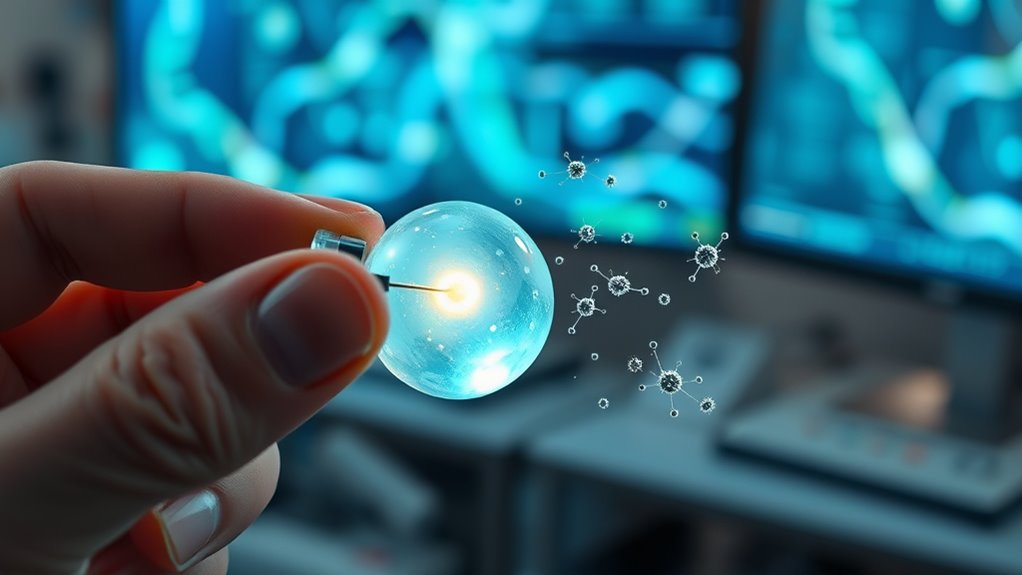
How can researchers effectively address the significant hurdles that hinder successful in vivo gene editing? First, they must improve delivery methods to target specific tissues without off-target effects. Second, enhancing nanoparticle design can boost stability and reduce immune reactions. Third, developing safer, more precise editing tools like prime editing minimizes unintended mutations. Fourth, establishing reliable, non-invasive monitoring techniques guarantees safe and effective treatment progress. Overcoming immune responses remains vital, as the body may reject delivery vectors or editing components. Additionally, achieving consistent, efficient editing across diverse tissue types challenges current technology. Finally, scaling up manufacturing processes while maintaining quality is essential for clinical success. Addressing these challenges requires a multidisciplinary approach, combining nanotechnology, molecular biology, and clinical research to bring in vivo gene editing from promising preclinical results to real-world therapies. Easy Conversion Tool can assist researchers and clinicians in understanding the scale of these challenges relative to large numerical values involved in medical research and healthcare data. Moreover, integrating advanced delivery systems can significantly improve targeting accuracy and therapeutic outcomes.
The Role of AI in Accelerating Genetic Therapies
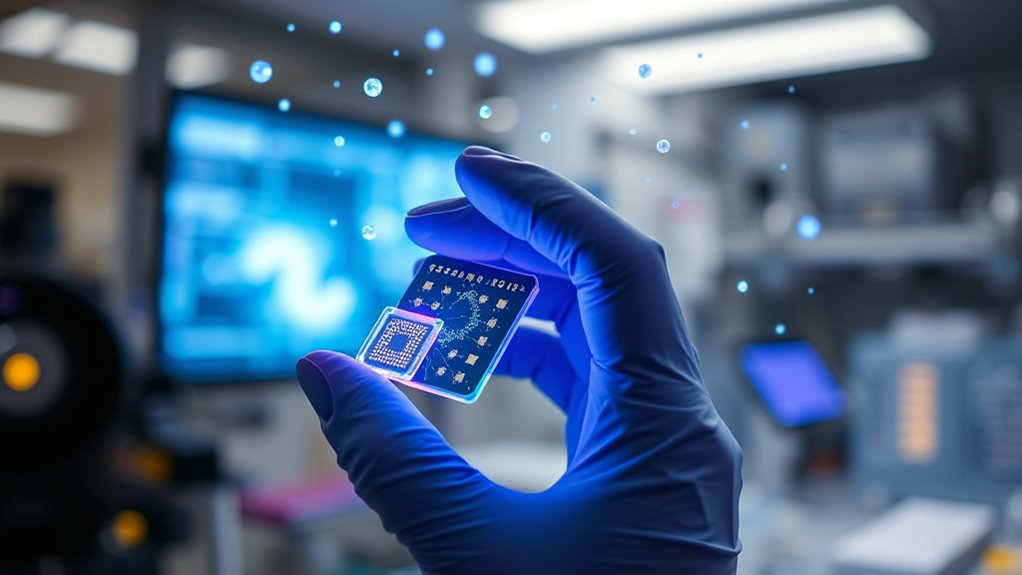
Advancements in nanotechnology have substantially improved gene delivery methods, but the complexity of designing precise and efficient editing tools still poses challenges. That’s where AI steps in, transforming how you develop genetic therapies. Tools like CRISPR-GPT automate the design of gene editing experiments, reducing trial-and-error and accelerating progress. AI models can predict off-target effects with high accuracy, improving safety and efficacy. They also help identify ideal delivery strategies, enhancing nanoparticle targeting. By analyzing vast datasets, AI uncovers new gene targets and suggests personalized treatment plans. This integration shortens development timelines, lowers costs, and broadens access to gene therapies. As AI continues to evolve, it will be vital in turning nanotech-based genetic treatments from experimental to mainstream options, offering new hope for genetic disease patients.
Addressing Safety and Ethical Concerns

As nanotechnology and gene editing tools become more powerful, addressing safety and ethical concerns is crucial to guarantee responsible development and public trust. You need to contemplate potential risks and moral questions to prevent misuse and unintended consequences. Here are key points to focus on:
- Ensuring precision to minimize off-target effects and genetic errors.
- Developing robust safety protocols for in vivo editing procedures.
- Establishing strict regulations to prevent unethical applications like germline modifications.
- Promoting transparency and public engagement to build trust and understanding.
Future Outlook: Transforming Healthcare or Overhyping Potential

The rapid progress in nanotechnology and gene editing suggests a future where healthcare could be revolutionized through precise, targeted treatments for genetic diseases. You might soon benefit from therapies that directly modify faulty genes with minimal side effects. Nanoparticles and CRISPR advancements promise faster, safer, and more effective cures, reducing reliance on invasive procedures. However, overhyping remains a concern; many technologies are still in early stages, and long-term safety isn’t fully understood. While the potential is enormous, scaling these innovations to mainstream medicine requires overcoming technical, regulatory, and ethical hurdles. You should stay cautiously optimistic, recognizing that real-world transformation may take years. Ultimately, the goal is to deliver personalized, durable cures—yet, it’s crucial to temper excitement with realistic expectations.
Frequently Asked Questions
How Soon Will CRISPR Nanotech Therapies Become Widely Accessible?
CRISPR nanotech therapies could become widely accessible within the next 5 to 10 years, but it depends on ongoing clinical trials, regulatory approvals, and manufacturing advancements. You might see initial treatments in specialized centers sooner, especially for conditions with urgent needs. As research progresses and safety proves, broader access will grow, but widespread availability will still require overcoming technical, regulatory, and ethical hurdles first.
What Are the Long-Term Safety Risks of in Vivo Gene Editing?
You should be aware that long-term safety risks of in vivo gene editing include unintended genetic changes, immune responses, and off-target effects that might cause new health issues. These edits could potentially pass to future generations if germline cells are affected. While advancements like prime editing aim to improve safety, ongoing monitoring and research are essential to fully understand and mitigate these risks, ensuring safe, effective therapies in the future.
Can Nanotechnology Overcome Current Delivery Limitations for All Organs?
Nanotechnology can markedly overcome current delivery limitations for many organs by customizing nanoparticle properties like charge and size, enabling targeted delivery to lungs, liver, spleen, and tumors. You can leverage lipid nanoparticles and organ-specific targeting techniques to improve precision. While challenges remain for some tissues, ongoing innovations suggest nanotech holds great potential to expand effective gene therapy across diverse organs, making treatments safer and more accessible.
How Do Ethical Concerns Influence Clinical Adoption of Gene Editing?
You might find that ethical concerns cast a gentle shadow over clinical adoption, urging caution and thoughtful debate. These considerations influence how quickly gene editing becomes routine, prompting regulators and scientists to carefully weigh risks versus benefits. You’re encouraged to see this as a sign of responsible progress, ensuring innovations serve humanity’s best interests without rushing into uncharted territory that could have unforeseen consequences.
Will AI Reliably Predict Off-Target Effects in Complex Gene Therapies?
AI is increasingly reliable at predicting off-target effects in complex gene therapies, especially with advanced models like CRISPR-GPT. It analyzes genetic sequences quickly, identifies potential risks, and reduces errors before lab testing. While AI isn’t perfect and still requires validation through experiments, it markedly streamlines the process, making gene editing safer and more precise. You can trust AI to be a valuable tool in minimizing unintended edits.
Conclusion
As you explore the potential of nanotech and gene editing, remember that over 60% of clinical trials show promising results, hinting at real hope. While challenges remain, ongoing innovations suggest these technologies could revolutionize healthcare. You might see a future where genetic diseases are not just managed but cured. Stay optimistic but cautious—this blend of nanotech and CRISPR could truly change lives if safety and ethics stay at the forefront.