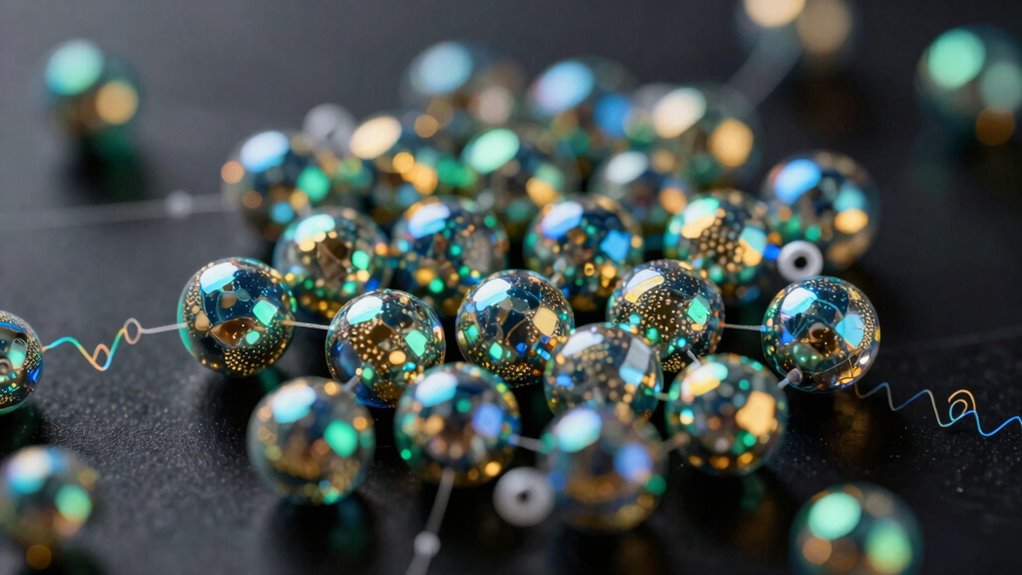

Tiny metal particles, like gold and silver nanoparticles, create super sensors by harnessing plasmonic effects. When light hits these particles, it excites free electrons, generating intense electromagnetic fields that amplify signals from molecules nearby. This boosts sensitivity, allowing detection of tiny amounts of substances such as biomolecules or explosives. Advances in nanostructure design, materials, and techniques like SERS have pushed these sensors to unprecedented levels. If you explore further, you’ll discover how these innovations revolutionize sensing technologies.
Play games included with Prime
Start a Prime free trial and play with Amazon Luna on your devices.
As an affiliate, we earn on qualifying purchases.
Key Takeaways
- Tiny metal particles support localized surface plasmon resonance, enabling intense electromagnetic field enhancements for sensitive detection.
- Adjusting particle size, shape, and composition tunes resonance, allowing detection of minute environmental or biological changes.
- Hybrid nanostructures combine metals with dielectrics to amplify signals like Surface-Enhanced Raman Scattering (SERS).
- Plasmonic sensors can visually indicate analyte presence through color changes caused by resonance shifts.
- These super sensors enable rapid, label-free detection of molecules, explosives, and environmental hazards with high sensitivity.
Surface-Enhanced Raman Scattering (SERS) sensor kit
As an affiliate, we earn on qualifying purchases.
As an affiliate, we earn on qualifying purchases.
The Science Behind Plasmonic Phenomena

Have you ever wondered how light interacts with metals at the nanoscale? When light hits a metal nanoparticle, it excites free electrons, causing them to oscillate collectively. These oscillations are called plasmons. If the nanoparticle is smaller than the light wavelength, it traps the electromagnetic energy, leading to strong local field enhancements. This phenomenon is known as localized surface plasmon resonance (LSPR). The resonance condition depends on factors like particle size, shape, and surrounding medium. Gold and silver nanoparticles are popular because they support distinct plasmonic responses. These interactions cause intense absorption and scattering of light, sometimes up to 40 times at resonance. This process underpins the high sensitivity of plasmonic sensors, enabling detection of minute environmental or biological changes. The tunability of nanoparticle properties can be adjusted by altering their size, shape, or surrounding environment, which enhances their effectiveness in sensing applications. Understanding plasmonic phenomena is essential for advancing sensor technology and developing innovative diagnostic tools. Additionally, advances in nanofabrication techniques allow for precise control over nanoparticle characteristics, further improving sensor performance.
gold silver nanoparticles for sensing
As an affiliate, we earn on qualifying purchases.
As an affiliate, we earn on qualifying purchases.
Key Materials Powering Plasmonic Sensors

Gold and silver are the primary materials used in plasmonic sensors due to their exceptional optical properties. Gold offers excellent chemical stability and produces larger resonance shifts, making it ideal for biosensing applications. Silver provides sharper resonance peaks and higher signal-to-noise ratios, but it’s less stable and requires protective coatings. Bimetallic layers combining silver’s sharpness with gold’s stability enhance sensitivity and reliability. Platinum nanoparticles, known for high light absorption and scattering, also support plasmonic functions. Additionally, doped metal oxides enable tunable resonances in the near-infrared and short-wavelength infrared regions, expanding sensing capabilities. These materials are chosen based on their optical responses, stability, and compatibility with different environments, ensuring appropriate performance in various sensing applications. The selection of these materials is crucial for optimizing the sensor performance and extending the range of detectable signals in diverse environments, especially when considering material stability and environmental compatibility. A deeper understanding of the plasmonic effects can further enhance sensor sensitivity and functionality.
plasmonic biosensor for biomolecules
As an affiliate, we earn on qualifying purchases.
As an affiliate, we earn on qualifying purchases.
Factors That Influence Sensor Sensitivity

Sensor sensitivity in plasmonic systems is primarily influenced by multiple factors related to the nanostructure’s physical and chemical properties. You need to contemplate how variations in size, shape, and composition affect the localized surface plasmon resonance (LSPR). Precise control over these features allows you to detect minute environmental changes. Additionally, the surrounding medium’s refractive index plays a vital role, amplifying the sensor’s responsiveness. The uniformity in nanoparticle size and narrow resonance bands enable detection of smaller spectral shifts. Inter-particle interactions can either enhance or hinder sensitivity, depending on their arrangement. To elevate performance, focus on optimizing fabrication methods, such as high-throughput processes, and explore hybrid designs that boost electromagnetic enhancements. These factors collectively determine how effectively your sensor identifies subtle molecular or environmental signals. Incorporating UST projector rankings can inspire innovative approaches to sensor design by emphasizing precision and clarity in system optimization. Moreover, ongoing research in nanoparticle synthesis can lead to more consistent and tunable nanostructures, further improving sensor reliability and manufacturing scalability. Additionally, advancements in fabrication techniques are crucial for achieving the consistency needed in large-scale production.
As an affiliate, we earn on qualifying purchases.
Innovative Applications of Nanoplasmonic Technologies

Nanoplasmonic technologies are transforming how you detect biological molecules and environmental hazards. With advances in biosensing, you can now identify biomolecular interactions and conformational changes with exceptional sensitivity. Additionally, innovative visual detection methods and explosive tracers are expanding the reach of nanoplasmonics into real-world applications. As the field evolves, the development of advanced sensing platforms is further enhancing the potential of nanoplasmonic sensors for diverse industries. These breakthroughs are driven by nanostructure engineering, which allows for tailored electromagnetic responses and increased detection capabilities. Moreover, the evolution of arcade games reflects the ongoing innovation and adaptation in entertainment technology, paralleling advancements in nanoplasmonic sensor design. Recognizing the importance of scientific skepticism, ongoing research continues to validate the reliability and accuracy of these sensor technologies. As research progresses, scalable manufacturing methods are becoming crucial for widespread adoption of nanoplasmonic sensors in various sectors.
Biosensing Breakthroughs
Recent advances in nanoplasmonic technologies have revolutionized biosensing by enabling highly sensitive and specific detection of biomolecules. You can now identify single molecules, track binding events in real-time, and even detect viruses with remarkable precision. These breakthroughs lead to faster diagnostics, personalized medicine, and improved environmental monitoring. Feel the excitement as nanomaterials enhance signal strength, offering unprecedented accuracy. Key highlights include:
- Detecting trace amounts of disease markers before symptoms appear
- Developing portable sensors for on-the-spot testing
- Achieving single-molecule sensitivity for early diagnosis
- Using nanostructures to distinguish between similar biomolecules
- Combining plasmonic effects with other techniques for amplified signals
- Understanding plasmonic resonances has been crucial in optimizing sensor performance. Additionally, advancements in nanofabrication techniques have allowed for more precise and reproducible sensor designs, further enhancing their reliability and sensitivity. The integration of advanced materials with nanoplasmonic sensors continues to open new avenues for ultra-sensitive detection capabilities. Moreover, ongoing research into biocompatible nanomaterials is expanding the range of biosensing applications in living systems. Furthermore, exploring surface chemistry modifications enhances the selectivity and stability of nanoplasmonic sensors in complex biological environments.
You’re at the forefront of transforming healthcare, security, and environmental safety through nanoplasmonic biosensing innovations.
Visual Detection Methods
Harnessing the unique optical properties of plasmonic nanostructures, scientists have developed innovative visual detection methods that enable rapid, on-the-spot identification of various analytes. These methods rely on changes in color resulting from localized surface plasmon resonance (LSPR) shifts when analytes interact with metal nanoparticles. For example, gold or silver nanoparticles can be engineered to produce vivid color changes visible to the naked eye, indicating the presence of specific molecules or contaminants. This colorimetric approach offers a simple, cost-effective alternative to traditional laboratory techniques, making it ideal for field testing, point-of-care diagnostics, and environmental monitoring. By tuning nanoparticle properties, you can create highly sensitive sensors that deliver immediate visual cues, streamlining detection processes across diverse applications.
Explosive Tracers Detection
Detecting explosive traces with nanoplasmonic technologies has transformed security screening by enabling rapid, highly sensitive identification of explosive molecules at minute concentrations. You can now detect even tiny amounts of TNT, RDX, DNT, and PETN with remarkable precision. These sensors leverage localized surface plasmon resonance (LSPR) to amplify signals and identify specific chemical signatures.
- Feel confident in heightened security and threat prevention
- Rely on portable, handheld devices for quick on-site analysis
- Detect explosives at nanogram levels, even in complex backgrounds
- Achieve real-time responses, reducing wait times and uncertainty
- Enhance safety with non-invasive, rapid screening methods
This innovation empowers you to respond swiftly, ensuring safety in airports, public events, and critical infrastructure.
Techniques Amplifying Sensor Capabilities

You can substantially boost sensor performance by leveraging techniques like Surface-Enhanced Raman Scattering (SERS), which amplifies signals for single-molecule detection. Hybrid plasmonic-photonic modes further sharpen resonance lines and increase sensitivity, opening new detection possibilities. Combining these methods allows you to push the limits of nanoplasmonic sensing in practical applications. Additionally, understanding plasmonic resonance phenomena helps optimize particle design for improved sensor capabilities. Exploring local automation strategies can facilitate the integration of these sensors into smart home systems for real-time monitoring and response. Incorporating encryption solutions into data transmission processes can further enhance the security of sensitive detection data.
Surface-Enhanced Raman Scattering
Have you ever wondered how scientists achieve single-molecule detection? Surface-enhanced Raman scattering (SERS) makes this possible by dramatically amplifying molecular signals through plasmonic effects. When light excites metal nanoparticles, local surface plasmon resonance creates intense electromagnetic fields, boosting Raman signals by factors up to 10^10. This enhancement allows you to detect even individual molecules with high precision.
- Experience real-time, label-free molecular identification
- Detect trace explosives and toxins at nanogram levels
- Achieve atomic-scale sensitivity for biosensing
- Enable rapid, portable diagnostics
- Push the boundaries of chemical and biological detection
Hybrid Plasmonic-Photonic Modes
Building on the powerful signal enhancements achieved through surface-enhanced Raman scattering (SERS), researchers are now combining plasmonic and photonic modes to push sensor capabilities even further. Hybrid plasmonic-photonic modes integrate the strong electromagnetic fields of plasmon resonances with the high-quality factors of photonic structures, such as dielectric cavities or waveguides. This synergy results in narrower resonance linewidths, increased field confinement, and enhanced sensitivity. By coupling metal nanoparticles with photonic resonators, you can amplify weak signals and improve detection limits for biomolecules, gases, or explosives. These hybrid modes also allow tunable spectral responses, making sensors more versatile. As a result, you gain higher resolution, better signal-to-noise ratios, and the ability to perform real-time, label-free sensing with atomic-layer precision.
Overcoming Challenges to Achieve Practical Nanoscale Sensors

Achieving practical nanoscale plasmonic sensors requires overcoming significant hurdles related to nanoparticle uniformity, stability, and reproducibility. You need consistent particle size and shape to sharpen LSPR bands and improve sensitivity. Ensuring long-term stability prevents degradation and maintains performance in real-world conditions. Reproducible fabrication methods are essential for reliable results across batches. Addressing these challenges, consider:
Overcoming nanoparticle uniformity and stability challenges is key to practical nanoscale plasmonic sensors.
- Developing advanced synthesis techniques for uniform, stable nanoparticles
- Using protective coatings to prevent oxidation and aggregation
- Implementing high-throughput manufacturing for consistent quality
- Designing hybrid structures to enhance robustness and sensitivity
- Employing precise characterization to monitor and control nanoparticle properties
Frequently Asked Questions
How Durable Are Plasmonic Sensors in Harsh Environments?
Plasmonic sensors’ durability in harsh environments varies based on materials and design. Gold sensors offer excellent stability and resist corrosion, making them suitable for tough conditions. Silver sensors, though more sensitive, need protective coatings to prevent degradation. Bimetallic layers combine stability and sharp resonance, enhancing lifespan. Proper surface protection and material choice are vital, so you should consider these factors to guarantee your sensors perform reliably outside controlled settings.
Can Plasmonic Sensors Be Integrated With Existing Detection Systems?
You can seamlessly integrate plasmonic sensors into your detection systems, creating a harmonious blend of innovation and tradition. Imagine adding a shimmering thread to a fabric, enhancing its pattern without disrupting its core. Their compatibility with optical fibers, microfluidic devices, and existing electronics makes them adaptable. With thoughtful design, these sensors enhance sensitivity and functionality, turning your system into a finely tuned instrument capable of detecting the faintest signals with elegance and precision.
What Are the Limitations of Current Nanofabrication Techniques?
Current nanofabrication techniques face limitations like inconsistent nanoparticle size and shape, which cause broad LSPR bands and reduce sensitivity. You also encounter challenges with scalability, as precise control over complex structures is tough at large volumes. Additionally, some methods require expensive equipment or hazardous chemicals, making high-throughput production costly and less environmentally friendly. Overcoming these issues is essential to improve sensor performance and commercial viability.
How Scalable Are Plasmonic Sensors for Commercial Production?
You can scale plasmonic sensors for commercial production, but it’s not a walk in the park. Current fabrication methods, like solution synthesis and nanoimprint lithography, have improved, yet challenges remain in achieving consistent quality and uniformity at large volumes. While high-throughput techniques are emerging, mass manufacturing still faces hurdles in maintaining precision, stability, and cost-effectiveness. So, with continued innovation, you’re inching closer to widespread, reliable plasmonic sensor deployment.
Are There Safety Concerns Related to Nanoparticle Use in Sensors?
Yes, there are safety concerns when using nanoparticles in sensors. You should handle them with care because they can pose health risks if inhaled, ingested, or if they come into contact with your skin. Nanoparticles might cause toxicity or environmental harm if released. Always use proper protective equipment, follow safety guidelines, and guarantee proper disposal to minimize potential risks associated with their use in sensors.
Conclusion
As you explore plasmonics, you’ll see how tiny metal particles act like magnifying glasses for sensing, turning the invisible into the detectable. With each breakthrough, these nanoplasmonic sensors become more like finely tuned musical instruments, harmonizing science and innovation. As you embrace this cutting-edge field, you’re stepping into a world where the smallest particles release the biggest possibilities, illuminating the path toward a future where super sensors are as commonplace as stars in the night sky.
NFL season / tailgating Picks
team gear
As an affiliate, we earn on qualifying purchases.