

Nano sensors could revolutionize your industrial monitoring by providing real-time, highly precise data even in extreme environments. They leverage quantum effects to detect minute changes in temperature, pressure, or chemicals, helping you prevent failures and optimize processes. Designed to withstand harsh conditions, these sensors reduce maintenance costs and downtime. If you want to discover how this technology can transform your operations and guarantee long-term reliability, there’s more to explore ahead.
Key Takeaways
- Nano sensors enable real-time, highly precise environmental data collection, improving process control and early failure detection.
- Leveraging quantum effects, nano sensors achieve unprecedented sensitivity to subtle environmental changes.
- Their durable materials ensure reliable performance in harsh, extreme industrial conditions, reducing maintenance costs.
- Enhanced monitoring capabilities support safety compliance and operational efficiency across sectors like oil, gas, and manufacturing.
- Long-term asset tracking with nano sensors minimizes downtime and optimizes resource management in demanding environments.
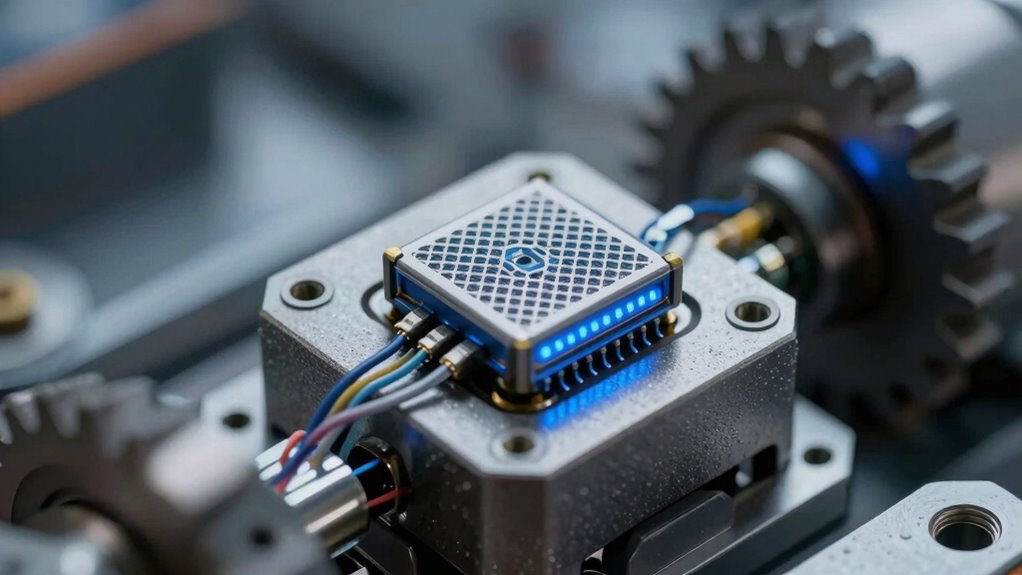
As industries seek more precise and real-time monitoring solutions, nano sensors are emerging as a game-changer. These tiny devices can detect minute changes in their environment, providing data that was previously impossible to gather at such a granular level. This breakthrough hinges on their ability to leverage quantum effects, which dramatically enhance their sensitivity and accuracy. Quantum phenomena enable nano sensors to measure even the slightest variations in temperature, pressure, or chemical composition, delivering insights that can optimize processes, prevent failures, and improve safety standards. As you incorporate these sensors into your operations, you’ll notice how they unlock a new dimension of control and responsiveness, transforming traditional monitoring methods into dynamic, data-driven strategies.
One of the most compelling advantages of nano sensors is their ability to operate effectively in harsh industrial environments, thanks to their material durability. These sensors are designed with robust materials that withstand extreme temperatures, corrosive chemicals, and mechanical stress, ensuring longevity and consistent performance. Their durability means you won’t need frequent replacements or maintenance, reducing operational costs and downtime. When deploying nano sensors, you can confidently monitor critical assets over extended periods, knowing they’ll continue to deliver reliable data despite challenging conditions. This durability also opens doors for applications in sectors like oil and gas, manufacturing, and chemical processing, where environmental resilience is essential for accurate monitoring. material durability plays a crucial role in ensuring the long-term success and reliability of these sensors in demanding settings. Additionally, their ability to operate reliably in harsh environments is vital for maintaining continuous oversight in industrial processes.

4Pcs Thin Film Pressure Sensor 20g-2Kg High Sensitivity Force Sensitive Resistor Force Sensor Pressure Sensors for Arduino DIY Industrial Precise Measurement Control
- Ultra-Thin & Fast Response: 0.4mm thickness with under 10ms response time
- High Sensitivity & Durability: Over 1 million uses with 3% resistance variance
- Wide Pressure Range: Measures 20g to 2kg forces
As an affiliate, we earn on qualifying purchases.
As an affiliate, we earn on qualifying purchases.
Frequently Asked Questions
How Affordable Are Nano Sensors for Small-Scale Industries?
Nano sensors are becoming increasingly affordable for small-scale industries due to improvements in manufacturing and increased market accessibility. You’ll find that their cost efficiency improves as technology advances, making them more viable for smaller operations. While prices can still vary, ongoing innovations are reducing costs, allowing small businesses to leverage nano sensors for better monitoring and control without breaking the bank. This trend makes advanced industrial monitoring accessible to a broader range of industries.
What Are the Potential Environmental Impacts of Nano Sensors?
You might think nano sensors are harmless, but their environmental toxicity and potential to cause ecosystem disruption tell a different story. These tiny devices could leach toxic substances or accumulate in wildlife, disrupting delicate balances. While they boost monitoring precision, their unintended environmental impacts could outweigh benefits. It’s vital to carefully assess and regulate nano sensors to prevent long-term ecological harm, rather than just focusing on technological advancements.
How Do Nano Sensors Compare to Traditional Monitoring Devices?
You’ll find nano sensors offer greater precision and responsiveness compared to traditional monitoring devices. Their durability allows them to withstand harsh industrial environments, reducing the need for frequent replacements. Additionally, nano sensors require less frequent calibration, maintaining accuracy over longer periods. This makes them more efficient and cost-effective, providing real-time data that enhances decision-making. Overall, nano sensors outperform conventional devices in durability, calibration, and data accuracy.
Are Nano Sensors Easy to Maintain and Replace?
Nano sensors are generally easy to maintain and replace due to their small size, but their durability can vary based on design and environment. You should regularly check their nano durability and perform sensor calibration to guarantee accurate readings. When needed, replacing nano sensors is straightforward, though careful handling is essential to avoid damage. Proper maintenance prolongs their lifespan and keeps industrial monitoring precise and reliable.
What Are the Cybersecurity Risks Associated With Nano Sensor Data?
Imagine you’re in a world where nano sensors transmit crucial data, much like a modern-day alchemist’s secret. You should be aware that cybersecurity risks include hacking vulnerabilities and data privacy breaches. Malicious actors could intercept or manipulate sensor data, compromising safety and operations. To prevent this, implement strong encryption and access controls, ensuring your nano sensor networks stay secure, keeping your industrial systems resilient against emerging cyber threats.

UbiBot CO2 Probe Compatible with GS1-A1RS/GS1-AETH1RS & SP1 – High Precision Environmental Sensor, Wide Range Monitoring, RS485, Lightning Protection
- Wide Measurement Range: CO2 0-40,000ppm, Temp -10°C to 60°C
- High Accuracy: ±50ppm+5% CO2, ±0.8°C Temp, ±6% RH
- Exclusive Compatibility: Works with UbiBot GS1-A1RS, SP1
As an affiliate, we earn on qualifying purchases.
As an affiliate, we earn on qualifying purchases.
Conclusion
Imagine a world where nano sensors patrol your factory like tiny, relentless watchdogs, catching even the faintest whisper of trouble before it escalates. These microscopic spies could turn your industrial monitoring from a clunky, slow process into a sleek, high-tech ballet of precision. Soon, you’ll wonder how you ever managed without these insidious little sentinels secretly ensuring everything runs smoothly—until they start demanding coffee breaks. Welcome to the future of monitoring, where nano sensors do all the heavy lifting.

TPMS Sensor, 315MHz Pre-Programmed Tire Pressure Sensors 426070C070 1pcs
- Vehicle Compatibility: Fits Toyota Sienna, Sequoia, Tundra 2007-2020
- Part Numbers: Replaces multiple OEM part numbers
- Pre-programmed: Sensor is pre-programmed for specific vehicles
As an affiliate, we earn on qualifying purchases.
As an affiliate, we earn on qualifying purchases.

Device and Circuit Cryogenic Operation for Low Temperature Electronics
- Condition: Used Book in Good Condition
As an affiliate, we earn on qualifying purchases.
As an affiliate, we earn on qualifying purchases.