

Nanofibers are used in modern material design due to their high surface area, strength, and flexibility. You can incorporate them into filters, biomedical devices, or energy storage systems to improve performance and durability. Their small size and surface modification options allow for tailored functionality, like enhanced cell attachment or pollutant capture. If you’re curious about how these tiny fibers are transforming industries, keep exploring—they hold innovative potential across many fields.
Prime for Young Adults — start your free trial
Fast free delivery, streaming and member deals for eligible 18–24 year olds.
As an affiliate, we earn on qualifying purchases.
Key Takeaways
- Nanofibers enhance material strength, flexibility, and lightweight properties for advanced structural components.
- Surface modification of nanofibers improves compatibility, adhesion, and functionality in composite materials.
- Their high surface area enables effective filtration, adsorption, and catalytic applications in modern materials.
- Nanofibers facilitate the development of biomedical devices, wound dressings, and tissue engineering scaffolds.
- Fabrication techniques like electrospinning allow precise control over nanofiber properties for tailored material design.
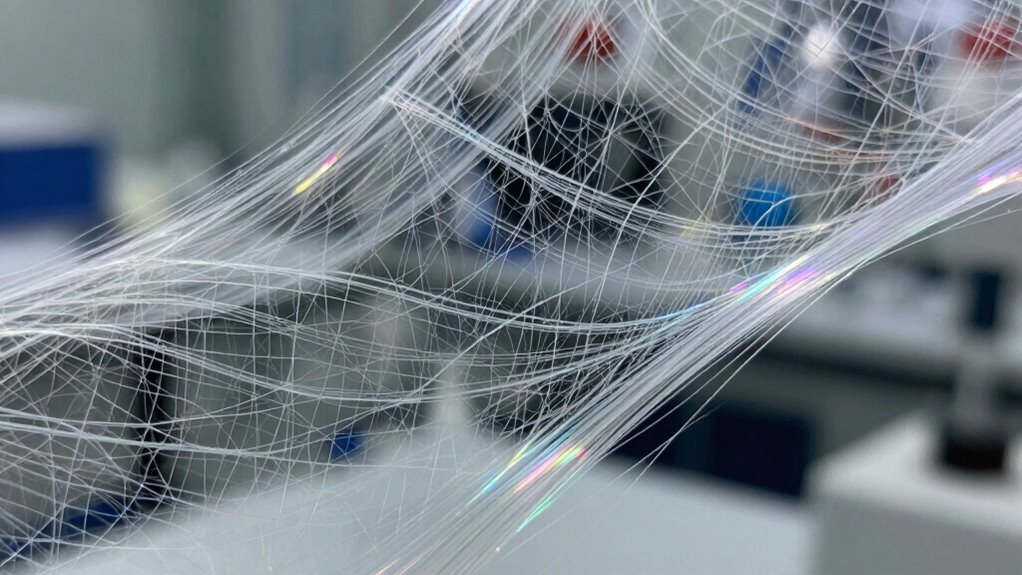
Nanofibers have revolutionized modern material design by offering exceptional strength, flexibility, and surface area in a tiny package. Their unique properties stem from their incredibly small size, typically less than 100 nanometers in diameter, which creates a vast surface area relative to volume. This makes nanofibers highly effective in applications like filtration, biomedical engineering, and energy storage. To harness these advantages, researchers focus on nanofiber fabrication methods that produce consistent, high-quality fibers. Techniques such as electrospinning are popular because they allow precise control over fiber diameter, length, and alignment. By adjusting parameters like voltage, solution viscosity, and collector design, you can tailor nanofiber properties to meet specific needs. The process is versatile, accommodating various polymers, ceramics, and composites, which broadens the scope of their use.
Once the nanofibers are fabricated, surface modification techniques come into play to enhance their functionality. These techniques involve altering the surface chemistry or topography to improve compatibility, adhesion, or reactivity. For instance, you might introduce functional groups through chemical treatments, enabling the nanofibers to bind selectively with other materials or biological entities. Plasma treatment is another common method, where you expose fibers to ionized gases to increase surface energy and wettability. These modifications are essential in fields like biomedical applications, where surface properties influence cell attachment and proliferation, or in filtration, where surface chemistry can improve pollutant capture. You, as a researcher or engineer, can combine nanofiber fabrication and surface modification to create highly specialized materials tailored for specific functions. Additionally, understanding the surface chemistry of nanofibers allows for more precise control over their interactions and performance in various environments.
Furthermore, surface modification techniques also help address challenges like fiber aggregation or poor dispersion in composite matrices. By attaching nanoparticles or coating nanofibers with protective layers, you can enhance their durability and performance. Incorporating surface coatings can also prevent degradation and improve compatibility with other materials. These modifications often lead to better mechanical strength, electrical conductivity, or chemical resistance, depending on the application. The ability to fine-tune nanofiber surfaces opens doors to innovations across industries, from lightweight aerospace components to advanced wound dressings. Ultimately, understanding and controlling nanofiber fabrication and surface modification techniques give you the power to design materials that are not only stronger and more flexible but also more functional and adaptable than ever before. This synergy between fabrication and surface engineering is transforming how we approach material science, making nanofibers an indispensable tool in modern design.
electrospinning nanofiber fabric
As an affiliate, we earn on qualifying purchases.
As an affiliate, we earn on qualifying purchases.
Frequently Asked Questions
Are Nanofibers Environmentally Sustainable?
Nanofibers can be environmentally sustainable if produced through eco-friendly manufacturing processes and sourced from renewable resources. You can reduce environmental impact by choosing nanofibers made from biodegradable materials or those derived from sustainable sources. Although traditional methods may involve harmful chemicals, advances in green chemistry are making nanofiber production more eco-friendly. By prioritizing renewable sourcing and sustainable practices, you help guarantee nanofibers’ use benefits both innovation and the environment.
What Are the Cost Implications of Nanofiber Production?
Think of nanofiber production as building a delicate, intricate tapestry—it’s costly and requires precision. You’ll find manufacturing costs are high due to the advanced equipment and materials involved. Scalability challenges also arise because producing large quantities without compromising quality is complex. These factors make nanofiber production expensive initially, but as technology advances and processes improve, costs could decrease, making them more accessible for broader applications.
How Durable Are Nanofiber-Based Materials?
Nanofiber-based materials are quite durable, thanks to their high fiber strength, which allows them to withstand stress and strain effectively. You’ll find that their material longevity is enhanced because the nanostructure provides resistance to wear and tear. While they may be delicate during manufacturing, once integrated into products, nanofiber materials offer impressive durability, making them suitable for applications requiring long-lasting performance and resilience.
Can Nanofibers Be Recycled or Reused?
You can recycle or reuse nanofibers, but it depends on the material and application. Recycling methods like solvent extraction or thermal treatments help recover nanofibers from composites. Reuse strategies involve cleaning and reprocessing nanofiber-based materials for new purposes. However, maintaining nanofiber integrity during recycling can be challenging. Advances in sustainable techniques are making it easier to reuse nanofibers efficiently, reducing waste and promoting eco-friendly practices.
What Are Potential Health Risks of Nanofiber Exposure?
You should be aware that exposure to nanofibers can pose health concerns, especially inhalation risks. When tiny fibers become airborne, you might breathe them in, which could cause respiratory issues or irritation. Prolonged or high-level exposure might increase risks of lung inflammation or other health problems. To stay safe, use proper protective equipment and guarantee good ventilation when handling nanofibers, minimizing inhalation risks.
As an affiliate, we earn on qualifying purchases.
Conclusion
Diving into the dynamic world of nanofibers, you discover the dazzling potential they bring to modern materials. Their versatility and importance propel innovation, providing powerful, precise solutions across industries. As you explore further, you’ll see how nanofibers fine-tune functionality, forge future-forward fields, and fuel fantastic feats in fabrication. Embrace this exciting evolution, and you’ll be at the forefront of a fascinating, future-facing frontier where science and structure seamlessly succeed.
As an affiliate, we earn on qualifying purchases.
nanofiber energy storage materials
As an affiliate, we earn on qualifying purchases.
As an affiliate, we earn on qualifying purchases.
Fall yard work Picks
leaf blowers
As an affiliate, we earn on qualifying purchases.