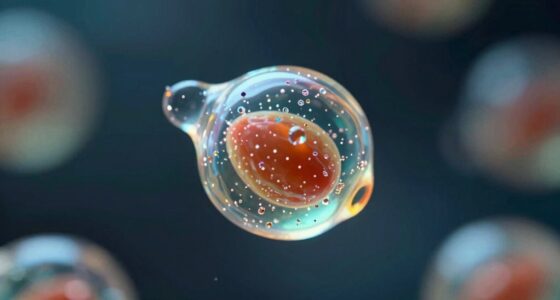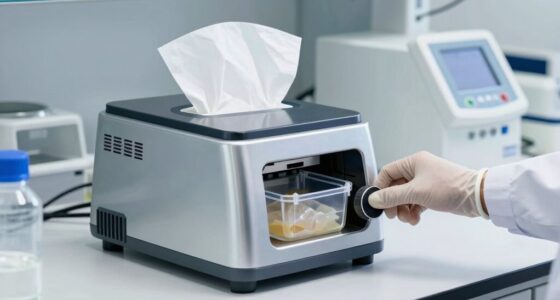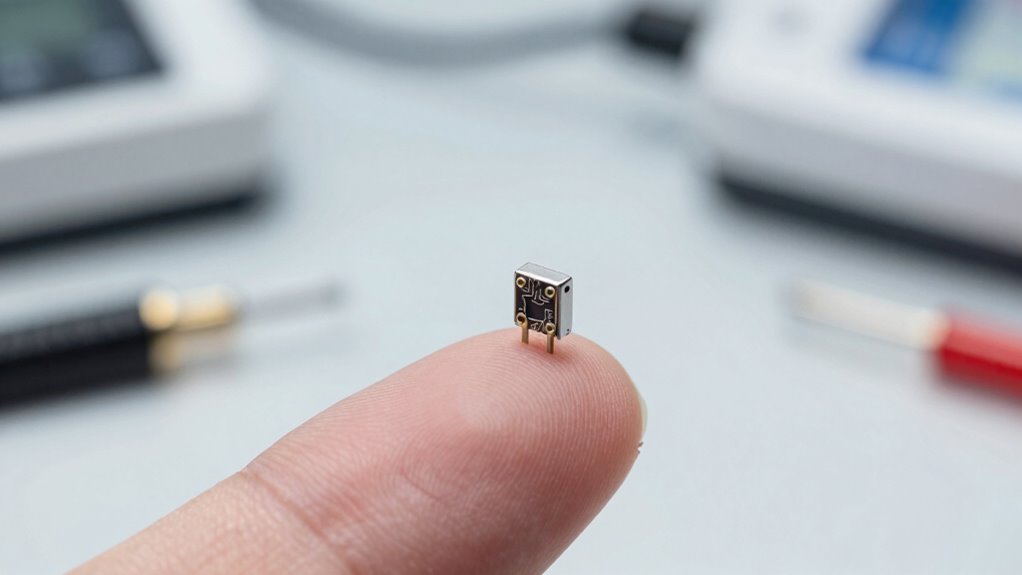

Biosensor miniaturization is essential because it boosts sensitivity, accuracy, and allows you to perform quick health or environmental checks anytime and anywhere. Smaller devices use minimal samples like saliva or sweat, making testing easier and less invasive. Plus, compact biosensors are more durable and resistant to environmental factors, ensuring reliability over time. If you want to discover how these advancements keep improving and making monitoring easier, keep exploring what’s next.

Get the latest gadgets delivered free with Prime
- Fast, free delivery on millions of items
- Prime Video, Amazon Music and more included
- Member-only deals all year
Key Takeaways
- Enables detection of biomarkers at the molecular level for earlier and more accurate diagnoses.
- Facilitates portable, wearable devices for real-time health monitoring anytime and anywhere.
- Requires smaller biological samples, making testing less invasive and more comfortable.
- Enhances device durability and environmental resistance for reliable long-term use.
- Supports ongoing technological advancements for more efficient, stable, and biocompatible biosensors.
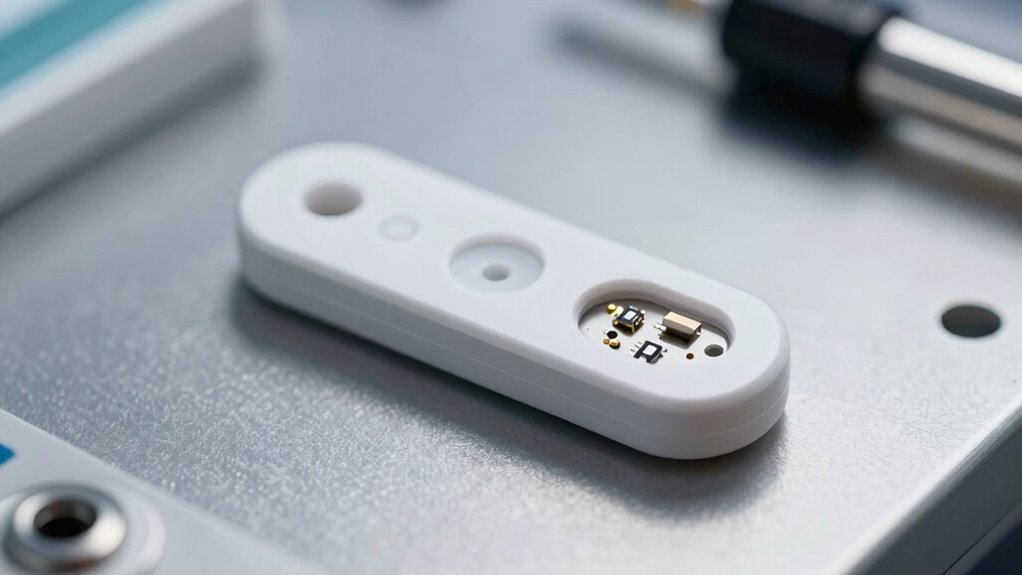
Have you ever wondered how tiny devices can detect diseases or monitor health in real-time? It’s all thanks to the incredible advancements in biosensor miniaturization. By shrinking these sensors down to a microscopic scale, scientists and engineers are transforming healthcare and environmental monitoring. One vital factor driving this progress is nanotechnology integration. When you incorporate nanotechnology into biosensor design, you enable these devices to operate at the molecular level, drastically increasing their sensitivity and specificity. This means that even the tiniest traces of a biomarker or pollutant can be detected accurately, providing earlier diagnoses and better monitoring.
Miniaturization also revolutionizes portable device design. When biosensors are smaller, they can be embedded into handheld gadgets or wearable technology, making health monitoring more accessible and convenient. Imagine being able to check your blood sugar levels, hydration status, or exposure to toxins anytime, anywhere, without the need for bulky lab equipment. This portability is a game-changer, especially for remote or underserved areas where traditional medical facilities are scarce. It empowers you to take control of your health and provides real-time insights that can prompt immediate action.
Another advantage of biosensor miniaturization is the reduced sample volume needed for testing. Traditional biosensing methods often require large samples, which can be invasive and uncomfortable. Smaller sensors need only tiny amounts of biological fluids, such as saliva or sweat, making the testing process less invasive and more user-friendly. This simplicity encourages regular, routine testing, helping catch potential health issues early before they develop into more serious problems. Additionally, smaller devices tend to be more cost-effective to produce, which can lower the overall cost of health monitoring tools, making them more widely available. Incorporating nanotechnology into biosensor design also improves their integration with existing healthcare systems, increasing their practical utility.
Furthermore, the integration of nanotechnology into biosensors enhances their durability and stability. When you design portable devices with miniaturized components, they become more resistant to environmental factors, extending their lifespan and reliability. This robustness is essential for devices intended for long-term use in diverse settings, from hospitals to outdoor environments. The molecular level operation enabled by nanotechnology further improves their performance and accuracy in challenging conditions. As research continues, ongoing advancements in biosensor materials will likely lead to even more resilient and efficient devices in the future. Moreover, innovations in sensor calibration techniques are helping to maintain accuracy over extended periods of use. Additionally, ongoing research into biocompatible materials ensures that these sensors can be safely used in close contact with the body for extended durations.
wearable biosensor health monitor
As an affiliate, we earn on qualifying purchases.
As an affiliate, we earn on qualifying purchases.
Frequently Asked Questions
How Does Miniaturization Affect Biosensor Cost?
Miniaturization generally lowers biosensor costs by addressing scalability challenges, allowing mass production of smaller devices. It reduces material usage and simplifies manufacturing processes, which cuts expenses. However, it can also introduce initial higher manufacturing costs due to advanced technology and precision needed. Overall, as you scale up production, miniaturized biosensors become more cost-effective, making them accessible for widespread use and improving healthcare and environmental monitoring.
What Materials Are Best for Tiny Biosensors?
You should choose advanced materials like graphene, nanomaterials, and flexible polymers for tiny biosensors, as they offer high sensitivity and durability. These materials, combined with innovative fabrication techniques like microfabrication and 3D printing, enable the creation of ultra-compact sensors. While traditional materials may fall short in size, these advanced options guarantee your biosensor remains both efficient and reliable, even at microscopic scales.
Can Miniaturized Biosensors Detect Multiple Analytes Simultaneously?
Yes, miniaturized biosensors can detect multiple analytes simultaneously through sensor multiplexing. By integrating various sensing elements into a compact device, you can perform multi-analyte detection efficiently. This advancement allows for rapid, thorough diagnostics in a small form factor, making it ideal for point-of-care testing or personalized medicine. Sensor multiplexing enhances the biosensor’s functionality, providing more data with less sample volume, which is essential for timely and accurate health assessments.
How Reliable Are Small Biosensors Over Long-Term Use?
Small biosensors can be quite reliable over long-term use when they have good sensor durability and calibration stability. You might notice that miniaturized sensors face challenges like material degradation or drift over time, but advances in materials and design help mitigate these issues. With proper maintenance and calibration, these tiny devices can deliver consistent, accurate readings, making them dependable tools for continuous monitoring in medical, environmental, or industrial applications.
What Are the Challenges in Power Supply for Tiny Biosensors?
You face challenges in powering tiny biosensors due to their limited space. Energy harvesting offers a solution by capturing ambient energy, reducing reliance on batteries. Effective power management becomes essential to optimize energy use and prolong sensor life. You need innovative methods to integrate energy harvesting techniques with compact power management systems, ensuring the biosensor remains functional and accurate over time without frequent maintenance or battery replacements.
As an affiliate, we earn on qualifying purchases.
Conclusion
As you explore biosensor miniaturization, you realize it’s like shrinking a complex laboratory into a tiny, portable device. This miniaturization makes testing faster, more accessible, and even wearable. Imagine a tiny sensor constantly monitoring your health, providing real-time data. This visual helps you understand how smaller devices don’t just save space—they revolutionize healthcare, making precise diagnostics available anytime, anywhere. The theory proves that less really can be more, transforming the future of medical technology.
As an affiliate, we earn on qualifying purchases.
As an affiliate, we earn on qualifying purchases.
Halloween Picks
halloween
As an affiliate, we earn on qualifying purchases.