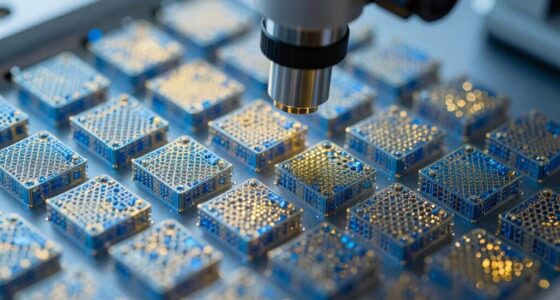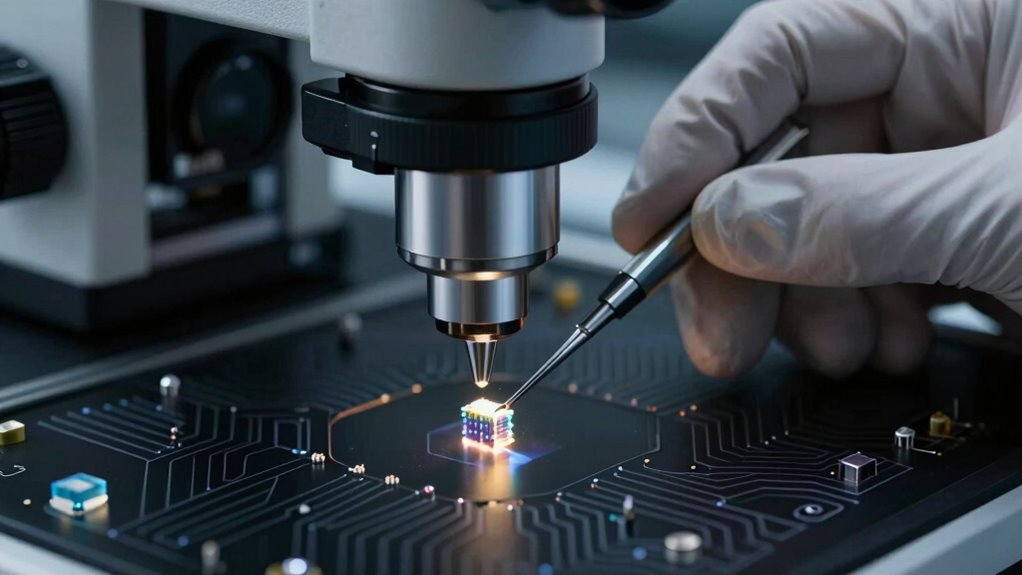

Reproducibility is essential in nanotech research because it guarantees your experiments produce consistent results, validating findings and building reliable tools. It helps you develop new materials and nanodevices with confidence. Overcoming scaling and control challenges requires standardized protocols and precise data management. By adopting best practices, you enhance trust and collaboration across labs. Keep exploring to discover how creating a reproducible culture accelerates advancements and drives impactful innovations in nanotechnology.
Key Takeaways
- Reproducibility validates nanotech findings, ensuring experiments can be reliably repeated and verified.
- It facilitates accurate comparison of results across different labs and studies.
- Standardized protocols and data improve consistency and reduce variability in nanomaterial synthesis.
- Reproducibility accelerates technological advancement by building trust and minimizing waste.
- Establishing a culture of meticulous documentation enhances research credibility and supports innovation.
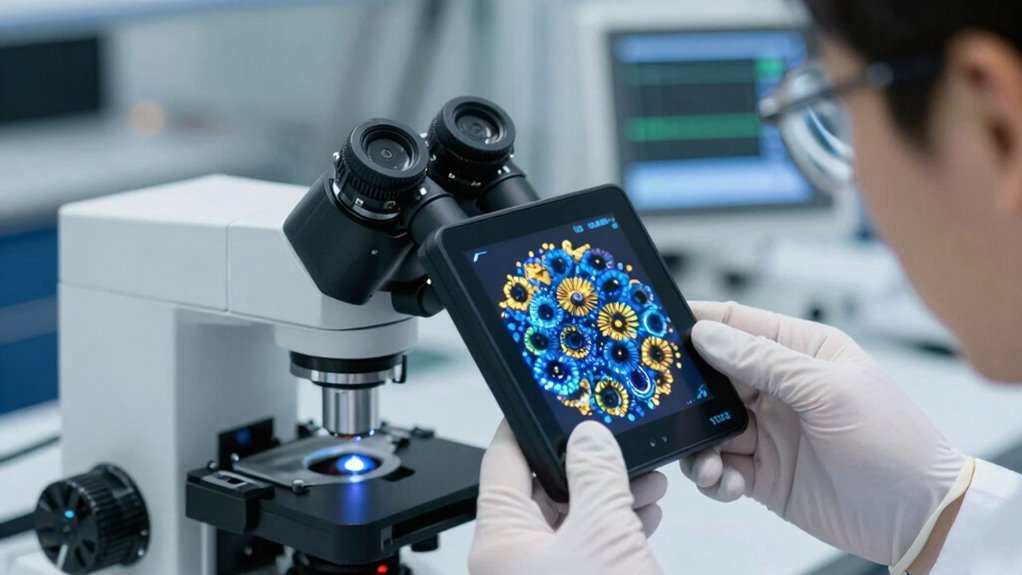
Reproducibility is crucial for advancing nanotech research, yet it remains a significant challenge in the field. When you aim to build reliable nanodevices or develop new materials, guaranteeing that experiments can be repeated with consistent results is fundamental. However, one of the main hurdles you face involves scaling challenges. As you move from small-scale laboratory experiments to larger, more practical applications, maintaining the same control over nanostructures becomes increasingly difficult. Variations in synthesis processes, environmental conditions, and even subtle differences in equipment can lead to inconsistent outcomes. These scaling challenges threaten the reproducibility that’s indispensable for validating your findings and moving toward real-world applications. Developing standardized protocols is essential to address these issues effectively. Additionally, incorporating free floating concepts, such as flexible experimental setups, can help accommodate variability during scale-up procedures. Strategies like automation and real-time monitoring can further enhance consistency across different scales.
Scaling challenges threaten nanotech reproducibility, making consistent control over nanostructures increasingly difficult during practical applications.
Alongside scaling issues, data standardization plays a critical role. Without standardized methods for collecting, analyzing, and reporting your data, it becomes nearly impossible to compare results across different labs or experiments. When your data lacks uniformity, you risk misinterpreting results or failing to identify true trends. This inconsistency hampers your ability to reproduce studies reliably and slows down the progress of nanotech innovation. To truly make reproducibility a priority, you need to establish clear protocols and adopt common frameworks for data documentation. Implementing consistent measurement techniques ensures that your data is comparable and reliable across different research efforts. Standardized data allows you and others in the field to verify results more efficiently, build upon previous work, and accelerate discoveries. Promoting inter-lab collaboration can significantly improve the adoption of these standards and facilitate shared learning.
Addressing these challenges requires a strategic approach. You should focus on developing and adhering to rigorous standard operating procedures. Implementing precise control over experimental conditions helps mitigate variability caused by scaling challenges. Furthermore, integrating robust data management systems ensures that your data is consistent, transparent, and accessible for future validation. Collaborating with other researchers to create and follow shared standards can considerably enhance reproducibility across the field. It’s about creating a culture where meticulous documentation and quality control are valued as much as the experiments themselves.
Ultimately, overcoming scaling challenges and promoting data standardization isn’t just about making your experiments reproducible; it’s about fostering a reliable foundation for nanotech research. When you prioritize these aspects, you increase the credibility of your work, reduce waste, and accelerate the translation of nanotechnologies from the lab to practical use. Reproducibility isn’t an optional extra—it’s the backbone of scientific progress in nanotech, ensuring that your discoveries stand up to scrutiny and truly contribute to technological advancement.
nanotech research reproducibility tools
As an affiliate, we earn on qualifying purchases.
As an affiliate, we earn on qualifying purchases.
Frequently Asked Questions
How Does Reproducibility Impact Commercial Nanotech Product Development?
Reproducibility impacts your commercial nanotech product development by ensuring consistent results across different batches, which boosts confidence in your innovations. It supports nanotech innovation by validating data and confirming that your methods work reliably. When you prioritize reproducibility, you enhance data validation, reduce costly errors, and accelerate the path to market. Ultimately, it helps you build trustworthy products and maintain a competitive edge in the fast-evolving nanotech industry.
What Are the Main Barriers to Achieving Reproducibility in Nanotech Labs?
You face barriers like experimental variability, which can stem from inconsistent procedures or environmental factors, making results hard to replicate. Data transparency also plays a role; when labs don’t share detailed methodologies or raw data openly, reproducing experiments becomes difficult. To overcome these challenges, adopting standardized protocols and promoting open data sharing are essential. These steps help guarantee your nanotech research is reliable and reproducible across different labs.
How Can Reproducibility Be Standardized Across Different Nanotech Research Institutions?
Think of standardization protocols as the universal language for nanotech research. To guarantee reproducibility, you should adopt consistent procedures across institutions and promote open data sharing, much like exchanging recipes. Collaborating on shared standards and openly sharing data helps eliminate discrepancies, making results more reliable. This unified approach ensures researchers worldwide can reproduce experiments accurately, advancing nanotech innovation with confidence and speed.
What Role Does Reproducibility Play in Nanotech Regulatory Approval Processes?
Reproducibility is vital in nanotech regulatory approval because it guarantees that nanotech products meet safety and efficacy standards. You rely on nanotech standards and data validation to demonstrate consistent results across trials, which regulators require for approval. By maintaining reproducibility, you build trust in your data, making it easier to navigate approval processes, reduce risks, and confirm your nanotech innovations comply with safety guidelines.
How Does Reproducibility Influence Funding and Publication of Nanotech Research?
Reproducibility greatly influences your chances of securing funding and getting your research published. When you prioritize data validation and quality assurance, your results become more reliable, making your work stand out to reviewers and funding bodies. Consistent, reproducible findings demonstrate the robustness of your methods, increasing confidence in your research’s validity. This focus not only boosts credibility but also enhances your reputation within the nanotech community.
standardized protocols for nanomaterial synthesis
As an affiliate, we earn on qualifying purchases.
As an affiliate, we earn on qualifying purchases.
Conclusion
Remember, in nanotech research, reproducibility isn’t just a checkbox—it’s the foundation of progress. When you guarantee results can be reliably repeated, you build trust and accelerate innovation. As the saying goes, “A chain is only as strong as its weakest link.” By prioritizing reproducibility, you strengthen the entire scientific community, turning small discoveries into big breakthroughs that stand the test of time. Keep integrity at the core, and your work will truly shine.

ChemiSys Nano Seek Quantitative Testing Kit for Nano and Micro Plastics in Urine
LABORATORY TESTING: Professional diagnostic kit designed for quantitative analysis of nano and micro plastics in urine samples
As an affiliate, we earn on qualifying purchases.
As an affiliate, we earn on qualifying purchases.

Precision Assembly Technologies and Systems: 6th IFIP WG 5.5 International Precision Assembly Seminar, IPAS 2012, Chamonix, France, February 12-15, … and Communication Technology, 371)
As an affiliate, we earn on qualifying purchases.
As an affiliate, we earn on qualifying purchases.