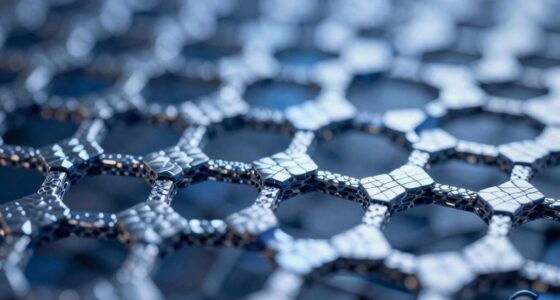

Surface functionalization is essential in nanotech because it directly impacts how nanoparticles behave, interact, and perform in various applications. It fine-tunes quantum effects, enhances optical and electrical properties, and helps make nanoparticles biocompatible for medical uses. It also enables precise targeting, improving drug delivery and imaging. By controlling surface chemistry, you can optimize performance and safety. Keep exploring to discover more ways this process drives innovation and advances across industries.

Get the latest gadgets delivered free with Prime
- Fast, free delivery on millions of items
- Prime Video, Amazon Music and more included
- Member-only deals all year
Key Takeaways
- Surface functionalization enables precise control of quantum effects, enhancing nanoparticle performance in nanodevices.
- It determines molecular interactions, improving stability, specificity, and functionality in various environments.
- Functionalized surfaces increase biocompatibility, making nanoparticles safer for medical and biological applications.
- It allows targeted delivery by attaching ligands, improving treatment efficacy and reducing side effects.
- Surface modification drives innovation, scalability, and industrial applications across nanotechnology fields.

Have you ever wondered how scientists tailor the surfaces of nanoparticles to achieve specific functionalities? Surface functionalization plays an indispensable role in this process, acting as the key to unlocking a nanoparticle’s full potential. When you modify the surface, you’re not just changing its appearance—you’re directly influencing how it interacts with its environment. This is especially important in nanotech, where tiny differences at the molecular level can lead to significant variations in behavior and performance.
One of the primary reasons surface functionalization is so essential is its impact on quantum effects. At the nanoscale, particles exhibit behaviors that don’t occur in bulk materials, such as quantum confinement and tunneling. By functionalizing the surface, you can manipulate these quantum effects, fine-tuning the particles’ optical, electrical, or magnetic properties. For example, attaching specific molecules or ligands can enhance the emission of light or improve electrical conductivity, making nanoparticles more effective in applications like sensors or quantum computing. The ability to control these quantum phenomena through surface chemistry gives you a powerful tool to design advanced nanodevices. Additionally, surface chemistry plays a crucial role in dictating how nanoparticles interact with their surroundings, further emphasizing its importance. Understanding the molecular-level interactions involved helps optimize these modifications for desired outcomes. Incorporating surface modifications based on specific application needs allows for even greater control over nanoparticle behavior. Moreover, developing surface functionalization techniques is vital for scaling up nanotech solutions for commercial and industrial use. A comprehensive understanding of surface interactions can also help in reducing potential toxicity and environmental impact during application.
Another critical aspect of surface functionalization is biocompatibility enhancements. When working with nanoparticles in biomedical applications—like drug delivery, imaging, or tissue engineering—you need to guarantee they’re safe and compatible with biological systems. Functionalizing surfaces with biocompatible molecules, such as polyethylene glycol (PEG) or specific antibodies, helps prevent immune rejection and reduces toxicity. This process guarantees that the nanoparticles can circulate within the body without causing adverse reactions, increasing their effectiveness and safety. By customizing surface chemistry, you’re essentially making nanoparticles more “friendly” to biological environments, which is indispensable for clinical success.
Furthermore, surface functionalization allows you to introduce specific targeting capabilities. You can attach ligands that recognize and bind to particular cell types or tissues, ensuring that nanoparticles reach their intended destination. This targeted approach maximizes therapeutic effects while minimizing side effects, which is essential in precision medicine.
In essence, surface functionalization is the backbone of nanotech innovation. It enables you to harness quantum effects for enhanced device performance and improve biocompatibility for safer medical applications. By carefully designing the surface chemistry, you’re not just modifying nanoparticles—you’re shaping their behavior, interactions, and ultimate success in real-world applications. This mastery over surface properties is what makes nanotechnology both powerful and versatile, opening the door to revolutionary advancements across industries.
nanoparticle surface functionalization kit
As an affiliate, we earn on qualifying purchases.
As an affiliate, we earn on qualifying purchases.
Frequently Asked Questions
How Does Surface Functionalization Impact Nanomaterial Toxicity?
Surface functionalization directly impacts nanomaterial toxicity by enhancing surface stability and controlling interactions with biological systems. When you functionalize surfaces properly, it reduces the release of toxic ions and prevents aggregation, which can cause harm. Durable functionalization guarantees these benefits last over time, minimizing toxicity risks. By modifying surface chemistry, you help make nanomaterials safer for biomedical and environmental applications, ultimately lowering potential health hazards.
What Are the Environmental Effects of Nanotech Surface Modifications?
You should consider that nanotech surface modifications can alter environmental impacts by changing how nanomaterials interact with ecosystems, potentially increasing toxicity or persistence. These modifications may lead to unforeseen environmental risks, complicating regulatory challenges as authorities work to establish safety standards. By understanding these effects, you can help develop safer nanomaterials and contribute to policies that minimize environmental harm while harnessing nanotech benefits.
Can Surface Functionalization Be Reversed or Altered After Application?
Yes, surface functionalization can often be reversed or altered after application, depending on the modification’s stability and the environment. You need to take into account the reversibility potential—some modifications are designed to be temporary or stimuli-responsive, allowing you to change or remove functional groups when needed. However, more stable modifications might resist alteration, making them less reversible. Always evaluate the intended application to determine the best approach for your nanotech surface.
How Cost-Effective Are Surface Functionalization Techniques?
Surface functionalization techniques are like delicate brushstrokes—cost-effective when scaled properly, but they face scalability challenges. You’ll find that initial setup costs can be high, yet improved cost efficiency comes with bulk production. To make them truly economical, focus on streamlining processes and choosing versatile methods. While some techniques remain costly for small batches, advancements are gradually making surface functionalization more affordable for widespread nanotech applications.
What Are the Future Trends in Nanotech Surface Engineering?
You’ll see future trends in nanotech surface engineering focusing on enhancing surface stability and functional durability. Innovations will likely involve advanced coatings and self-healing materials that adapt to environmental changes, ensuring long-term performance. Researchers are also exploring eco-friendly functionalization methods to reduce environmental impact. These advancements will make nanomaterials more reliable across industries like medicine, electronics, and energy, ultimately enabling more durable, efficient, and sustainable nanotechnologies.
biocompatible nanoparticles for drug delivery
As an affiliate, we earn on qualifying purchases.
As an affiliate, we earn on qualifying purchases.
Conclusion
In the grand scheme of nanotechnology, surface functionalization is your secret weapon, turning plain nanomaterials into powerful, targeted tools. It’s like giving your nanotech a suit of armor—enhancing stability, specificity, and performance. Don’t forget, even in the age of steampunk, where gears and cogs rule, a well-functionalized surface still rules the game. Master this art, and you’ll reveal endless possibilities—just like the inventors of yore, pushing boundaries beyond their time.
quantum dot surface modification
As an affiliate, we earn on qualifying purchases.
As an affiliate, we earn on qualifying purchases.
As an affiliate, we earn on qualifying purchases.
Halloween Picks
halloween
As an affiliate, we earn on qualifying purchases.