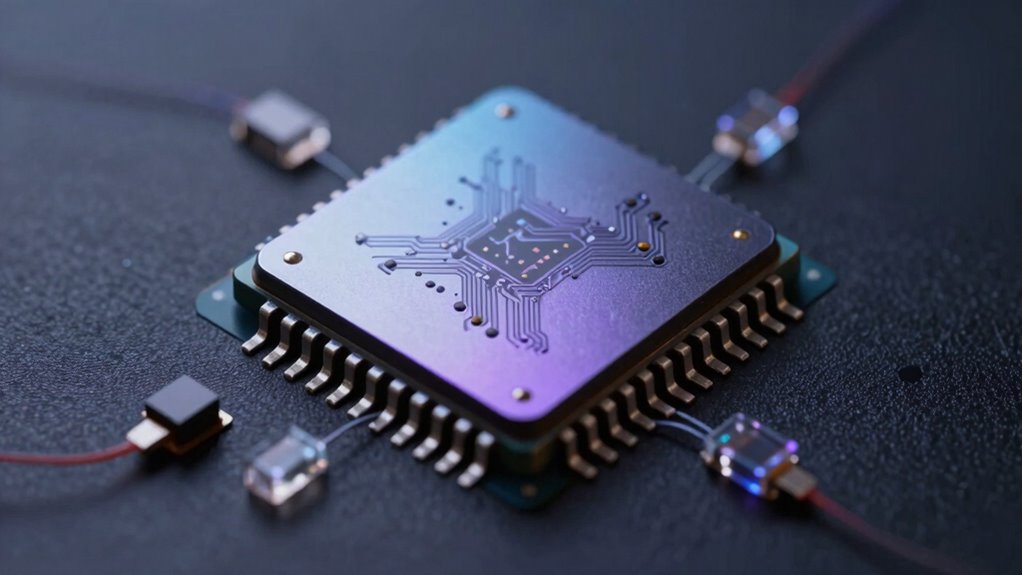

Nanoelectronics and sensing often evolve together because advancements in one directly enable progress in the other through quantum effects and new materials. As nanoelectronic devices become smaller and more sensitive, they open up new possibilities for detecting at the single-molecule level. Meanwhile, innovative materials like graphene support these quantum phenomena, driving faster, more reliable sensors. If you keep exploring, you’ll discover how this synergy continues to push technological boundaries further.
Key Takeaways
- Nanoelectronics enable the fabrication of ultra-sensitive sensors through precise control at the atomic scale.
- Material innovations in nanoelectronics enhance sensor performance and facilitate integration of quantum effects.
- Quantum phenomena at nanoscale improve detection sensitivity and allow for single-molecule sensing.
- Advances in fabrication techniques support miniaturization without sacrificing sensor functionality.
- The interplay of quantum effects and novel materials accelerates the development of smarter, more reliable sensors.

As nanoelectronics advances, it’s driving a revolution in sensing technologies, enabling devices that are smaller, faster, and more sensitive than ever before. This progress isn’t happening in isolation; instead, it’s fueled by a close interplay between quantum effects and material innovations. When you explore nanoelectronics, you quickly realize that at such tiny scales, classical physics gives way to quantum phenomena. These quantum effects—like tunneling and quantized energy levels—aren’t just challenges to overcome; they’re tools that, when harnessed properly, markedly enhance sensor capabilities. For example, quantum tunneling enables ultra-sensitive detection of electrical changes, making sensors capable of measuring phenomena at the single-molecule level. This is a game-changer for fields like biomedical sensing, environmental monitoring, and security. Additionally, understanding the quantum phenomena at play is essential for designing next-generation sensors that leverage these effects for improved performance. The development of nano-scale fabrication techniques allows for precise control over these quantum effects, further expanding possibilities. Material innovations are equally crucial in shaping this evolving landscape. As you explore the latest in nanoelectronics, you see that new materials—such as graphene, transition metal dichalcogenides, and carbon nanotubes—offer properties that traditional materials simply can’t match. These materials are lightweight, flexible, and exhibit remarkable electrical, thermal, and mechanical characteristics. Their integration into nanoscale sensors allows for unprecedented levels of miniaturization without sacrificing performance. For instance, graphene’s high conductivity and large surface area make it ideal for highly sensitive chemical and biological sensors. As you push device sizes downward, these material innovations help maintain, or even boost, sensitivity and stability, which would be impossible with conventional materials. The synergy between quantum effects and material innovations means that as you develop new nanoelectronic devices, you’re constantly accessing new sensing capabilities. Quantum phenomena enable detection at the smallest scales, while advanced materials provide the platform to realize these effects practically. This relationship drives rapid progress, making sensors more responsive and more versatile. It’s no coincidence that recent breakthroughs in nanoelectronics often coincide with the discovery or engineering of novel materials that support quantum behavior. Together, these factors accelerate advancements, leading to sensors that are quicker, more reliable, and capable of capturing data that was previously out of reach. As a result, nanoelectronics and sensing evolve hand in hand, each pushing the other forward, shaping a future where sensing devices are more integrated, intelligent, and capable than ever before.

Graphene Oxide Powder Diameter 20um-100 Gram
Product name: Graphene Oxide Powder
As an affiliate, we earn on qualifying purchases.
As an affiliate, we earn on qualifying purchases.
Frequently Asked Questions
How Do Material Properties Influence Both Nanoelectronics and Sensing Development?
Material properties, like conductivity and surface functionalization, directly impact nanoelectronics and sensing development. High material conductivity improves electronic performance, enabling faster, more efficient devices. Surface functionalization enhances sensor sensitivity by allowing specific interactions with target molecules. When you understand and manipulate these properties, you can design better nanoelectronic components and highly sensitive sensors simultaneously, because both fields rely on tailored material characteristics for ideal functionality.
What Are the Main Challenges in Integrating Nanoelectronics With Sensing Devices?
The main challenge is balancing quantum tunneling effects with signal amplification. Quantum tunneling can cause unpredictable current flow, complicating device stability, while achieving effective signal amplification requires precise control at the nanoscale. You must develop materials and architectures that minimize tunneling issues without sacrificing sensitivity. Overcoming these hurdles is essential for seamless integration, ensuring your nanoelectronic sensors are reliable, sensitive, and ready for real-world applications.
How Does Scalability Impact the Evolution of Nanoelectronics and Sensing Technologies?
Scalability considerably impacts the evolution of nanoelectronics and sensing technologies. You’ll face scalability limitations that hinder mass production, making it tough to develop reliable, cost-effective devices. Manufacturing challenges become more complex at smaller scales, requiring advanced techniques and stricter quality control. Overcoming these hurdles is essential for widespread adoption, enabling you to innovate faster, reduce costs, and improve device performance, ultimately advancing the integration of nanoelectronics and sensing systems.
What Role Does Interdisciplinarity Play in Advancing Both Fields Simultaneously?
Interdisciplinarity plays a vital role in advancing nanoelectronics and sensing by integrating theoretical advancements from physics, chemistry, and materials science. Your collaboration across fields accelerates innovation and helps address complex challenges. It also helps shape regulatory frameworks, ensuring safe, effective development. By combining diverse expertise, you facilitate breakthroughs that propel both nanoelectronics and sensing technologies forward simultaneously, fostering a dynamic environment for scientific progress and practical applications.
How Are Environmental Factors Considered in Nanoelectronic Sensing Applications?
You’re probably wondering how nanoelectronic sensors survive nature’s chaos. Well, you’d want to prioritize environmental durability to keep sensors intact amid humidity, temperature swings, or chemical exposure. This guarantees signal fidelity, preventing false readings or device failure. By considering these factors during design, you make sure your sensors stay reliable in real-world environments, even when Mother Nature throws her worst, so your data remains trustworthy and precise.

Novel Approaches for Single Molecule Activation and Detection (Advances in Atom and Single Molecule Machines)
As an affiliate, we earn on qualifying purchases.
As an affiliate, we earn on qualifying purchases.
Conclusion
Just like two dancers in perfect sync, nanoelectronics and sensing move together, each step fueling the other’s growth. As you explore this tiny world, you’ll see how advances in one spark innovations in the other, creating a dance of progress that’s hard to stop. Together, they’re shaping a future where technology becomes more precise and responsive—like a finely tuned instrument playing a harmonious tune. Keep watching—they’re leading us into a new era of discovery.
nanoelectronic device fabrication tools
As an affiliate, we earn on qualifying purchases.
As an affiliate, we earn on qualifying purchases.

Quantum Systems at the Nanoscale: Fundamentals, Characterization, Properties, and Emerging Applications (Lecture Notes in Nanoscale Science and Technology Book 45)
As an affiliate, we earn on qualifying purchases.
As an affiliate, we earn on qualifying purchases.