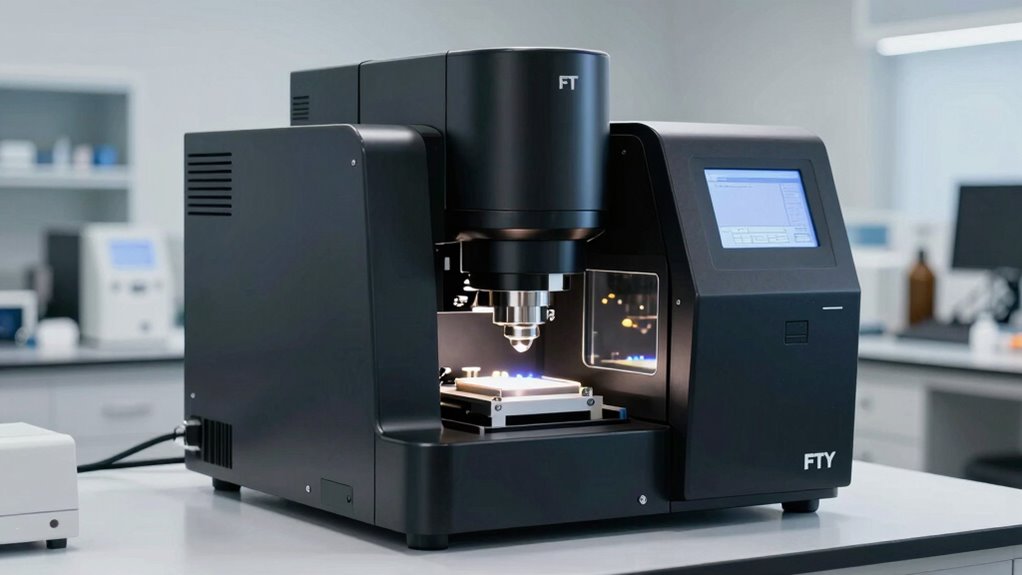

A great FTIR spectrometer offers high spectral resolution to clearly differentiate close peaks and identify subtle molecular differences. It features a versatile sample compartment that handles powders, liquids, and films effortlessly. Advanced optics and detectors ensure precise, stable measurements, while integrated accessories expand your capabilities. Reliable calibration routines and user-friendly interfaces make operation smooth and consistent. If you keep exploring, you’ll uncover how these features combine to deliver exceptional analytical performance.
Key Takeaways
- Superior spectral resolution enables precise differentiation of closely spaced absorption peaks, enhancing analytical accuracy.
- Innovative sample compartment design allows versatile, contamination-free handling of various sample types and sizes.
- Advanced optics and detectors ensure consistent, high-quality data across diverse measurement modes.
- Robust calibration routines and environmental shielding maintain long-term instrument stability and reproducibility.
- User-friendly interfaces combined with automated features streamline operation and elevate overall analytical performance.
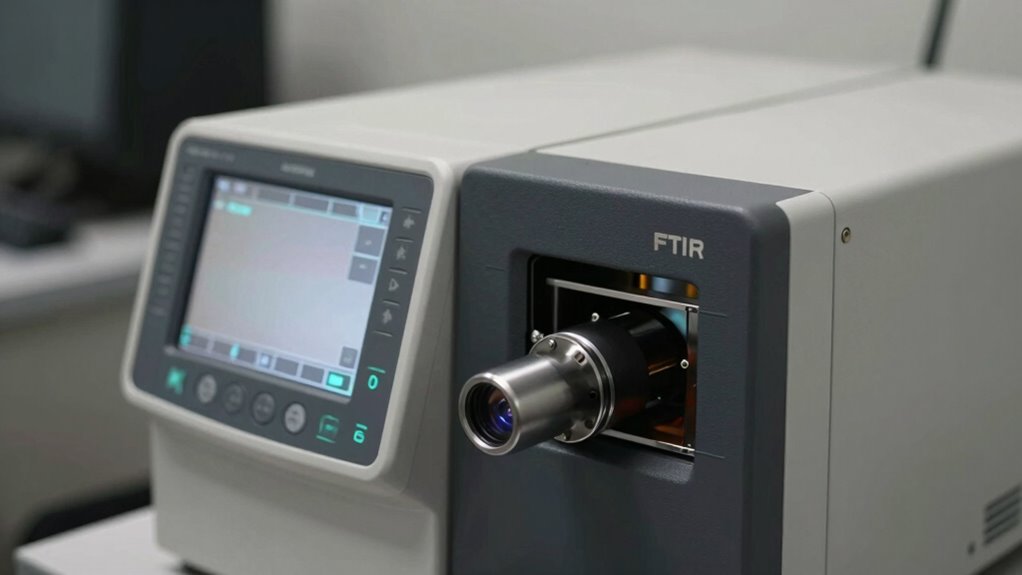
An FTIR spectrometer is a powerful tool that provides detailed information about the molecular composition of a sample through infrared light absorption. When evaluating the features that distinguish a good instrument from a truly great one, spectral resolution stands out as a vital factor. High spectral resolution allows you to distinguish between closely spaced absorption peaks, giving you a clearer picture of complex mixtures or subtle molecular differences. If your spectrometer offers superior spectral resolution, you’ll find it easier to identify specific functional groups and analyze samples with high precision. This capability becomes especially important when working with intricate samples or when detailed molecular fingerprinting is necessary. A great FTIR instrument minimizes peak overlap and guarantees that your data is sharp and accurate, saving you time and reducing the need for extensive post-analysis. Additionally, a well-designed optical path and high-quality detectors contribute significantly to the instrument’s overall performance, ensuring consistent and reliable results.
High spectral resolution ensures precise identification of molecular structures and reduces peak overlap for clearer analysis.
Another key feature that sets a great FTIR spectrometer apart is the design and functionality of the sample compartment. The sample compartment must be versatile enough to accommodate a variety of sample types and sizes, whether you’re analyzing powders, liquids, or films. A well-designed sample compartment offers easy sample loading, minimal sample contamination, and stable positioning during measurements. It should also enable quick adjustments to facilitate different measurement modes, such as transmission or Attenuated Total Reflection (ATR). The best instruments incorporate features like adjustable sample holders, temperature control, and compatibility with accessories that expand analytical capabilities. When your sample compartment is optimized for flexibility and convenience, your workflow becomes more efficient, and your results more reliable. Moreover, incorporating automated sample handling can further streamline your analytical process, especially when dealing with multiple or repetitive measurements. The integration of advanced optics and detectors enhances both spectral resolution and sampling accuracy, providing consistent high-quality data across various applications. Ensuring your instrument has robust environmental shielding can also help maintain measurement stability in different laboratory conditions. Additionally, the use of calibration routines and software tools helps maintain the instrument’s peak performance over time, ensuring ongoing accuracy and reliability.
In essence, a great FTIR spectrometer combines high spectral resolution with a thoughtfully designed sample compartment, guaranteeing you get detailed, accurate insights from your samples efficiently. These features, when paired with quality optics and user-friendly interfaces, elevate your analytical capabilities from merely good to truly exceptional. Understanding spectral resolution and other key features helps ensure you select an instrument that meets your specific analytical needs.

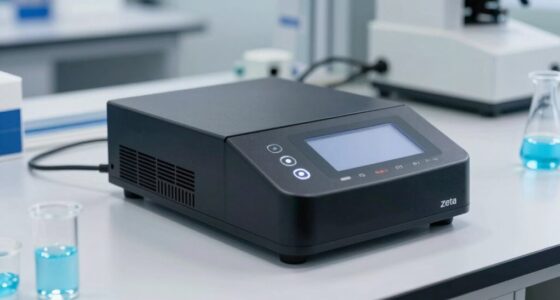
Spectrometers, High-Resolution Blue Light Hazard & Flicker Spectrometer
1. **High-Resolution Measurements**: Our High-Resolution Blue Light Hazard & Flicker Spectrometer features an impressive measurement range of 0.1-500K…
As an affiliate, we earn on qualifying purchases.
As an affiliate, we earn on qualifying purchases.
Frequently Asked Questions
How Does FTIR Technology Compare to Other Spectroscopic Methods?
You’ll find FTIR technology offers superior spectral resolution compared to many other spectroscopic methods, making it easier to distinguish subtle differences in samples. Its high sample versatility allows you to analyze solids, liquids, and gases with minimal preparation. Unlike some techniques, FTIR provides rapid, non-destructive results, making it ideal for routine and complex analyses alike. This combination of spectral resolution and sample versatility truly sets FTIR apart from other spectroscopic methods.
What Are the Maintenance Requirements for an FTIR Spectrometer?
Imagine your FTIR spectrometer working flawlessly—regular calibration keeps it precise, usually weekly or monthly, depending on usage. You’ll want to follow cleaning protocols, like wiping down optics and replacing filters, to prevent contamination and guarantee accurate results. Keep an eye on lamp life and replace components as recommended by the manufacturer. Consistent maintenance helps you get reliable data and extends your instrument’s lifespan, giving you confidence in every analysis.
Can FTIR Spectrometers Analyze Solid, Liquid, and Gas Samples Simultaneously?
No, FTIR spectrometers typically don’t analyze solid, liquid, and gas samples simultaneously. You need to prepare each sample type properly, like pressing pellets for solids, using liquid cells, or gas cells for gases. Good spectral resolution and precise sample preparation are critical for accurate results. While some advanced models can handle multiple sample types, most require switching accessories or configurations to analyze different states effectively.
How Do Environmental Conditions Affect FTIR Spectrometer Performance?
Environmental conditions greatly impact FTIR spectrometer performance. You need to guarantee environmental stability by controlling temperature, humidity, and vibration, as these factors can cause measurement inconsistencies. Regular calibration procedures are essential to maintain accuracy, especially if conditions fluctuate. By minimizing environmental disturbances and adhering to proper calibration routines, you can achieve reliable, precise spectral data, regardless of external environmental influences.
What Are the Cost Considerations for High-End FTIR Spectrometers?
When considering high-end FTIR spectrometers, you need to factor in calibration frequency and sample preparation costs. These advanced models often require more frequent calibration to maintain accuracy, which adds to ongoing expenses. Additionally, they may demand specialized sample preparation techniques, increasing both time and material costs. While the initial investment is higher, these features guarantee superior performance and precision, ultimately saving you money through more reliable results.

Hand-held XRF Analyzer Fluorescence Spectrometer for Ore Sample Metal Analysis
Cutting-Edge XRF Technology: Incorporates advanced X-Ray Fluorescence Spectrometry (XRF) technology, providing the latest in non-destructive metals elemental analysis….
As an affiliate, we earn on qualifying purchases.
As an affiliate, we earn on qualifying purchases.
Conclusion
Choosing the right FTIR spectrometer is like selecting the perfect compass for a journey—you need precise features to navigate the complex landscape of analysis. A good instrument guides you through the terrain, but a great one unlocks new horizons, revealing hidden insights buried deep within your samples. When you prioritize advanced features, you’re not just measuring—you’re setting out on a voyage of discovery, transforming data into knowledge and opening doors to endless possibilities.
advanced optics FTIR instrument
As an affiliate, we earn on qualifying purchases.
As an affiliate, we earn on qualifying purchases.

Spectrometer, 0.3 Meter Integrating Sphere For Luminance Calibration
1. High Precision Luminance Calibration: Our 0.3 Meter Integrating Sphere is designed for accurate and precise luminance calibration,…
As an affiliate, we earn on qualifying purchases.
As an affiliate, we earn on qualifying purchases.