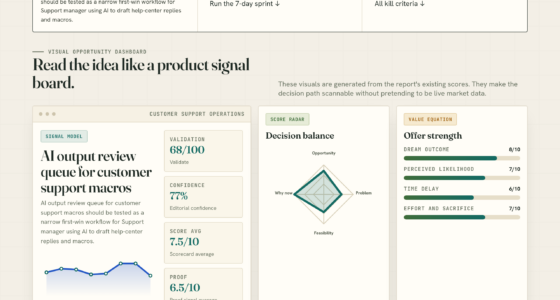

📊 Full opportunity report: The Persistent Presence Of AI After Adoption on ThorstenMeyerAI.com — validation score, market gap, and execution plan.

Get the latest gadgets delivered free with Prime
- Fast, free delivery on millions of items
- Prime Video, Amazon Music and more included
- Member-only deals all year
TL;DR
Large enterprises are slow to adopt AI, but their entrenched position and data control make them difficult to displace. Incumbents’ conservatism is both a weakness and a strength, enabling them to absorb AI into their existing systems.
Large enterprises are demonstrating persistent dominance in AI, despite widespread reports of slow adoption and internal resistance. Microsoft, Salesforce, SAP, and ServiceNow continue to lead AI integration, embedding AI into core systems and maintaining their market control, according to recent industry analyses. This ongoing presence underscores the importance of trust, data, and integration in enterprise AI strategies.
Recent industry insights, including Thorsten Meyer’s analysis, confirm that the most significant AI platforms in enterprises are not disruptors but established players like Microsoft Copilot, Salesforce Agentforce, and SAP Joule. These incumbents have transformed into the ‘operational control planes’ for enterprise AI, leveraging their deep integration with trusted data sources and compliance frameworks.
Despite the apparent slowness in AI pilot programs—where 95% of initiatives have delivered little or no immediate results—these firms have maintained their market dominance. Their conservative approach, driven by data gravity, regulatory compliance, and workflow integration, creates a high switching cost for customers, effectively locking them into existing platforms.
Industry analysts, including BCG, emphasize that in an AI-first world, incumbents possess structural advantages that position them to win long-term, provided they adapt in time. The convergence of major vendors around shared architectures—agents operating on trusted data within governed environments—further cements their entrenched position.
Incumbents are painfully slow to adopt AI — and remarkably hard to displace. How can both be true? They’re the same fact wearing two faces.
- 95% of pilots deliver nothing
- The internal customer resists
- Two-year timelines to change
- Built to resist transformation
- Absorb most enterprise AI spend
- Became the “control planes”
- Two years no rival can rip it away
- BCG: “a clear right to win”
Implications of Incumbent Dominance in AI
This persistence of incumbents in AI adoption matters because it challenges the narrative that disruptors will quickly overthrow established players. Their deep integration, trust, and data control form a formidable moat that makes displacement difficult, even as AI technology advances rapidly. For businesses and investors, this underscores the importance of understanding the value of existing platforms and the strategic advantage of entrenched ecosystems.
Furthermore, it highlights that the slow pace of AI adoption is not necessarily a weakness but a feature that sustains incumbents’ market power. Recognizing this can influence how new entrants approach AI strategies, shifting focus from rapid disruption to integration and partnership.
As an affiliate, we earn on qualifying purchases.
Historical and Strategic Context of Enterprise AI
The perception that AI would swiftly disrupt enterprise systems has been challenged by recent observations. While initial forecasts predicted rapid shifts, actual adoption has been sluggish, with many pilots failing to deliver tangible results. Nonetheless, major vendors have embedded AI into their core platforms, transforming them into operational control centers that leverage existing trust and data infrastructure.
This pattern reflects a broader trend in enterprise technology: the importance of data gravity, regulatory compliance, and workflow integration. These factors create high switching costs, making it difficult for enterprises to abandon established vendors even as new AI capabilities emerge. The convergence of vendor architectures in 2026 illustrates how incumbents have effectively absorbed the AI wave rather than being overtaken by disruptors.
"The slowness that makes enterprises resistant to change is also what makes them durable in the AI era."
— Thorsten Meyer
As an affiliate, we earn on qualifying purchases.
Unresolved Questions About Incumbent AI Strategies
It remains unclear how quickly incumbents will evolve their AI offerings to meet emerging demands and whether their conservative approach will limit their ability to innovate. Additionally, the long-term impact of new entrants that focus on niche or specialized AI solutions is still uncertain, as is the potential for disruptive startups to develop new architectures that bypass traditional incumbents.
As an affiliate, we earn on qualifying purchases.
Future Developments in Enterprise AI Competition
Observations suggest that incumbents will continue to deepen their AI integrations, reinforcing their control over enterprise data and workflows. Monitoring how quickly they innovate and respond to emerging threats from niche AI startups will be critical. Additionally, regulatory developments and shifts in enterprise priorities could influence the pace and direction of AI adoption in the coming years.
AI compliance and governance solutions
As an affiliate, we earn on qualifying purchases.
As an affiliate, we earn on qualifying purchases.
Key Questions
Why are incumbents still dominant in AI despite slow adoption?
Incumbents hold critical data, trust, and integrated systems that create high switching costs, making them difficult to displace even with slow adoption rates.
Will the slow pace of AI adoption change in the future?
It is uncertain; while incumbents are embedding AI steadily, regulatory pressures, technological breakthroughs, or new competitors could accelerate or alter the current dynamics.
Do disruptors have no chance against these entrenched players?
Disruptors face significant challenges due to incumbents' data moat and integrated ecosystems, but niche innovations or new architectures could still pose threats in specific areas.
What should enterprises consider when choosing an AI platform?
Trust, data control, regulatory compliance, and integration capabilities are crucial factors, as they determine long-term stability and flexibility.
Source: ThorstenMeyerAI.com
Fall Picks
fall essentials
As an affiliate, we earn on qualifying purchases.