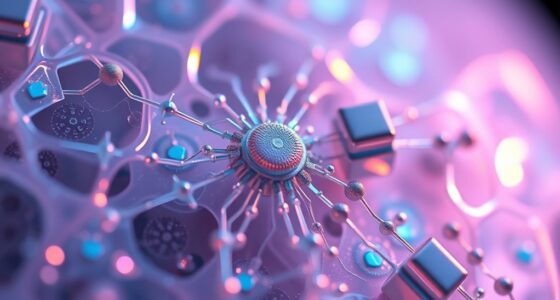
Self-assembly at the nano level is a natural process where molecules organize themselves into precise, complex structures driven by interactions like hydrogen bonds, van der Waals forces, and hydrophobic effects. You can control this process by adjusting conditions such as temperature, pH, and concentration. Since it mimics natural molecular behaviors, it enables efficient creation of nanomaterials without external tools. If you explore further, you’ll discover how scientists harness this phenomenon to advance nanotechnology and materials science.
Key Takeaways
- Self-assembly at the nano level involves molecules organizing spontaneously into precise nanostructures driven by molecular interactions.
- Forces like hydrogen bonds, Van der Waals, electrostatic, and hydrophobic effects direct nanoscale molecular arrangements.
- Conditions such as temperature, pH, concentration, and solvent influence the pathways and final nanostructures formed.
- This process enables efficient, bottom-up fabrication of complex nanomaterials without external machinery.
- Applications include nanotechnology in medicine, electronics, and materials science, harnessing natural molecular tendencies for innovation.

Have you ever wondered how tiny structures can form themselves without direct human intervention? It’s a fascinating process known as self-assembly, and it operates at the nano level, where the rules of classical physics blur and molecular interactions take center stage. In the world of nanotechnology, self-assembly is the natural tendency of molecules to organize into structured patterns or arrangements. This process isn’t random; it’s driven by specific forces and interactions at the molecular scale, leading to the spontaneous formation of nanostructures with remarkable precision. When molecules come together, they do so based on their inherent properties and the energy landscape they navigate. These molecular interactions—such as hydrogen bonds, van der Waals forces, electrostatic attractions, and hydrophobic effects—dictate how and when structures emerge.
During nanostructure formation, molecules seek the most energetically favorable configurations. Think of it as a puzzle where each piece finds its perfect fit based on shape, charge, or polarity. These interactions guide molecules to assemble into larger, more complex architectures without external manipulation. For example, surfactant molecules can spontaneously form micelles in water, while DNA strands can self-assemble into intricate double helices. The beauty of this process lies in its efficiency: it doesn’t require complicated machinery or human control, just the right conditions and molecular properties.
Molecules naturally self-assemble into complex structures driven by shape, charge, and polarity.
Conditions like temperature, pH, concentration, and solvent type influence how molecules interact and assemble. Slight changes can alter the pathway and final structure, giving scientists a way to tailor nanostructures for specific applications. This natural, bottom-up approach is incredibly advantageous because it allows for the creation of complex, functional materials with minimal effort and waste. In essence, self-assembly harnesses the inherent molecular interactions to produce highly ordered nanostructures that are fundamental in fields ranging from medicine to electronics.
Understanding nanostructure formation through molecular interactions helps you appreciate how nature and technology intertwine. It’s a process that exemplifies the elegance of simplicity—molecules following their intrinsic tendencies to build sophisticated architectures. This self-organizing behavior, driven by fundamental forces, is what makes nanotechnology so promising. It opens doors to designing new materials, drug delivery systems, and electronic components, all by leveraging the natural propensity of molecules to assemble themselves. So, the next time you see a complex nanostructure, remember—it’s a product of molecular interactions working in harmony, guiding tiny building blocks to create something extraordinary without any direct human hand.
self-assembly nanotechnology kit
As an affiliate, we earn on qualifying purchases.
As an affiliate, we earn on qualifying purchases.
Frequently Asked Questions
What Are the Potential Risks of Nano Self-Assembly?
You might face risks like biocompatibility concerns if nano self-assembly materials aren’t safe for the body, potentially causing toxicity or immune reactions. Uncontrolled aggregation can also occur, leading to unexpected behavior or blockages in biological systems. These issues highlight the importance of thorough testing and regulation to guarantee safe application, as unintended consequences could impact health or environmental safety if not properly managed.
How Does Temperature Affect Nano Self-Assembly Processes?
Temperature control plays a vital role in nano self-assembly, as it directly influences assembly kinetics. When you increase the temperature, particles move faster, speeding up the assembly process. Conversely, lowering the temperature slows down kinetics, leading to more precise structures. Maintaining ideal temperature guarantees controlled assembly, reducing defects and promoting uniform nanostructures. So, you must carefully manage temperature to achieve desired outcomes in nano self-assembly processes.
Can Self-Assembly Be Controlled Precisely at the Atomic Level?
You can control self-assembly at the atomic level, but achieving perfect atomic precision remains a challenge. Advanced techniques like atomic force microscopy and molecular engineering push the boundaries of assembly control, offering unprecedented precision. Yet, the delicate interplay of forces at this scale means there’s always an element of unpredictability. The quest for perfect atomic-level control continues, promising revolutionary breakthroughs in nanotechnology, but it’s a battle against nature’s smallest, most elusive forces.
What Are the Environmental Impacts of Nano Self-Assembly?
You might wonder about the environmental impacts of nano self-assembly, and it’s crucial to take into account environmental safety and ecological impact. While nanotechnology offers benefits, it can also pose risks like toxicity or pollution if nanoparticles are released into ecosystems. You should prioritize responsible development, conduct thorough safety assessments, and implement proper disposal methods to minimize ecological harm and ensure sustainable use of nanomaterials.
How Scalable Are Nano Self-Assembly Techniques for Industrial Use?
Think of nano self-assembly like building a tiny city with LEGO bricks—you can scale it up, but it’s tricky. You face scalability challenges like controlling uniformity and precision at larger volumes. For industrial integration, you need reliable, cost-effective methods, which are still developing. While promising, current techniques aren’t fully ready for mass production, so you must overcome these hurdles before widespread application becomes practical.

RELIANCER Molecular Model Kit,444PCS Organic Molecular Chemistry Set w/C60,Atoms,Bonds,Molecular Structures Building Kit for Chemistry Learning,STEM Science Kits for Teachers,Students,Young Scientists
- Number of Pieces: 444-piece organic chemistry set
- Atom Types: 136 atom pieces of various elements
- Bond Types: 154 flexible, hard, short, overlength, V-bonds
As an affiliate, we earn on qualifying purchases.
As an affiliate, we earn on qualifying purchases.
Conclusion
As you explore into the world of nano self-assembly, remember it’s like watching a symphony of tiny dancers perfectly choreograph themselves without a conductor. This process opens endless possibilities, shaping future technologies from medicine to materials. By understanding these minuscule yet mighty interactions, you become part of a groundbreaking journey—where nature’s smallest acts create the grandest innovations. Embrace this invisible dance, for it holds the keys to a future built on the power of self-organization.

Snow Crystals: A Case Study in Spontaneous Structure Formation
As an affiliate, we earn on qualifying purchases.
As an affiliate, we earn on qualifying purchases.

Poly Organo Phosphazene Nanomaterials for Therapy
As an affiliate, we earn on qualifying purchases.
As an affiliate, we earn on qualifying purchases.