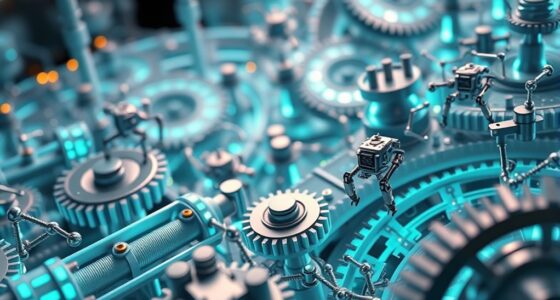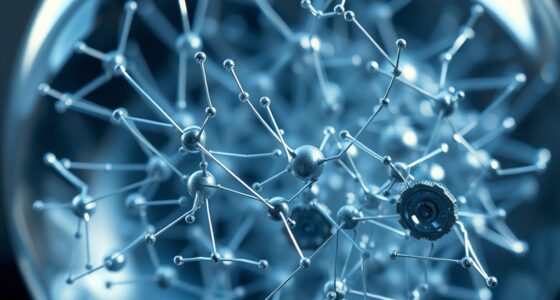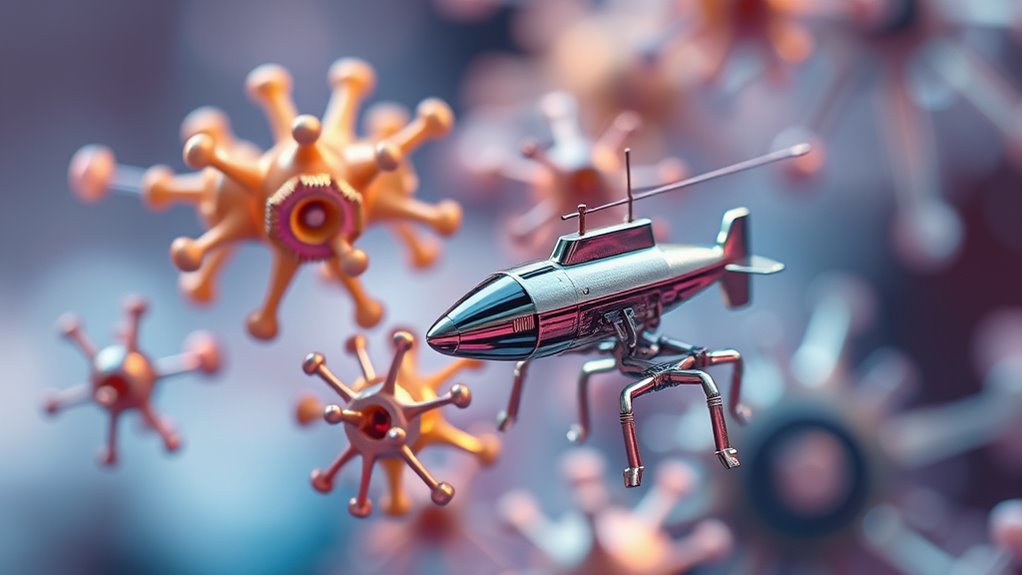

Molecular machines are tiny devices driven by chemical energy that perform specific tasks at the nanoscale, like moving cargo or changing shape. In contrast, nanorobots are more complex systems that often combine multiple molecular components to navigate environments and carry out targeted functions, such as repairing tissues or delivering drugs. Understanding their differences helps you see how simple molecular movements evolve into sophisticated nanoscale tools—continue exploring to learn more about their fascinating capabilities.

Get the latest gadgets delivered free — and shop member deals
- Fast, free delivery on millions of items
- Access to Prime Big Deal Days deals on October 6–7
- Prime Video, Amazon Music and more included
Key Takeaways
- Molecular machines are nanoscale devices performing specific tasks through energy-driven conformational changes; nanorobots are larger, integrated systems capable of complex functions.
- Molecular machines operate at the molecular level, often using chemical energy; nanorobots incorporate multiple components like sensors and actuators for autonomous operation.
- Molecular machines are primarily designed for chemical or biological tasks; nanorobots are engineered for applications like targeted drug delivery and environmental monitoring.
- Molecular machines are typically simpler in structure, focusing on movement or force generation; nanorobots are more complex, integrating electronics and control systems.
- Both operate at the nanoscale but differ in scale, complexity, functionality, and integration, with nanorobots representing an advanced, multifunctional evolution of molecular machinery.
As an affiliate, we earn on qualifying purchases.
Defining Molecular Machines and Their Core Characteristics

Molecular machines are nanoscale devices that perform specific tasks by converting energy into controlled motion. You can think of them as tiny engines, built from molecules, that move or change shape in precise ways. These machines have core characteristics like complexity, directionality, and responsiveness. They often operate through chemical reactions, light, or electric signals, allowing them to perform functions such as moving cargo or altering structures at the molecular level. Unlike larger machines, their design relies on molecular interactions, like bonds and forces, to generate motion. Their ability to perform repetitive tasks with high precision makes them essential in nanotechnology. Understanding their design principles helps you grasp how they differ from larger, more familiar machines, setting the stage for exploring their capabilities.
As an affiliate, we earn on qualifying purchases.
Exploring Nanorobots and Their Functional Capabilities

Have you ever wondered how nanorobots can perform complex tasks at such a tiny scale? These tiny devices can navigate through fluids, target specific cells, and deliver drugs precisely where needed. They use a combination of sensors, actuators, and power sources to operate effectively in confined environments. Some nanorobots are designed to detect chemical signals, enabling them to identify harmful bacteria or cancer cells. Others can physically interact with their surroundings, performing tasks like cleaning clogged arteries or repairing tissue. Their capabilities extend to environmental monitoring, where they gather data on pollutants or biological agents. Despite their size, nanorobots demonstrate impressive functionality, making them promising tools for medicine, environmental science, and manufacturing. Their potential is only beginning to be discovered, especially with AI integration enhancing their operational capabilities.
As an affiliate, we earn on qualifying purchases.
Construction and Design Principles at the Nanoscale

To construct effective nanoscale devices, you need to understand their structural components and the materials used. You’ll also have to master assembly techniques and control methods that guarantee precise operation. Focusing on these principles is key to designing reliable molecular machines and nanorobots. Additionally, understanding ethical hacking principles can help in developing secure communication channels for these tiny devices.
Structural Components and Materials
Designing structural components at the nanoscale requires selecting materials that are both strong and flexible enough to perform their functions reliably. You need materials with high tensile strength, like carbon-based structures such as graphene or carbon nanotubes, which provide durability and flexibility. Metals like gold or platinum are often used for their conductivity and biocompatibility, but their mechanical properties vary. Polymers and hybrid materials can offer lightweight, adaptable options, especially when flexibility is essential. You should consider how these materials behave under different conditions, including temperature and chemical exposure. Additionally, understanding the mechanical properties of materials helps predict their performance in various environments. Precise control over material properties is vital for ensuring the stability and performance of molecular machines and nanorobots. Ultimately, your choice of materials influences the device’s functionality, lifespan, and integration capabilities at the nanoscale.
Assembly and Control Methods
Constructing molecular machines and nanorobots requires precise assembly techniques that enable control over their intricate structures. You use methods like chemical synthesis, self-assembly, and DNA origami to build at the nanoscale. These techniques allow you to program specific interactions and configurations. For example, with chemical synthesis, you create custom molecules that assemble into desired structures. Self-assembly leverages natural tendencies of molecules to organize themselves, while DNA origami employs DNA strands to form complex, programmable shapes. By combining these approaches, you achieve precise control over size, shape, and function, ensuring your nanodevices perform their intended tasks effectively. Mastering these methods is essential to designing reliable, functional molecular machines and nanorobots.
As an affiliate, we earn on qualifying purchases.
Operational Mechanisms of Molecular Machines

Understanding how molecular machines operate requires examining the intricate mechanisms that enable their movement and function at the nanoscale. These machines typically rely on chemical energy, often from ATP hydrolysis or other molecular sources, to drive their actions. Their components are designed to undergo conformational changes—shifts in shape—that produce movement or perform specific tasks. This process involves precise interactions between molecules, such as binding and releasing substrates, which trigger these shape changes. Some molecular machines use rotational mechanisms, like the bacterial flagellar motor, while others employ linear stepping motions. The energy transduction at this scale is highly efficient, allowing molecular machines to operate reliably within the crowded and dynamic environment of a cell. Their operation exemplifies nature’s mastery of nanoscale engineering. Additionally, understanding these mechanisms can inform the development of robust safety measures for advanced AI systems.
How Nanorobots Perform Tasks in Complex Environments

Nanorobots navigate complex environments by integrating advanced sensing, adaptable control systems, and precise actuation mechanisms. You can think of them as tiny explorers, responding swiftly to changes around them. They use sensors to detect chemical signals, temperature shifts, and physical obstacles, which guide their actions. Their control systems adapt in real-time, allowing them to modify their behavior based on the environment. Precise actuation mechanisms enable accurate movement and task execution despite crowded or unpredictable conditions. Additionally, their design often incorporates miniaturized components that allow for seamless operation within tiny spaces. This combination guarantees they perform tasks efficiently, even in highly complex or dynamic settings.
Applications of Molecular Machines in Various Fields

Molecular machines have begun transforming various fields by enabling precise control at the nanoscale. In medicine, they help develop targeted drug delivery systems, releasing medication only where needed, reducing side effects. In materials science, they assist in creating stronger, more adaptable nanomaterials with enhanced properties. Chemistry benefits from molecular machines by facilitating complex reactions and catalysis with unprecedented accuracy. Electronics see advancements as molecular machines enable the construction of ultra-small components, leading to faster, more efficient devices. Additionally, environmental science uses them to detect and neutralize pollutants at a molecular level. Their ability to perform specific tasks with high precision access innovative solutions across multiple disciplines, pushing the boundaries of what’s possible at the smallest scales. The development of high-precision nanoscale components is further advancing the integration of molecular machines into everyday technology.
Practical Uses of Nanorobots in Medicine and Industry

Nanorobots are making significant strides in medicine and industry by performing targeted operations with high accuracy. In medicine, they can deliver drugs directly to affected cells, perform minimally invasive surgeries, and assist in diagnostics. In industry, nanorobots help with precise manufacturing, materials repair, and environmental monitoring. You might encounter nanorobots used for dog names, targeted drug delivery, reducing side effects and improving treatment efficiency, cleaning and repairing micro-scale components in manufacturing processes, detecting and neutralizing pollutants in environmental applications. These applications are transforming how we approach complex tasks, making processes faster, safer, and more efficient. As nanorobots advance, their practical uses will expand, offering innovative solutions across various fields.
Limitations and Challenges Faced by Both Technologies

Although these tiny machines hold great promise, both molecular machines and nanorobots face significant hurdles that limit their current capabilities. One major challenge is controlling their movement precisely at such a small scale, which remains difficult due to environmental unpredictability and technical constraints. Stability is another concern; molecular structures can be fragile and susceptible to degradation, while nanorobots may encounter issues with power sources or control systems. Additionally, manufacturing consistency is tough to achieve, leading to variability in performance. Safety and biocompatibility also pose hurdles, especially in medical applications, where unintended interactions could cause harm. Overcoming these limitations requires advances in materials, control mechanisms, and manufacturing techniques before these technologies can reach their full potential. Incorporating mindfulness strategies may help researchers develop better control and stability in these tiny systems by fostering focused innovation and problem-solving.
Future Perspectives and Emerging Trends in Nanoscale Engineering

As nanoscale engineering advances, you’ll see innovative designs that push the boundaries of what’s possible. However, integrating these tiny machines into real-world applications presents significant challenges. Along the way, you’ll need to contemplate ethical and safety issues to ensure responsible development of these emerging technologies. Additionally, understanding the growth process of chia seeds can offer valuable insights into sustainable and efficient production methods at the nanoscale.
Innovations in Design
Emerging trends in nanoscale engineering are revolutionizing how you design molecular machines and nanorobots, opening up new possibilities for precision and functionality. Advances focus on creating more adaptable, efficient, and responsive devices. You’ll see innovations like programmable self-assembly, enabling components to organize themselves into complex structures autonomously. Researchers are also exploring hybrid materials combining biological and synthetic elements for enhanced durability and biocompatibility. Additionally, new fabrication techniques like DNA origami allow for precise, customizable shapes and functions at the molecular level. These developments empower you to engineer nanodevices with greater control, versatility, and integration potential, paving the way for smarter, more capable nanoscale systems that can perform increasingly sophisticated tasks in medicine, environmental monitoring, and beyond.
Integration Challenges Ahead
Building on recent innovations in nanoscale design, integrating these advanced molecular machines and nanorobots into practical systems presents significant hurdles. You’ll face challenges in ensuring reliable control and coordination of countless tiny components within complex environments. Compatibility issues may arise when combining different materials or functions, hindering seamless operation. Powering these devices efficiently without damaging surrounding structures is another obstacle. Additionally, you need to address issues related to stability and durability, as nanoscale components can be sensitive to external conditions. Scaling up production while maintaining precision remains difficult, making widespread implementation uncertain. Overcoming these barriers requires interdisciplinary research, innovative fabrication techniques, and robust control systems. While progress is promising, these integration challenges must be addressed before molecular machines and nanorobots can reach their full potential in real-world applications.
Ethical and Safety Concerns
The rapid advancement of nanoscale engineering brings with it pressing ethical and safety concerns that cannot be overlooked. As you develop molecular machines and nanorobots, you must consider potential risks, such as unintended biological interactions, environmental impact, and misuse. These concerns raise questions about regulation, long-term effects, and control mechanisms. You should also be aware of the following issues:
- Potential for bioethical dilemmas, such as privacy and consent
- Environmental hazards from nanomaterial release
- Risks of malicious use or unintended consequences
Staying vigilant and establishing strict guidelines can help ensure these technologies benefit society without compromising safety or ethics. Addressing these concerns now paves the way for responsible innovation in nanoscale engineering.
Frequently Asked Questions
How Do Molecular Machines Differ From Biological Enzymes?
Molecular machines differ from biological enzymes because they are engineered devices designed to perform specific tasks at the nanoscale, often using synthetic materials. Enzymes are natural biological catalysts that speed up chemical reactions in living organisms. While enzymes rely on their complex protein structures for function, molecular machines can be built from various materials and may not necessarily work through catalytic processes, focusing instead on mechanical movement or task execution.
Can Nanorobots Operate Autonomously Without External Control?
Yes, nanorobots can operate autonomously, but it depends on their design and purpose. Many are programmed to perform specific tasks without external control, using onboard sensors and decision-making algorithms. However, some still require external guidance or control systems for precise operation. As technology advances, autonomous nanorobots become more sophisticated, enabling them to adapt to their environment and carry out complex functions independently.
What Are the Ethical Concerns Surrounding Nanorobot Deployment?
You should consider that deploying nanorobots raises ethical concerns like privacy invasion, especially if they can access personal data discreetly. You also need to think about potential misuse, such as unauthorized surveillance or harmful applications. Additionally, there’s the risk of unintended consequences, like environmental impact or health issues, which require strict regulation. It’s vital to balance technological progress with responsible use to prevent harm and maintain public trust.
How Scalable Are Molecular Machines for Industrial Applications?
Imagine tiny gears turning seamlessly within a vast factory—that’s how scalable molecular machines are for industry. You can scale their production through advances in synthesis and assembly techniques, allowing large quantities to be created efficiently. As you refine these processes, molecular machines could perform complex tasks at an industrial scale, transforming manufacturing, medicine, and energy sectors. Their potential for scalability is promising, but it requires ongoing innovation and precise control.
Are There Hybrid Systems Combining Molecular Machines and Nanorobots?
Yes, hybrid systems combining molecular machines and nanorobots are emerging. You might see these systems designed to leverage molecular machines’ precision and nanorobots’ mobility. Researchers are exploring ways to integrate both, enabling applications like targeted drug delivery, environmental sensing, and nanoscale manufacturing. These hybrids aim to maximize capabilities, offering more versatile and efficient solutions at the nanoscale. As technology advances, expect these systems to become more sophisticated and widely used.
Conclusion
Just as Da Vinci dreamed of flying machines, understanding molecular machines and nanorobots opens future innovations. While they differ in complexity and scale, both hold the power to transform medicine, industry, and beyond. Embrace these tiny marvels, knowing they’re the modern-day alchemy shaping our world. With continued advancements, you’re on the cusp of a nanoscale revolution—where science fiction becomes reality, turning the impossible into the everyday.
Fall Picks
fall essentials
As an affiliate, we earn on qualifying purchases.