
Nano-lubricants use tiny nanoparticles to improve how your machinery runs. They create smoother movement by acting like micro ball bearings and forming protective films on metal surfaces. These particles stay evenly dispersed, reducing friction, heat, and wear over time. This means your equipment can operate more efficiently and last longer with less maintenance. To discover how these advanced lubricants achieve such benefits, keep exploring their innovative mechanisms and effects.
Key Takeaways
- Nanoparticles in lubricants reduce friction and heat, improving machinery efficiency.
- Stable nanoparticle dispersion prevents clumping, ensuring consistent lubrication performance.
- Enhanced lubrication mechanisms, like protective films and micro-asperity filling, extend equipment lifespan.
- Improved physicochemical interactions maintain lubricant stability under high pressure and temperature.
- Longer-lasting lubricants decrease maintenance frequency and energy consumption, boosting overall operational efficiency.
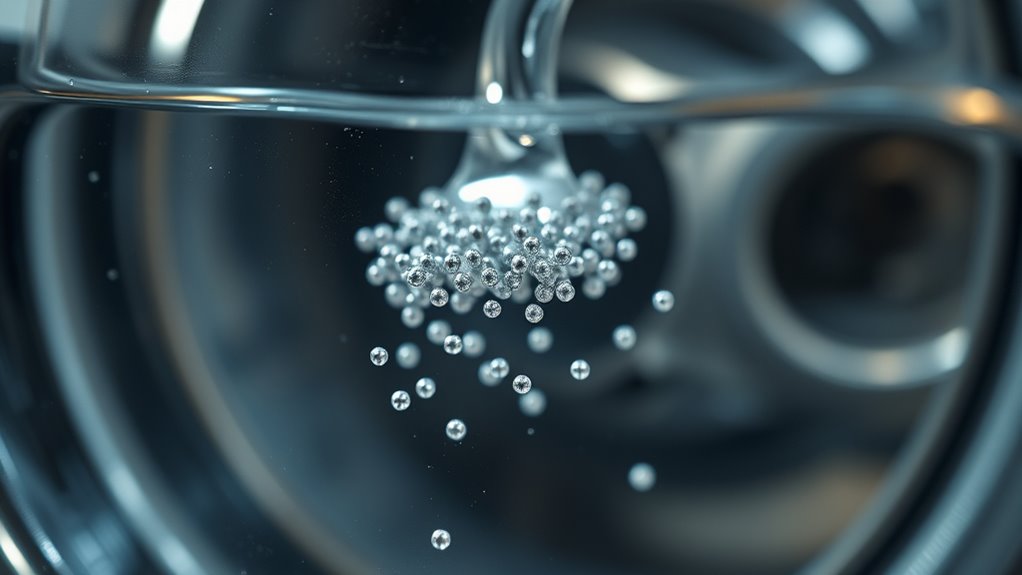
Nano-lubricants are innovative fluids enhanced with nanoparticles that considerably boost lubrication performance. When you choose nano-lubricants, you’re tapping into advanced technology designed to improve efficiency and reduce wear in machinery. One of the key factors behind their effectiveness is nanoparticle stability. These tiny particles need to remain evenly dispersed within the lubricant to maintain *ideal* performance. If they clump together or settle, it can lead to inconsistent lubrication and diminish the benefits of using nano-lubricants. That’s why manufacturers focus heavily on ensuring nanoparticle stability, employing surface treatments or specific additives that keep particles uniformly distributed over time. Stable nanoparticles enable the lubricant to sustain its enhanced properties, providing consistent protection and reducing friction more effectively than conventional oils.
Understanding the lubrication mechanisms at play helps you appreciate why nano-lubricants outperform traditional options. When nanoparticles are properly stabilized, they actively participate in reducing friction through several mechanisms. For example, some nanoparticles act as tiny ball bearings, facilitating smoother movement between contact surfaces. Others form protective films on metal surfaces, preventing direct contact and minimizing wear. Additionally, certain nanoparticles can fill in microscopic surface asperities—those tiny bumps and valleys—creating a smoother interface that decreases resistance. This multi-faceted approach to lubrication means your machinery experiences less heat generation, lower energy consumption, and extended service life. The particles’ small size allows them to penetrate tight spaces and surface irregularities that larger molecules simply can’t reach, further enhancing the lubrication process.
Furthermore, the physicochemical interactions between nanoparticles and base fluids are crucial for maintaining particle dispersion, ensuring the lubricant’s stability and performance over time. When properly engineered, these interactions promote better adhesion and cohesion, ensuring the nanoparticles stay embedded within the lubricant matrix during operation. This stability prevents the particles from agglomerating or settling, which could otherwise compromise the lubricant’s effectiveness. As a result, you benefit from a more durable and reliable lubricant that maintains its properties under high pressure and temperature conditions. The combined effect of nanoparticle stability and well-understood lubrication mechanisms leads to reduced friction, lower energy losses, and longer intervals between maintenance or oil changes.

Hot Shot's Secret FR3 Friction Reducer Nano-Lubricant with Wear Protection, 32 oz
ADVANCED LUBRICATION TECHNOLOGY: FR3 Friction Reducer is engineered with nano-lubricant technology that dramatically minimizes resistance, enhances performance, and…
As an affiliate, we earn on qualifying purchases.
As an affiliate, we earn on qualifying purchases.
Frequently Asked Questions
How Do Nano-Lubricants Impact Long-Term Machinery Durability?
Nano-lubricants boost your machinery’s long-term durability by enhancing wear resistance and preventing corrosion. The tiny particles create a stronger protective layer, reducing friction and minimizing component wear. They also inhibit rust formation, which extends the lifespan of your equipment. With nano-lubricants, you can expect less maintenance, fewer breakdowns, and improved operational efficiency, ensuring your machinery remains reliable and durable over the years.
Are Nano-Lubricants Environmentally Safe and Biodegradable?
Nano-lubricants are often thought to be completely eco-friendly, but that’s an exaggeration. While many are designed to be biodegradable, concerns about their environmental impact remain. You should be cautious, as some formulations may contain substances that aren’t fully biodegradable, potentially harming ecosystems. Always check for eco-certifications and ingredient transparency to guarantee you’re choosing nano-lubricants with minimal biodegradability concerns and a positive environmental impact.
What Are the Cost Implications of Adopting Nano-Lubricants?
Adopting nano-lubricants involves higher initial investment costs due to specialized manufacturing and formulation requirements. Your cost analysis should weigh these upfront expenses against long-term savings from improved efficiency and reduced maintenance. While the initial investment may seem steep, the increased durability and performance of nano-lubricants can lower operational costs over time, making them a cost-effective choice for your machinery and processes in the long run.
How Do Nano-Lubricants Compare With Traditional Lubricants in Extreme Temperatures?
You’ll find nano-lubricants excel in extreme temperatures, thanks to their superior thermal stability. Unlike traditional lubricants, they maintain consistent viscosity behavior, preventing breakdown or thickening when heat spikes or cold hits. Imagine your machinery running smoothly through scorching heat or freezing cold—nano-lubricants make that possible. They provide reliable protection where conventional oils falter, ensuring your equipment stays efficient and protected regardless of temperature fluctuations.
What Are the Health Risks Associated With Handling Nano-Lubricants?
When handling nano-lubricants, you face health risks like nano particle inhalation and skin absorption. Breathing in these tiny particles can cause respiratory issues, while skin contact may lead to absorption of potentially harmful substances. To protect yourself, wear appropriate personal protective equipment, such as masks and gloves, and work in well-ventilated areas. Always follow safety guidelines to minimize exposure and reduce health risks.

Nano-Oil – NanoLube Anti Friction Concentrate 10 weight
Renders any Metal to Metal Dynamic Contacts very smooth
As an affiliate, we earn on qualifying purchases.
As an affiliate, we earn on qualifying purchases.
Conclusion
As you explore nano-lubricants, you’ll notice how their efficiency gains seem almost like a coincidence—enhancing performance just when you least expect it. These tiny particles subtly reduce friction, saving energy and extending equipment life. It’s fascinating how such small innovations can have such a big impact, turning everyday lubrication into a game-changer. So, next time you think about efficiency, remember, sometimes it’s the smallest details that make the biggest difference.

World’s Best Engine Oil Additive: Diamond NanoLube Reduces Friction up to 60%. Perfect For Gas & Diesel Engines. Diamond Sphere Nanotechnology for More Power, Engine Life, and Reduced Oil Changes.
Reduces friction by approximately 60% compared to conventional engines, by forming an ultra-low friction film on top of…
As an affiliate, we earn on qualifying purchases.
As an affiliate, we earn on qualifying purchases.

400-HD Heavy-Duty Garage Door Lubricant Spray – Rust Preventative with Long-Lasting Hinge & Track Protection
Special 3 Way Nozzle System for precise application to hard-to-reach areas, ensuring complete coverage.
As an affiliate, we earn on qualifying purchases.
As an affiliate, we earn on qualifying purchases.