

Ultra-light nanomaterials for aerospace combine advanced nanotechnology with lightweight design, helping you build stronger and more fuel-efficient aircraft. These materials, like nanocomposites and nano coatings, improve strength, resistance, and thermal management while reducing weight. They enable aircraft to perform better, last longer, and burn less fuel. As you explore further, you’ll discover how ongoing innovations are revolutionizing aerospace with ultra-light, durable nanomaterials that push boundaries and boost performance.
Key Takeaways
- Nano materials like graphene and nanotubes significantly reduce aircraft weight while maintaining high strength and durability.
- Nano coatings protect aircraft surfaces from corrosion and thermal damage without adding extra weight.
- Embedding nanomaterials into composites enhances resistance to fatigue and environmental stressors, enabling ultra-light, resilient structures.
- These ultra-light nanomaterials improve fuel efficiency, lower emissions, and extend aircraft lifespan.
- Ongoing advancements in nanotechnology are driving the development of sustainable, high-performance aerospace materials.
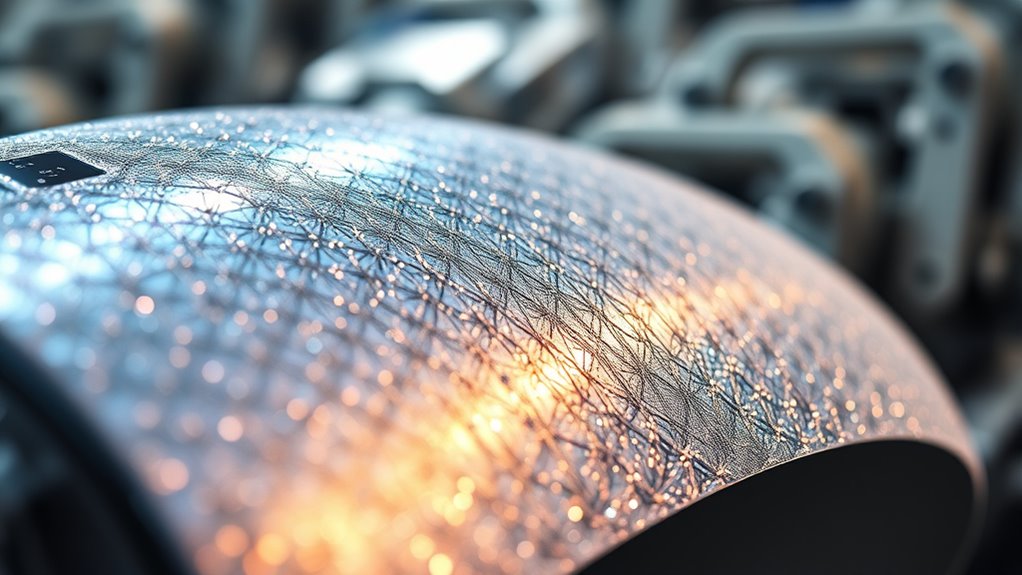
Have you ever wondered how tiny materials can revolutionize aerospace technology? The answer lies in the remarkable world of nano materials, which are transforming aircraft design by making structures lighter, stronger, and more efficient. Among these innovations, nano coatings and composite integration stand out as game-changers. You might not see these materials with the naked eye, but their impact is profound, enabling aircraft to perform better while consuming less fuel.
Nano coatings, in particular, are thin layers of nanomaterials applied to surfaces to enhance their properties. These coatings can provide protection against corrosion, reduce drag, and improve thermal resistance. Imagine your aircraft’s fuselage coated with a nano-thin layer that prevents oxidation without adding weight. This not only extends the lifespan of components but also improves overall performance. The beauty of nano coatings is their ability to deliver high-performance results without markedly increasing weight, which is vital in aerospace applications. They are an integral part of composite integration strategies, where multiple materials are combined at the nanoscale to create superior structures.
Nano coatings protect aircraft surfaces from corrosion, reduce drag, and boost thermal resistance without adding weight.
Composite integration involves embedding nano materials into traditional composite materials to unlock new levels of strength and durability. Think of it as upgrading your airplane’s structural elements with a blend of carbon fibers and nanomaterials like graphene or nanotubes. This integration produces composites that are lighter than metals but just as strong, if not stronger, and more resistant to fatigue and environmental stressors. When nano materials are seamlessly incorporated into composites, they enable the creation of ultra-light structures that maintain safety and stability while reducing weight. This reduction directly translates into fuel efficiency and lower emissions.
The synergy between nano coatings and composite integration allows you to design aircraft that are not only lighter but also more resilient against harsh environmental conditions, such as extreme temperatures and corrosive atmospheres. These advancements make maintenance easier and extend the service life of aerospace components. You’ll find that these nano-engineered materials also contribute to better heat dissipation and reduced aerodynamic drag, further improving flight efficiency. As a result, aerospace manufacturers can push the boundaries of aircraft performance, making flights longer, safer, and more economical.
In essence, nano coatings and composite integration are paving the way for a new era of ultra-light nanomaterials. Their combined capabilities enable you to build aircraft that are more innovative, sustainable, and efficient than ever before. This tiny revolution is transforming aerospace from the ground up, proving that small materials can have an outsized impact on the future of flight. Additionally, advancements in nanomaterial development continually enhance the properties and applications of these innovative materials, driving further progress in aerospace technology.

Aero Cosmetics Ceramic Wax Aircraft Grade Hybrid Multi-Polymer Ceramic Wax Long Lasting Hydrophobic UV Protection Advanced SiO2 Technology Superior Shine, Gloss, & Depth of Color
- Aircraft Grade Protection: Withstands extreme temperatures and speeds
- Advanced SiO2 Nano Technology: Provides long-lasting hydrophobic UV protection
- Easy to Use: Spray on and buff dry, alcohol-free
As an affiliate, we earn on qualifying purchases.
As an affiliate, we earn on qualifying purchases.
Frequently Asked Questions
How Do Ultra-Light Nanomaterials Impact Spacecraft Reentry Temperatures?
You’ll find that ultra-light nanomaterials help reduce spacecraft reentry temperatures by enhancing thermal insulation and heat dissipation. Their lightweight structure minimizes heat transfer, preventing overheating, while their high surface area allows for efficient heat dissipation. This combination ensures your spacecraft maintains safer temperatures during reentry, protecting sensitive equipment and improving overall safety. By leveraging these nanomaterials, you can optimize thermal management and achieve more reliable reentry performance.
What Are the Long-Term Durability Concerns of Nanomaterials in Space?
You should be aware that nanomaterial degradation over time poses a significant durability concern in space. Space radiation effects accelerate this degradation, weakening the material’s structure and performance. As you rely on nanomaterials for long-term missions, understanding how radiation impacts their integrity becomes vital. Continuous exposure may lead to deterioration, so developing protective measures and selecting radiation-resistant nanomaterials are essential to guarantee longevity and safety in space applications.
Can Nanomaterials Be Recycled or Reused After Aerospace Missions?
While nanomaterials’ reuse potential shows promise, recycling challenges remain significant. You might find that their delicate structures can be hard to recover intact after missions, making reuse complex. Nevertheless, ongoing research aims to develop more efficient recycling methods, which could eventually allow you to repurpose nanomaterials, reducing waste. For now, careful consideration of their lifecycle and innovative recycling techniques will help maximize their long-term value in aerospace applications.
How Do Nanomaterials Influence the Cost of Aerospace Manufacturing?
Nanomaterials influence aerospace manufacturing costs by enabling cost reduction and boosting manufacturing efficiency. Their lightweight properties reduce overall vehicle weight, which cuts fuel expenses and extends mission capabilities. Additionally, nanomaterials streamline production processes through enhanced strength and durability, decreasing maintenance and replacement costs. By integrating nanomaterials, you can achieve more efficient manufacturing, lower expenses, and improved performance, ultimately making aerospace projects more economically feasible and sustainable.
Are There Environmental Risks Associated With Nanomaterial Production?
You should know that nanomaterial production can pose environmental risks, such as environmental toxicity and resource depletion. When you manufacture nanomaterials, you might release toxic particles into ecosystems, harming wildlife and human health. Additionally, the process often consumes significant resources, contributing to resource depletion. It’s important to implement strict safety protocols and sustainable practices to minimize these environmental risks and protect our planet while advancing nanotechnology.

Advancements in Nanomaterials for Sustainable Aviation
As an affiliate, we earn on qualifying purchases.
As an affiliate, we earn on qualifying purchases.
Conclusion
As you explore the world of ultra-light nanomaterials for aerospace, you’ll find they’re gently guiding us toward a future that’s lighter, stronger, and more efficient. These tiny innovations quietly revolutionize how we imagine flight, making it feel almost effortless. With each step forward, you’re helping craft a journey that’s smoother and more sustainable. Embrace these advancements—they’re subtly shaping a sky where possibilities feel almost within reach, inviting you to dream bigger than ever before.
ultra-light nanocomposite aircraft parts
As an affiliate, we earn on qualifying purchases.
As an affiliate, we earn on qualifying purchases.

Nano Bond Ceramic Coating 9H PRO (30ML), Car, Plastic, Glass, and Wheel Exterior Care Product kit, Hydrophobic, Long Lasting Professional Care, High Gloss Paint Shine, Automotive Polishing Sio2
- Durable Paint Protection: Forms an 80% SiO2 protective layer
- Long-Lasting vs. Wax: Molecular bonding for extended protection
- Hydrophobic Water Repellency: Water and grime bead and roll off
As an affiliate, we earn on qualifying purchases.
As an affiliate, we earn on qualifying purchases.