For experiments that need remote environmental records, the Onset HOBO MX1104 stands out as the best overall pick for its temperature, humidity, light, and analog measurement options. The Elitech RCW-800W-TDE suits setups that need two external temperature probes and WiFi access, while the Kestrel DROP D3 offers a compact way to track temperature, humidity, and pressure. The main tradeoffs are measurement range, sensor placement, connection reliability, and whether you need continuous remote access or occasional Bluetooth downloads. A logger that fits the experiment’s sampling plan and environment matters more than a long feature list. Read on for the full comparison and guidance by use case.

Get the latest gadgets delivered free — and shop member deals
- Fast, free delivery on millions of items
- Access to Prime Big Deal Days deals on October 6–7
- Prime Video, Amazon Music and more included
Complete the kit


Key Takeaways
- Onset HOBO MX1104 covers the broadest measurement mix in this lineup, including light and analog input alongside temperature and humidity.
- Elitech RCW-800W-TDE is the clearest fit for experiments that need two external temperature probes and WiFi monitoring.
- Kestrel DROP D3 adds pressure measurement in a compact unit, while most alternatives focus on temperature and humidity.
- Bluetooth models such as the Elitech GSP-6 and HOBO MX1101 fit nearby sampling workflows; WiFi models make remote checks more practical.
- Frigga V5C is designed for single-use real-time monitoring, so it suits a bounded run better than a reusable long-term experiment.
| Temp Stick Remote WiFi Temperature and Humidity Sensor with Data Logging |  | Best for Long-Term Remote Monitoring | Connectivity: 2.4 GHz WiFi | Power: 2 AA batteries | Stated battery life: 1–2 years | VIEW ON AMAZON | See Our Full Breakdown |
| Lascar Electronics EL-WIFI-TH Wireless Temperature/Humidity Data Logger |  | Best for Local Readouts and WiFi Logging | Temperature range: 5 to 60 °C | Temperature accuracy: ±0.3 °C | Measurement resolution: 0.01 °C | VIEW ON AMAZON | See Our Full Breakdown |
| Elitech RCW-800W-TDE WiFi Temperature Data Logger with Dual External Probes | 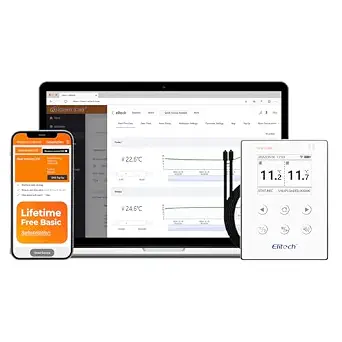 | Best for Dual-Point Temperature Experiments | Model: RCW-800W-TDE | Temperature range: −40 °F to 176 °F (−40 °C to 80 °C) | Temperature accuracy: 0.5 °C | VIEW ON AMAZON | See Our Full Breakdown |
| Elitech GSP-6 Dual Probe Bluetooth Temperature & Humidity Data Logger |  | Best for Regulated Cold-Chain Work | Temperature range: −40 to 185 (unit not specified in supplied product data) | Humidity range: 10% to 99% RH | Connectivity: Bluetooth | VIEW ON AMAZON | See Our Full Breakdown |
| Kestrel DROP D3 Wireless Temperature, Humidity, and Pressure Data Logger |  | Best Compact Logger for Outdoor Conditions | Connectivity: Bluetooth | Compatibility: iOS and Android devices | Waterproof: Yes | VIEW ON AMAZON | See Our Full Breakdown |
| Onset HOBO MX1104 Bluetooth Analog, Temperature, Humidity, and Light Data Logger | 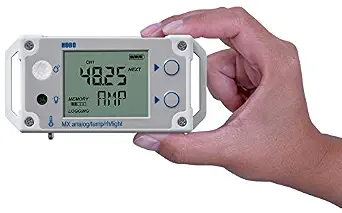 | Best for Multi-Variable Experiments | Measurements: Temperature, relative humidity, and light intensity | External input: Analog input for additional sensors | Wireless: Bluetooth Low Energy; 100-foot range | VIEW ON AMAZON | See Our Full Breakdown |
| Tempo Disc Mini Bluetooth Wireless Thermometer and Temperature Data Logger |  | Best Compact Logger | Temperature range: -30°C to +85°C | Accuracy: ±0.4°C | Dimensions: 30 × 30 × 10 mm | VIEW ON AMAZON | See Our Full Breakdown |
| YOWEXA Bluetooth Temperature and Humidity Data Logger with App, 500,000-Point Capacity |  | Best for Display-Led Lab Monitoring | Temperature range: -40°C to 125°C | Temperature accuracy: ±0.2°C from 0–65°C; ±0.5°C in other ranges | Humidity range: 0–100% RH | VIEW ON AMAZON | See Our Full Breakdown |
| Frigga V5C Single-Use Real-Time Temperature and Humidity Data Logger |  | Best for Shipment Experiments | Connectivity: 4G/5G with 2G fallback | Battery life: Up to 60 days at 1-hour upload intervals | Data points: 28,800 | VIEW ON AMAZON | See Our Full Breakdown |
| HOBO by Onset MX1101 Temperature and Relative Humidity Data Logger |  | Best for Straightforward Reusable Monitoring | Temperature range: -20°C to 70°C | Temperature accuracy: ±0.21°C from 0°C to 50°C | Relative humidity range: 1–90% RH, non-condensing | VIEW ON AMAZON | See Our Full Breakdown |
| wireless data loggers for experiment | Temperature range | Connectivity | Temperature accuracy |
|---|---|---|---|
| Temp Stick Remote WiFi Tempera | — | 2.4 GHz WiFi | — |
| Lascar Electronics EL-WIFI-TH | 5 to 60 °C | — | ±0.3 °C |
| Elitech RCW-800W-TDE WiFi Temp | −40 °F to 176 °F (−40 °C to 80 °C) | WiFi | 0.5 °C |
| Elitech GSP-6 Dual Probe Bluet | −40 to 185 (unit not specified in supplied product data) | Bluetooth | — |
| Kestrel DROP D3 Wireless Tempe | — | Bluetooth | — |
| Onset HOBO MX1104 Bluetooth An | — | — | — |
| Tempo Disc Mini Bluetooth Wire | -30°C to +85°C | — | — |
| YOWEXA Bluetooth Temperature a | -40°C to 125°C | Bluetooth and USB | ±0.2°C from 0–65°C; ±0.5°C in other ranges |
| Frigga V5C Single-Use Real-Tim | -30°C to 70°C | 4G/5G with 2G fallback | ±0.5°C from -20°C to 40°C; ±1°C outside that range |
| HOBO by Onset MX1101 Temperatu | -20°C to 70°C | — | ±0.21°C from 0°C to 50°C |
More Details on Our Top Picks
Temp Stick Remote WiFi Temperature and Humidity Sensor with Data Logging
The Temp Stick suits experiments where remote alerts and long unattended runs matter more than probe placement. It sends temperature and humidity readings over 2.4 GHz WiFi, and its stated battery life of 1–2 years can reduce interruptions during a long study. If the connection drops, it keeps data for up to a month and uploads it after reconnecting, giving it a stronger offline buffer than a setup that depends on continuous access. Compared with the Elitech RCW-800W-TDE, it uses replaceable AA batteries and offers longer stated battery life, while the Elitech provides dual external probes and a wider temperature range. The Temp Stick’s 2.4 GHz requirement and restriction against public or guest WiFi can rule it out in shared labs. It also lacks the external probes offered by several experiment-focused alternatives.
Pros:- App, email, and unlimited text alerts support remote monitoring.
- Stores readings offline for up to a month and uploads them after reconnection.
- Uses two AA batteries with a stated 1–2 year battery life.
- Does not require a subscription or gateway.
Cons:- Works on 2.4 GHz WiFi only and is not suitable for public or guest networks.
- The listed upper temperature limit is 140 °F.
- No external probes are listed for positioning sensors separately from the main unit.
Best for: Researchers monitoring a stable room, incubator area, or storage space who need remote alerts and long battery intervals on a compatible private WiFi network.
Not ideal for: Lab teams using public or guest WiFi, or experiments that require dual external probes or temperatures above 140 °F.
- Connectivity:2.4 GHz WiFi
- Power:2 AA batteries
- Stated battery life:1–2 years
- Upper temperature range:140 °F
- Temperature reading accuracy:±0.1 °C
- Offline data storage:Up to 1 month
- Dimensions:3.5 in W × 1.25 in H
- Compatibility:Alexa, IFTTT
Our verdict“Choose the Temp Stick for long-running room or storage experiments that need remote alerts and have access to a compatible private WiFi network.”
Lascar Electronics EL-WIFI-TH Wireless Temperature/Humidity Data Logger
The EL-WIFI-TH combines live WiFi logging with a readable local display, a useful pairing when experimenters want to check conditions at the logger as well as from a host PC or the EasyLog cloud. Its LCD shows current readings, min/max values, and signal strength, while onboard memory retains data through temporary WiFi outages. Compared with the Temp Stick, Lascar makes more of the local readout and includes a rechargeable battery, USB cable, and wall bracket; the Temp Stick instead has a longer stated battery life and a month of offline storage. The Lascar’s 5–60 °C range limits experiments at colder or hotter conditions, and its supplied software compatibility is dated to Windows XP, Vista, and 7. The display also rounds more coarsely than the logger’s measurement resolution, so fine changes are not visible on the screen.
Pros:- Streams readings to a host PC or EasyLog cloud through a standard WiFi router.
- LCD shows local readings, min/max values, and signal strength.
- Onboard memory retains readings during temporary WiFi loss.
- Includes a rechargeable battery, micro USB cable, and wall bracket.
Cons:- Temperature range is limited to 5–60 °C.
- Listed software compatibility covers Windows XP, Vista, and 7.
- The 0.5 °C display resolution is coarser than the 0.01 °C measurement resolution.
Best for: Researchers who want a visible local min/max readout alongside WiFi access to room or equipment temperature and humidity logs.
Not ideal for: Labs running below 5 °C or above 60 °C, or teams that need documented software compatibility with current operating systems.
- Temperature range:5 to 60 °C
- Temperature accuracy:±0.3 °C
- Measurement resolution:0.01 °C
- Display resolution:0.5 °C
- Wireless standard:802.11b (WEP, WPA/WPA2-PSK)
- Mounting:Tabletop; wall bracket included
- Software:Free downloadable EasyLog software
Our verdict“Pick the Lascar when a local display and standard-router WiFi logging matter more than broad temperature coverage or modern listed software support.”
Elitech RCW-800W-TDE WiFi Temperature Data Logger with Dual External Probes
With two external temperature probes and a range from −40 °F to 176 °F, the RCW-800W-TDE is the clearest fit here when an experiment needs readings from two locations or a broader temperature span. WiFi cloud uploads pair with SMS, email, app, web, audible, and visual alarms, giving teams several ways to respond when readings stray from limits. That makes it more adaptable for probe-based work than the Temp Stick, which focuses on a single sensor location and long battery intervals. In exchange, Elitech’s stated backup battery operation is at least seven days only under specified conditions: 25 °C and five-minute upload intervals. Remote alerts and cloud uploads also depend on WiFi. Its 0.5 °C accuracy may be less suitable than a tighter tolerance requires, so buyers should match it to their experiment’s measurement criteria.
Pros:- Dual external probes allow monitoring at two locations.
- −40 °F to 176 °F range covers a broad span of experimental conditions.
- Offers cloud uploads and SMS, email, app, web, audible, and visual alarms.
- Rechargeable battery supports at least seven days after power failure under stated conditions.
Cons:- Backup duration depends on temperature and upload interval.
- WiFi is required for cloud uploads and remote alerts.
- Listed temperature accuracy is 0.5 °C.
Best for: Researchers monitoring two temperature points, such as separate positions in equipment or a controlled environment, who want cloud logs and multiple alarm channels.
Not ideal for: Experiments requiring humidity readings, sub-0.5 °C accuracy, or dependable remote alerts without WiFi.
- Model:RCW-800W-TDE
- Temperature range:−40 °F to 176 °F (−40 °C to 80 °C)
- Temperature accuracy:0.5 °C
- Probes:Dual external temperature probes
- Connectivity:WiFi
- Alerts:SMS, email, app, web, audible, and visual
- Backup battery:Rechargeable lithium; at least 7 days at 25 °C with 5-minute upload intervals
- Operating humidity:10–90%
Our verdict“Choose the RCW-800W-TDE for WiFi-connected experiments that need two temperature probe locations and a wide operating range.”
Elitech GSP-6 Dual Probe Bluetooth Temperature & Humidity Data Logger
The GSP-6 is aimed at experiments where temperature and humidity records need a compliance-oriented workflow. It includes two external sensors, a calibration certificate, and a large LCD for current and max/min values; the listed CDC/VFC and FDA 21 CFR Part 11 requirements make it more specialized than the general-purpose Kestrel DROP D3. Battery and USB power give labs more than one way to keep it running, and its built-in magnet helps position the logger without relying on a shelf. The tradeoff is a less direct setup process: advanced settings require Elitechlog software, and the single-button interface may slow configuration. The supplied data gives temperature and humidity ranges but no accuracy figures, so teams with tight measurement tolerances should confirm those before choosing it.
Pros:- Includes two external sensors and a calibration certificate.
- Listed for CDC/VFC and FDA 21 CFR Part 11 requirements.
- Battery and USB dual power support flexible placement and operation.
- Large LCD displays current and max/min values, with magnetic mounting.
Cons:- Advanced settings require downloading Elitechlog software.
- Single-button interface may limit convenient configuration.
- Provided product data does not specify temperature or humidity accuracy.
Best for: Pharmaceutical, vaccine, or cold-chain teams that need dual external temperature and humidity sensing with compliance-related documentation.
Not ideal for: Researchers who need quick phone-based setup, stated accuracy figures for specification matching, or logging that does not depend on Elitechlog for advanced settings.
- Temperature range:−40 to 185 (unit not specified in supplied product data)
- Humidity range:10% to 99% RH
- Connectivity:Bluetooth
- Probes:Two external sensors included
- Power:Battery and USB
- Display:Large LCD with current and MAX/MIN values
- Software:Elitechlog, free download
- Compliance:CDC/VFC and FDA 21 CFR Part 11 requirements
Our verdict“Choose the GSP-6 for documented cold-chain monitoring with dual probes, provided its software-led setup and unspecified accuracy figures fit your protocol.”
Kestrel DROP D3 Wireless Temperature, Humidity, and Pressure Data Logger
The DROP D3 earns its place through rugged, waterproof logging across several environmental measures. Alongside temperature and humidity, it tracks heat index, dew point, station pressure, density altitude, and pressure trends, which can help experiments where ambient conditions affect results. Its compact design, integrated D-ring, and storage for thousands of points suit field placement better than the more display-focused Lascar EL-WIFI-TH. Bluetooth links it to iOS or Android devices for viewing, saving, and sharing data, but that connection model does not provide the cloud uploads and remote alarm options described for the Lascar or RCW-800W-TDE. Product details also give no measurement accuracy, sampling interval, or battery information, leaving important protocol-fit questions unanswered. It makes the most sense when portability and weather resistance outweigh those missing specifics.
Pros:- Tracks temperature, humidity, heat index, dew point, station pressure, density altitude, and pressure trend.
- Waterproof construction supports wet or outdoor environments.
- Stores thousands of data points.
- Bluetooth works with iOS and Android devices for viewing, saving, and sharing data.
Cons:- Product data does not state measurement accuracy or sampling interval.
- No cloud uploads or remote alarm functions are listed.
- Battery type and battery life are not specified in the supplied data.
Best for: Field researchers who need a compact, waterproof logger for temperature, humidity, and related atmospheric conditions, with Bluetooth access from a phone or tablet.
Not ideal for: Lab teams that require specified accuracy, cloud-based remote alarms, or a documented sampling interval and battery life before selecting equipment.
- Connectivity:Bluetooth
- Compatibility:iOS and Android devices
- Waterproof:Yes
- Data storage:Thousands of data points
- Tracked measurements:Temperature, humidity, heat index, dew point, station pressure, density altitude, and pressure trend
- Mounting:Integrated D-ring
- Color:Blue
Our verdict“Pick the DROP D3 for portable, waterproof field experiments that benefit from several atmospheric measurements and can work with Bluetooth-based data access.”
Onset HOBO MX1104 Bluetooth Analog, Temperature, Humidity, and Light Data Logger
The MX1104 fits experiments that need temperature, humidity, and light in one logger, with an analog input for an additional sensor. That flexibility gives it a wider role than the HOBO MX1101, which records only temperature and relative humidity. Its 1.9 million measurement capacity can support long runs or frequent sampling without regular downloads, while 16-bit resolution preserves fine measurement steps. Setup and data access happen through HOBOmobile on iOS over Bluetooth, within a stated 100-foot range. The tradeoff is that this workflow is less accommodating for Android-only teams, and Bluetooth requires someone to be within range to collect data. I’d choose it for multi-sensor bench experiments; for simpler temperature and humidity monitoring, the smaller MX1101 is more focused.
Pros:- Combines temperature, relative humidity, and light measurements
- Analog input allows connection to additional sensors
- Stores up to 1.9 million measurements
- Self-describing sensors support automatic configuration
Cons:- HOBOmobile app compatibility is specified for iOS
- Bluetooth data access is limited to a stated 100-foot range
Best for: Research teams running long experiments that need light plus temperature and humidity, or an analog sensor input.
Not ideal for: Android-only labs or teams needing remote monitoring beyond Bluetooth range.
- Measurements:Temperature, relative humidity, and light intensity
- External input:Analog input for additional sensors
- Wireless:Bluetooth Low Energy; 100-foot range
- Storage:Up to 1.9 million measurements
- Resolution:16-bit
- App:HOBOmobile for iOS
- Dimensions:4.44 × 2.13 × 1.15 inches
Our verdict“Choose the MX1104 when an experiment needs several measurement types and large onboard storage in one logger.”
Tempo Disc Mini Bluetooth Wireless Thermometer and Temperature Data Logger
For experiments where sensor placement is tight, the Tempo Disc’s 30 × 30 × 10 mm body is easier to tuck into a small enclosure or storage space than the larger YOWEXA YDP-20EB-E. It records temperature across -30°C to 85°C, sends readings to iOS or Android phones over Bluetooth, and keeps up to 250 days of data onboard. That mix suits monitoring runs where frequent phone contact is inconvenient, while CSV export supports later analysis. The logger is temperature-only, though, so it cannot replace the YOWEXA when humidity is part of the experiment. Its stated Bluetooth range depends on clear line of sight and can shrink around obstacles; it also needs a Bluetooth-enabled phone for access. I’d pick it for compact temperature logging, not multi-variable lab work.
Pros:- Compact 30 × 30 × 10 mm form fits confined locations
- Stores up to 250 days of temperature data
- CSV export supports analysis outside the app
- Supports simultaneous users on iOS and Android
Cons:- Measures temperature only
- Bluetooth range can drop substantially when obstacles block line of sight
- Requires a Bluetooth-enabled smartphone for use
Best for: Researchers monitoring temperature in small spaces who want long onboard retention and phone access on iOS or Android.
Not ideal for: Experiments requiring humidity or other sensor channels, or teams needing dependable connectivity through walls and equipment.
- Temperature range:-30°C to +85°C
- Accuracy:±0.4°C
- Dimensions:30 × 30 × 10 mm
- Weight:8 g
- Bluetooth range:Up to 225–270 feet in clear line of sight
- Onboard storage:Up to 250 days / 8 months
- Battery:Replaceable CR2032; up to 1-year life
Our verdict“Choose the Tempo Disc for unobtrusive, long-running temperature monitoring in a confined space.”
YOWEXA Bluetooth Temperature and Humidity Data Logger with App, 500,000-Point Capacity
The YOWEXA is suited to experiments where staff need to check conditions at the instrument as well as export records afterward. Its backlit 4-inch display shows readings locally, and the external probe measures both temperature and humidity across broad stated ranges. Compared with the Tempo Disc Mini, it takes up more space but adds humidity measurement, USB connectivity, and multiple report formats. The logger stores up to 500,000 groups, though the supplied data notes a workflow distinction: automatic export provides summary information, while detailed tables require PoChain software. That software setup adds friction before analysis can begin. Battery or USB power gives more placement choices, but the 13-ounce unit is less discreet than a compact logger. I’d favor it where a visible display and dual-variable readings matter more than a lightweight, simple setup.
Pros:- Measures temperature and humidity with an external probe
- Backlit 4-inch display supports at-instrument checks
- USB and Bluetooth connectivity with battery or USB power
- Exports reports in PDF, XLS, TXT, CSV, and DLG formats
Cons:- Detailed data tables require PoChain software
- Automatic export provides summary information at the stated 500,000-group capacity
- Setup through PoChain is required after battery installation
Best for: Lab staff who need visible temperature and humidity readings at the instrument and can use PoChain for detailed data handling.
Not ideal for: Researchers seeking a pocket-sized logger or straightforward detailed exports without dedicated software.
- Temperature range:-40°C to 125°C
- Temperature accuracy:±0.2°C from 0–65°C; ±0.5°C in other ranges
- Humidity range:0–100% RH
- Humidity accuracy:±3% RH from 10–90% RH at 25°C; ±4% in other ranges
- Data capacity:Up to 500,000 groups
- Connectivity:Bluetooth and USB
- Power:3 AAA batteries or USB; stated battery life up to 1 year
Our verdict“Choose the YOWEXA when a large readable display and temperature-plus-humidity measurements outweigh software setup needs.”
Frigga V5C Single-Use Real-Time Temperature and Humidity Data Logger
The Frigga V5C serves a different experimental problem from the reusable HOBO MX1101: it follows a shipment and records conditions across its route. Its 4G/5G connectivity with 2G fallback sends data to the cloud, while the logger also tracks light, location, and shock alongside temperature and humidity. That broader record can help researchers investigate handling events, not just final environmental conditions. It holds 28,800 data points and is rated for up to 60 days at hourly uploads, making it a fit for bounded transport studies. The central tradeoff is its single-use design, which makes it unsuitable as a continuing lab instrument. Accuracy also varies outside specified temperature and humidity bands. Compared with the MX1101’s Bluetooth-based reusable monitoring, the Frigga adds route visibility but gives up reuse and local experimental flexibility.
Pros:- Tracks temperature, humidity, light, location, and shock
- Cellular connectivity uploads records to the cloud
- USB PDF reports provide a downloadable record
- LCD shows current, maximum, and minimum temperatures
Cons:- Single-use design limits it to one shipment or deployment
- Battery life is stated up to 60 days at hourly upload intervals
- Measurement accuracy decreases outside specified ranges
Best for: Teams studying cold-chain, pharmaceutical, food, or laboratory shipments that need cloud records of route and handling conditions.
Not ideal for: Labs seeking a reusable logger for repeated bench experiments or long-term continuous monitoring.
- Connectivity:4G/5G with 2G fallback
- Battery life:Up to 60 days at 1-hour upload intervals
- Data points:28,800
- Temperature range:-30°C to 70°C
- Temperature accuracy:±0.5°C from -20°C to 40°C; ±1°C outside that range
- Humidity range:5–95% RH
- Use:Single-use
Our verdict“Choose the Frigga V5C for shipment-focused experiments that need remote route and handling data in a single-use logger.”
HOBO by Onset MX1101 Temperature and Relative Humidity Data Logger
The MX1101 is the more focused HOBO choice for experiments that need just temperature and relative humidity. It records up to 84,650 measurements and shows current readings and logger status on its LCD, while Bluetooth access through HOBOmobile supports setup, graphs, alarms, and sharing on iOS or Android. Compared with the feature-rich MX1104, it gives up light measurement, an analog input, and much larger storage; in return, it offers a simpler two-variable setup and a stated one-year battery life at a one-minute interval. Its 100-foot Bluetooth range means data access still requires proximity, and humidity accuracy is specified as typical within 20–80% RH, with reduced accuracy beyond that band. I’d choose it for repeatable ambient monitoring, not experiments that depend on extra channels or remote uploads.
Pros:- Measures temperature and relative humidity in one logger
- LCD shows readings and logger status
- HOBOmobile supports setup, graphs, alarms, and data sharing
- Replaceable AAA batteries with stated one-year typical life at a 1-minute interval
Cons:- Stores up to 84,650 measurements, far less than the MX1104
- Bluetooth range is limited to up to 100 feet
- Humidity accuracy decreases outside the 20–80% RH range
Best for: Researchers who need a reusable temperature-and-humidity logger with a local display and iOS or Android access.
Not ideal for: Multi-variable experiments needing light or analog sensor input, or remote monitoring without nearby Bluetooth access.
- Temperature range:-20°C to 70°C
- Temperature accuracy:±0.21°C from 0°C to 50°C
- Relative humidity range:1–90% RH, non-condensing
- Relative humidity accuracy:±2% typical from 20–80% RH
- Memory:128 KB; up to 84,650 measurements
- Wireless:Bluetooth Low Energy; up to 100-foot range
- Battery:Two user-replaceable AAA alkaline batteries
Our verdict“Choose the MX1101 for reusable, two-variable ambient experiments where an LCD and mobile graphs are enough.”

How We Picked
I ranked these loggers by how well their measurement capabilities, connectivity, and form factor serve real experimental workflows. I gave more weight to sensor coverage and placement flexibility when those features could answer a wider range of research questions, then considered whether WiFi, Bluetooth, or single-use operation matched the likely monitoring routine. Data capacity and app access matter, but they do not compensate for a logger that cannot measure the needed variable or reach the sample location.
The order reflects the breadth of useful experimental setups each product appears suited to, with narrower devices placed where their specialization is valuable. The HOBO MX1104 leads for its wider input set; the dual-probe Elitech leads among focused WiFi temperature monitors. Compact Bluetooth units and high-capacity models can be better fits for particular sampling plans, while the single-use Frigga serves a different, finite-run need. Buyers should confirm accuracy, calibration support, sampling interval, operating range, and data export details against the manufacturer’s documentation before choosing.
Factors to Consider When Choosing Wireless Data Loggers For Experiments
Before choosing a logger, work backward from the experiment: define what must be measured, where the sensors need to sit, and how quickly you must know when conditions change. Those decisions shape whether broader sensor inputs, remote access, or a simple download workflow will help most.
Match the measured variables to the research question
Start by listing the environmental variables that could affect your result, including any that are easy to overlook, such as light exposure or pressure. A temperature and humidity logger cannot answer a question about illumination, and adding a separate instrument can complicate synchronization. Multi-input models may reduce that burden, but only if their inputs support the sensor type and range your study requires. Avoid buying based on the number of listed channels alone; check whether each channel measures a relevant quantity. Also compare stated accuracy and resolution with the size of the changes your experiment needs to detect. If the expected difference is close to the logger’s stated uncertainty, a broader feature set will not fix the measurement gap.
Plan sensor placement before choosing the enclosure
The logger’s body may not belong beside the sample: its size, heat, or exposure to moisture can affect readings or interfere with the setup. External probes help when you need the recording unit outside a chamber or when two locations must be compared. A self-contained logger can be simpler for a small incubator or field enclosure, but access to its controls and radio signal may be limited once it is installed. Sketch the sensor locations and cable routes before ordering, including how you will secure probes without changing airflow or contact conditions. Check the probe’s cable length and environmental rating, not only the logger’s. A device that fits the measurement location poorly can produce less useful data than a simpler logger placed correctly.
Choose connectivity around the monitoring routine
WiFi can support remote checks and alerts, which helps when a failed condition needs a quick response. It also depends on network access at the experiment site and on software that can receive and export the records. Bluetooth is often a better fit when a researcher can visit the logger and download data nearby; it avoids relying on continuous network coverage. Wireless does not mean the logger can communicate through every chamber wall, refrigerator, or field obstruction, so check the actual installation path. Decide how often anyone must see the readings, rather than treating remote access as an automatic benefit. For an experiment where a missed alarm could invalidate a run, verify alert behavior and connection recovery before deployment.
Set logging interval and retention from the experiment timeline
A fast sampling interval can capture brief fluctuations, but it also fills memory sooner and may increase the frequency of downloads or battery changes. A slow interval preserves capacity but can miss short events that matter to the hypothesis. Estimate the run length and sample interval together, then leave room for setup checks and delays. Compare advertised point capacity with the number of channels being logged, since multi-variable recording can change how quickly storage is consumed. Decide whether you need a live feed, a complete record after the run, or both. Before a long experiment, run a short trial to confirm the selected interval, storage behavior, and timestamp handling match your plan.
Check calibration, power, and data handling
Experimental records are only useful if you can explain how the measurements were produced and retrieve them later. Check whether calibration certificates, recalibration services, or documented accuracy over time are available for the model. Battery life depends on the sampling and communication pattern, so published runtime figures may not match a setup that sends frequent updates. Confirm how the app exports data and whether files preserve timestamps, units, and channel labels in a format your analysis tools can read. Keep a plan for clock synchronization, battery replacement, and file backup before the first run. These workflow details can matter more over a semester-long study than a small difference in headline storage capacity.
Decide when a specialized or single-use logger makes sense
Specialized designs can simplify an experiment when their limits line up with a bounded task. A single-use unit may suit a one-way shipment or a run where retrieving and reusing the logger is impractical, but it is a poor match for repeated laboratory studies that need consistent equipment. Compact units reduce setup clutter and can fit multiple locations, while small enclosures may offer fewer sensor options or less accessible controls. A premium multi-input logger makes sense when it replaces separate instruments or supports several planned protocols. For a narrow study with one temperature threshold to track, that breadth may add expense and configuration work without improving the result. Tie the choice to the whole study lifecycle, from installation through data export and equipment reuse.
Frequently Asked Questions
Should I choose WiFi or Bluetooth for a logger inside a lab incubator?
Choose based on how quickly you need to see a change and whether the logger can maintain a connection from its installed position. WiFi favors remote checks, but incubator walls, network restrictions, and signal interruptions can limit access. Bluetooth is suitable when you can retrieve records nearby and the experiment does not require remote alerts. Test the connection with the logger in its final position and the incubator closed. For either type, confirm that data continues to record if the wireless link drops.
Can one logger track conditions at two different points in my experiment?
Only if its supported sensors and inputs match the variables and locations you need to compare. A dual-probe temperature logger can compare two temperature points, but it does not automatically provide two independent humidity readings. Check whether the device records each probe as a separate channel and whether the software labels those channels clearly. Also account for probe cable length and the possibility that running a cable changes airflow or chamber sealing. If the locations are far apart, separate synchronized loggers may be easier to place and interpret.
How do I know whether a logger’s accuracy is sufficient for my experiment?
Compare the manufacturer’s stated accuracy with the smallest difference your experiment needs to distinguish, across the actual operating range. Resolution describes the smallest displayed increment, but it does not guarantee that the reading is that accurate. Look for calibration documentation and confirm whether the specifications apply to the probe as well as the logger body. If your study depends on small changes, compare candidate devices against a traceable reference before collecting research data. Record calibration dates and any corrections as part of the experiment record.
Is a high-capacity logger the right choice for a long experiment?
Capacity helps only when it covers the planned sampling interval, number of channels, and run duration. Estimate the total readings for the full study and include setup time, repeated runs, and any faster sampling needed during critical phases. Then check battery life and whether data can be retrieved without interrupting the experiment. A high point count cannot protect a run from depleted batteries, a failed sensor, or gaps caused by clock or export problems. A short pilot run can reveal those issues before the main study begins.
When is a single-use wireless logger a better fit than a reusable model?
A single-use logger can make sense for a finite trip or monitoring task where returning the device for another run is difficult. It may reduce the need to recover equipment, but it is less suited to repeated experiments that benefit from consistent setup and calibration history. Check how readings are accessed after the run and whether the wireless service remains available along the route or at the destination. For laboratory work, compare the cost and waste of repeated disposables with the maintenance needs of a reusable unit. The choice depends on recovery logistics as much as on the measured variable.
Conclusion
I would choose the Onset HOBO MX1104 as the best overall when an experiment benefits from temperature, humidity, light, and analog measurement in one system. The Elitech RCW-800W-TDE is my best fit for dual-point WiFi temperature monitoring, while the YOWEXA logger is a value-oriented option for buyers who prioritize its stated 500,000-point capacity and Bluetooth app workflow. For beginners, the Temp Stick offers a straightforward WiFi-centered approach to temperature and humidity monitoring; check that its network and software requirements fit the site. Choose the Kestrel DROP D3 for compact temperature, humidity, and pressure logging, or the Frigga V5C for a defined single-use monitoring run. Match your final choice to the measurement variables, placement, and data recovery plan your experiment actually requires.
Fall Picks
fall essentials
As an affiliate, we earn on qualifying purchases.