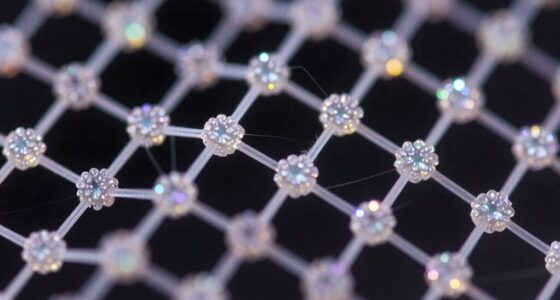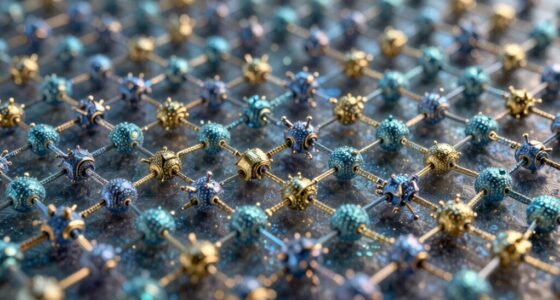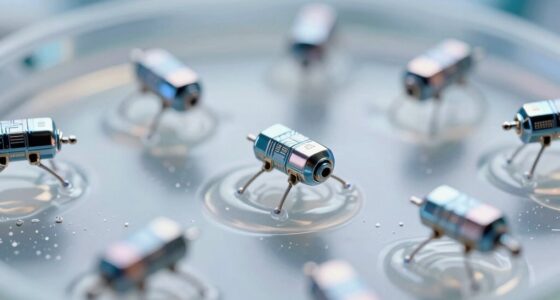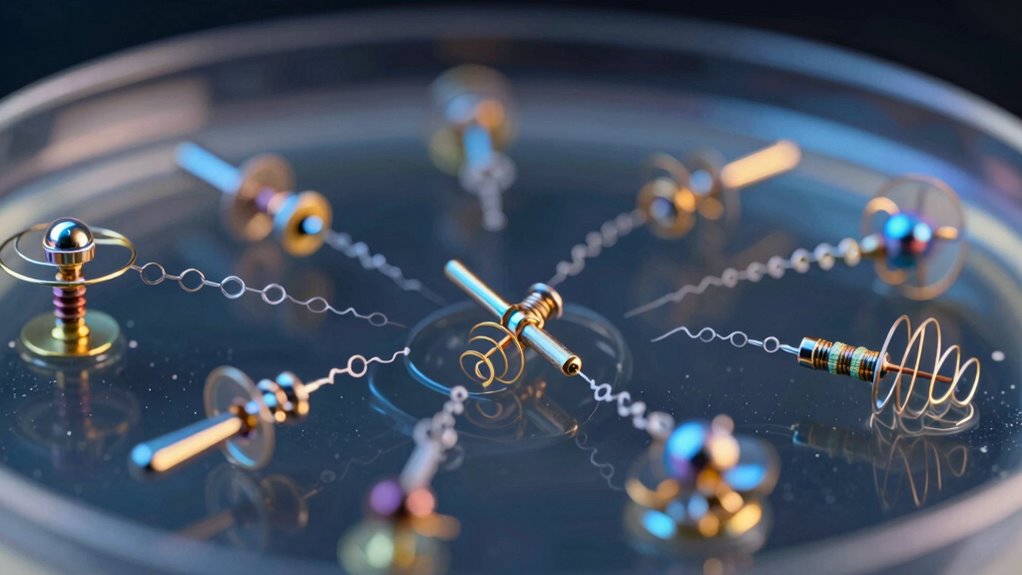

Nanomotors are tiny engines that turn energy into controlled movement at the nanoscale, using forces like chemical reactions, light, or magnetic fields. They rely on designing asymmetric structures to break symmetry and produce propulsion, overcoming challenges like Brownian motion. Materials like gold, platinum, and nanocomposites help them operate efficiently. By understanding how these miniature engines work, you’ll discover the amazing science behind their potential and how they’re transforming medicine and technology.
Listen free for 30 days with Audible
Thousands of audiobooks and originals — cancel anytime.
As an affiliate, we earn on qualifying purchases.
Key Takeaways
- Nanomotors are molecular-scale machines converting energy into motion through mechanisms like catalytic reactions, light, or magnetic fields.
- They rely on symmetry breaking and surface interactions to generate directed movement at the nanoscale.
- Propulsion methods include bubble generation, self-electrophoresis, and photothermal effects, often using catalytic or responsive materials.
- External stimuli such as light, ultrasound, or magnetic fields guide and control nanomotor movement in complex environments.
- Applications range from targeted drug delivery to environmental sensing, with ongoing innovations enhancing their capabilities.
As an affiliate, we earn on qualifying purchases.
What Are Nanomotors and Why Are They Important?

Have you ever wondered how tiny devices can move and perform tasks at the molecular level? That’s where nanomotors come in. These are molecular-sized machines that convert energy into motion, generating forces in the piconewton range. They operate in environments with low Reynolds numbers, meaning they need special mechanisms, like symmetry breaking, to move effectively. Nanomotors are essential because they can navigate complex biological fluids, making them ideal for targeted drug delivery, precise diagnostics, and other biomedical applications. Their ability to operate autonomously or respond to external stimuli opens new possibilities in medicine and nanotechnology. Understanding their mechanisms helps us grasp how they mimic natural biological motors, pushing the boundaries of what tiny devices can achieve, transforming science and healthcare at the smallest scales. Additionally, advancements in biomimicry guide the development of these innovative nanomachines. Exploring energy conversion at the nanoscale further enhances our understanding of their potential capabilities.
As an affiliate, we earn on qualifying purchases.
The Fundamentals of Nanoscale Movement

At the nanoscale, forces operate on piconewton levels, making movement highly sensitive to tiny interactions. Because of the low Reynolds numbers, nanomotors must break symmetry to generate directed motion, as simple reciprocal movements cancel out. Understanding these scale-dependent forces and symmetry-breaking is essential to controlling nanoscale movement effectively. Additionally, investigating regulatory factors can help optimize nanomotor performance. Since the behavior of nanomotors can be influenced by ear wax odor, understanding environmental factors can further enhance their efficiency. Furthermore, scaling laws govern how forces and movement behaviors change at the nanoscale, providing insights into designing more effective nanomotors. Recognizing the influence of solar energy on nanoscale systems can also inform innovative energy harnessing techniques for nanotechnology applications. Moreover, exploring energy transfer mechanisms can lead to breakthroughs in nanomotor efficiency and power sources.
Scale-Dependent Forces
Understanding scale-dependent forces is essential when studying nanomotors because the physical laws governing their movement differ markedly from macroscale systems. At this tiny scale, you face unique challenges and behaviors. Surface forces dominate over gravity, meaning interactions at the nanosurface drive motion more than weight. Brownian motion causes constant, random jostling, making directed movement a challenge. Low Reynolds number indicates viscous forces outweigh inertial forces, requiring non-reciprocal motion to generate propulsion. Electrostatic and chemical interactions become more significant, enabling mechanisms like self-electrophoresis or catalytic bubble formation. Additionally, visual cues can assist in understanding and designing nanomotor mechanisms. These forces shape how nanomotors convert energy into movement, demanding innovative designs to harness these scale-dependent effects effectively. For instance, understanding the fluid dynamics at this scale is crucial to optimize propulsion strategies.
Symmetry Breaking Necessity
In nanoscale environments, the physics that govern motion differ substantially from those at larger scales. You need to disrupt symmetry because, at this tiny scale, reciprocal motions produce no net movement due to low Reynolds numbers. Without symmetry breaking, your nanomotor would just oscillate without progressing. Nature and engineers solve this by creating asymmetric structures or applying external stimuli that favor one direction over another. For example, catalytic reactions or uneven surface properties generate localized forces, nudging the motor forward. This asymmetry ensures that energy input results in a directed, efficient motion. Fundamentally, breaking symmetry is what transforms random fluctuations and reversible motions into purposeful, unidirectional movement—crucial for nanomotors to perform tasks effectively in complex microenvironments.
As an affiliate, we earn on qualifying purchases.
How Do Nanomotors Generate Power?

Nanomotors generate power by converting various forms of energy into mechanical motion through nanoscale reactions and physical processes. You can think of it like a tiny engine transforming energy into movement. Here’s how they do it:
- Chemical reactions: Catalysts like platinum decompose fuels such as hydrogen peroxide, producing oxygen bubbles that push the nanomotor forward. Nanomotor efficiency depends on optimizing these catalytic processes. Advances in catalyst design have further enhanced energy conversion rates. Additionally, researchers are exploring reaction kinetics to improve the speed and effectiveness of these chemical processes.
- Electrophoresis: Local electric fields created by ionic gradients propel the motor without external guidance. Advances in electrokinetic techniques have improved control over nanomotor movement.
- Bubble propulsion: Catalytic reactions generate bubbles that expand and burst, driving the nanomotor in liquids.
- Photothermal effects: Asymmetrical platinum structures absorb light, creating heat that causes movement via thermal gradients.
- Heritage of innovation: The development of nanomotors is influenced by advancements in material science, enabling more efficient energy conversion mechanisms.
These mechanisms allow nanomotors to harness energy efficiently at tiny scales.
As an affiliate, we earn on qualifying purchases.
The Role of Materials in Nanomotor Design
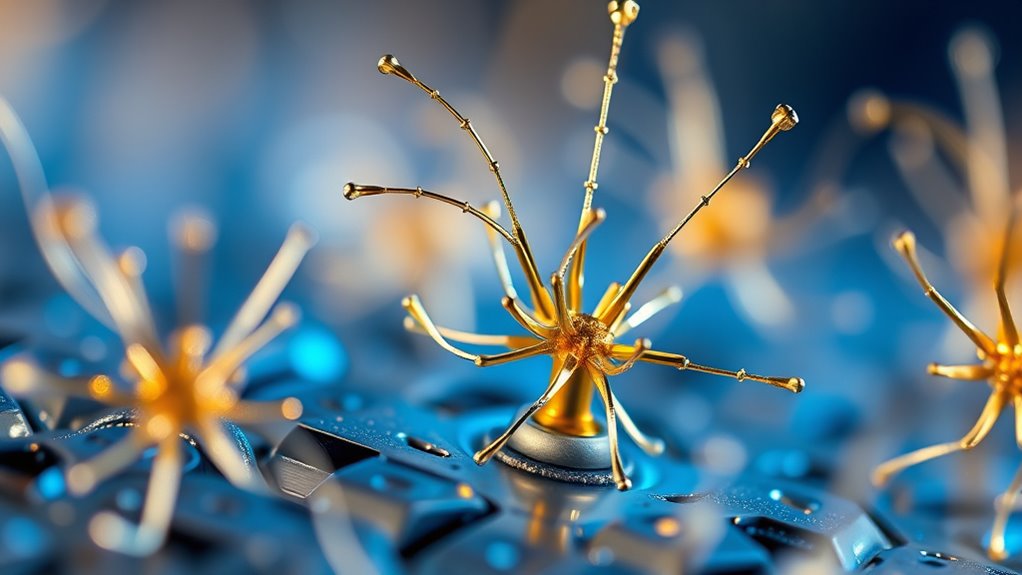
What materials are essential for designing effective nanomotors? You need materials that facilitate catalytic reactions, maneuverability, and biocompatibility. Metallic nanomaterials like gold and platinum are vital because they catalyze hydrogen peroxide decomposition and generate bubbles for propulsion. Bimetallic structures, such as Au-Pt, enhance efficiency, especially when combined with carbon nanotubes for strength and conductivity. Nonmetallic nanocomplexes, enzymes, and even living cells can drive movement, offering versatility in different environments. Silver halide and silver-platinum composites use halide fuels, which are regenerable through light, increasing sustainability. Additionally, materials like S-NaX with platinum provide selectivity for specific ions like Cs+. The right combination of these materials ensures your nanomotor can move reliably, efficiently, and safely in its intended application. Material selection is crucial for optimizing performance and ensuring compatibility with various environments. Furthermore, advances in material engineering continue to expand the possibilities for nanomotor functionality and application scope.
Mechanisms Behind Nanomotor Propulsion

You should explore the various propulsion techniques nanomotors use to move through fluids, from chemical reactions to external fields. These energy sources, like catalytic fuels or light, enable nanomotors to generate motion in low Reynolds number environments. Understanding how these mechanisms operate helps you grasp the diverse strategies behind nanomotor propulsion. Energy conversion methods play a crucial role in powering these tiny engines effectively. For example, self-propulsion mechanisms often utilize asymmetric surface properties to convert chemical energy directly into movement. Additionally, researchers are investigating alternative propulsion strategies, such as magnetic or acoustic actuation, to expand the versatility of nanomotor functions. Advances in nanoengineering are opening new possibilities for customizing propulsion techniques to suit specific applications.
Propulsion Techniques Used
To achieve movement at the nanoscale, researchers employ a variety of propulsion mechanisms that convert different energy sources into motion. First, self-electrophoresis generates local electric fields, propelling nanomotors without external guidance. Second, bubble-induced propulsion relies on catalytic reactions, like hydrogen peroxide decomposition, creating oxygen bubbles that push the motor forward. Third, chemical propulsion transforms fuels into motion, often using platinum to catalyze reactions efficiently. Fourth, external physical fields, such as magnetic, electric, or optical forces, directly actuate nanomotors, guiding their movement precisely. These techniques leverage unique nanomaterial properties and energy interactions, enabling controlled, efficient propulsion despite the challenges posed by low Reynolds numbers and Brownian motion.
Energy Sources Explored
Nanomotors harness a variety of energy sources to generate motion, each leveraging specific mechanisms at the nanoscale. Some use chemical fuels like hydrogen peroxide, which catalyzes bubble formation for thrust. Others rely on external fields—magnetic, electric, or optical—to guide their movement. Photothermal conversion, especially with platinum asymmetry, transforms light into motion. Self-electrophoresis generates local electric fields internally, eliminating external guidance. Bubble propulsion results from catalytic reactions in microtubes. Here’s a visual breakdown:
| Energy Source | Mechanism |
|---|---|
| Chemical fuels | Catalysis creates bubbles or chemical gradients |
| External fields | Magnetic, electric, or optical actuation |
| Photothermal | Light energy heats and moves nanostructures |
| Self-electrophoresis | Internal electric fields drive motion |
| Catalytic reactions | Fuel decomposes, producing thrust |
Overcoming Challenges in Nanoscale Navigation

Controlling nanoscale environments presents significant challenges due to the dominance of microfluidic forces and Brownian motion, which can disrupt directed movement and reduce efficiency. To overcome this, you need to:
Controlling nanoscale environments requires overcoming microfluidic forces and Brownian motion for effective guidance.
- Break symmetry with non-reciprocal motion, ensuring propulsion isn’t canceled out.
- Use materials or designs that minimize the effects of random particle movements.
- Employ external stimuli like light or magnetic fields for precise guidance.
- Develop control strategies that adapt to fluid flow and environmental changes.
- Incorporate study techniques and exam preparation to optimize experimental design and data interpretation. Additionally, understanding nanoscale dynamics can help in designing more effective nanomotors and improve experimental accuracy in measurements.
Innovative Features Enhancing Nanomotor Functionality

You can enhance nanomotor performance by incorporating multi-stimuli responsiveness, allowing them to change direction based on chemical or ultrasound signals. Adaptive navigation techniques enable precise control in complex environments, even amid fluid flow or obstacles. Light-driven propulsion methods offer chemical-free activation, harnessing photocatalysis for efficient, clean movement.
Multi-Stimuli Responsiveness
Multi-stimuli responsiveness is a cutting-edge feature that substantially enhances nanomotor functionality by enabling dynamic control over their movement and behavior. You can manipulate nanomotors by applying different stimuli, making them adaptable in complex environments. Here’s what this means for you:
- You can switch directions or alter speed by changing chemical fuels, allowing precise navigation.
- Ultrasound waves can activate or deactivate nanomotors, offering remote control.
- Temperature-sensitive polymers respond to heat, enabling regulation of motor activity.
- Light exposure can propel nanomotors without chemicals, using photocatalytic effects.
This versatility helps nanomotors perform tasks like targeted drug delivery and environmental sensing, adapting seamlessly to various conditions and requirements.
Adaptive Navigation Techniques
Adaptive navigation techniques empower nanomotors to modify their movement strategies in real-time, enabling precise operation within complex and dynamic environments. You can program these tiny engines to respond to chemical signals, temperature shifts, or acoustic cues, adjusting their direction or speed accordingly. This responsiveness allows nanomotors to navigate through crowded biological fluids or microchannels efficiently, avoiding obstacles and targeting specific sites. By integrating sensors and smart materials, they detect local conditions and adapt on the fly, ensuring ideal performance. These techniques also facilitate targeted delivery, as nanomotors can steer toward chemical gradients or stimuli, enhancing their effectiveness. Overall, adaptive navigation elevates nanomotors from simple movers to intelligent agents capable of complex, context-aware actions.
Light-Driven Propulsion Methods
Light-driven propulsion methods harness visible or near-infrared light to power nanomotors without relying on chemical fuels, offering a cleaner and more controllable means of movement. You can visualize this as:
- Photocatalysis: Light activates catalysts like platinum, causing chemical reactions that generate motion.
- Asymmetrical Nanostructures: Designs such as stomatocytes use light to induce localized heating or pressure differences.
- Smart Polymers: Temperature-sensitive materials change shape or properties under light, controlling movement.
- Light Absorption: Nanomaterials like gold or silver absorb light, converting it into thermal or mechanical energy to propel the motor.
These methods enable precise, reversible control over nanomotor activity, making them ideal for biomedical and microfluidic applications. Light offers a non-invasive, efficient power source that enhances nanomotor versatility.
Applications of Nanomotors in Medicine and Technology

Nanomotors are transforming medicine and technology by enabling precise, active manipulation at the microscopic level. In medicine, you can use nanomotors to deliver drugs directly to targeted cells, reducing side effects and increasing effectiveness. They can navigate complex biological environments, transport cargo, and perform microsurgeries with high accuracy. In technology, nanomotors power tiny devices for environmental sensing, pollutant removal, and data collection. They operate in liquids and biological fluids without relying on static electrostatic forces, making them versatile tools. Their ability to respond to stimuli like chemical fuels, light, or ultrasound allows you to control their movement precisely. As a result, nanomotors open new frontiers for minimally invasive treatments and innovative nanotechnologies that adapt to their surroundings seamlessly.
Future Perspectives and Emerging Trends

As research advances, the future of nanomotor technology hinges on integrating multifunctional capabilities and improving control mechanisms. You can expect developments like:
- Combining sensing and actuation to create smart nanomotors that adapt to their environment.
- Enhancing energy efficiency through new propulsion methods, reducing reliance on toxic fuels.
- Developing precise navigation systems, enabling targeted delivery in complex biological systems.
- Incorporating stimuli-responsive materials for better control via chemical, optical, or thermal triggers.
These trends aim to make nanomotors more versatile, safer, and easier to deploy across various fields. Future innovations will likely focus on seamless integration with existing technologies and smart functionalities. Such progress will enable broader applications, transforming how we approach medicine, manufacturing, and environmental monitoring.
Exploring the Impact of Nanomotors on Scientific Advancement

Advancements in nanomotor technology are already transforming scientific research across multiple disciplines. You now have tools capable of steering complex biological environments, enabling targeted drug delivery, minimally invasive surgeries, and precise diagnostics. In materials science, nanomotors facilitate the development of self-healing materials and responsive systems, pushing innovation further. Your ability to manipulate forces at the piconewton scale allows for detailed studies of molecular interactions and cellular behaviors, accelerating discoveries in biophysics and biochemistry. Additionally, nanomotors open new avenues in environmental sensing, allowing real-time monitoring of pollutants or toxins. As you harness their potential, you’ll see a ripple effect across medicine, engineering, and environmental science, fundamentally changing how scientists approach problem-solving and technological innovation.
Frequently Asked Questions
How Do Nanomotors Interact With Complex Biological Environments?
You’ll find nanomotors interact with complex biological environments through their ability to adapt and respond to stimuli like chemical fuels, temperature, or light. They can transport cargo, navigate fluids, and function without relying on electrostatic interactions. By harnessing smart polymers and multi-stimuli responses, you enable nanomotors to operate efficiently in vivo, overcoming challenges like Brownian motion and microfluidic dynamics, making them ideal for precise biomedical applications.
What Safety Concerns Exist for Nanomotor Applications in Vivo?
Think of nanomotors as tiny explorers with a risky journey ahead. You should be aware of potential toxicity from fuels like hydrogen peroxide and metallic materials that might harm tissues. There’s also the chance of immune reactions or inflammation. Controlling their movement precisely is challenging, which could lead to unintended tissue damage. Ensuring biocompatibility and safe clearance from the body remains essential before widespread in vivo applications.
Can Nanomotors Operate Effectively in Highly Viscous Fluids?
You can make nanomotors operate effectively in highly viscous fluids by designing them with adaptable propulsion mechanisms, like chemical or photothermal methods. Using materials such as platinum or enzyme-based systems helps generate enough force to overcome viscosity. Incorporating multi-stimuli responses and smart polymers also allows you to regulate movement, ensuring they work efficiently despite the resistance in viscous environments. Proper geometry and fuel choices further enhance their mobility.
How Is the Energy Efficiency of Nanomotors Measured?
You measure the energy efficiency of nanomotors by comparing the useful work they perform to the energy input. Think of it like evaluating a car’s miles per gallon; you look at how much movement or cargo transport the nanomotor achieves versus how much fuel or energy it consumes. Researchers often analyze parameters like propulsion force, speed, and energy loss to determine how well these tiny engines convert energy into motion.
What Are the Ethical Implications of Deploying Nanomotors in Medicine?
You should consider that deploying nanomotors in medicine raises ethical concerns like safety, privacy, and informed consent. You must guarantee they don’t cause unintended harm or environmental damage. Transparency about their risks and benefits is essential. You also need to address potential misuse, such as unauthorized control or data collection. As you develop these technologies, prioritize regulation and ethical guidelines to protect patients and society.
Conclusion
Nanomotors are revolutionizing science, with researchers developing over 200 different types so far. These tiny engines could transform medicine, electronics, and environmental tech. Imagine, by 2030, nanomotors might perform billions of tasks inside your body, improving health and diagnostics. As you explore their potential, remember that these microscopic engines hold the power to reshape our future—proving that even the smallest innovations can make the biggest impact.
Evergreen bestsellers Picks
bestsellers
As an affiliate, we earn on qualifying purchases.