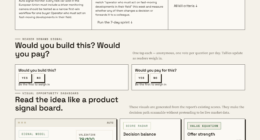

📊 Full opportunity report: China: The Visible Hand on ThorstenMeyerAI.com — validation score, market gap, and execution plan.

Get the latest gadgets delivered free — and shop member deals
- Fast, free delivery on millions of items
- Access to Prime Big Deal Days deals on October 6–7
- Prime Video, Amazon Music and more included
TL;DR
China is implementing a highly centralized, state-led approach to AI and industrial development, prioritizing strategic sectors through plans like ‘AI+’ and ‘Robot+’. The government owns much of the capital and guides innovation, but the role of private firms remains significant. The impact on global tech leadership and domestic inequality is still unfolding.
China’s government is actively directing its AI and robotics sectors through a series of strategic plans, notably the ‘AI+’ and ‘Robot+’ campaigns, emphasizing state ownership and top-down coordination. This approach marks a decisive shift from market-driven innovation to a centralized, state-led model, with significant implications for global technology competition and domestic inequality.
According to analysis from Thorsten Meyer, China’s party-state employs a ‘visible hand’ to direct technological and industrial development, owning large parts of the capital through state-owned enterprises and state banks. The 15th Five-Year Plan (2026-2030) prioritizes AI, robotics, and supply chain security, with specific campaigns mobilizing provincial and municipal levels to meet national targets.
While private companies like DeepSeek and Alibaba lead frontier breakthroughs in AI, the state’s role primarily involves funding, regulation, and ownership, rather than direct invention. For more on this, see the growing AI power gap. The strategy leverages existing industrial strengths—such as manufacturing—and aims to control social stability through regulation, especially over AI and algorithms. The model’s strength lies in swift, coordinated action, but it also creates significant gaps, notably in social safety nets and rural-urban inequality, which remain under-addressed.
The Visible Hand
Where the US bets on the market’s invisible hand, China bets on the visible one: the party-state directs the transition by plan — owns the capital, names the strategic tracks — strong where the state acts, thin where the individual stands.
Independent commentary, produced with AI assistance under human editorial oversight. The views are the author’s own and may change. This is analysis, not policy, economic, investment, or legal advice. Descriptions of “common prosperity,” dibao, the hukou system, the 15th Five-Year Plan, “AI+”/”Robot+,” DeepSeek, and China’s robotics and state-ownership landscape reflect publicly reported information as of mid-2026 and may change; figures are indicative and several are contested estimates. This phase maps differing approaches and endorses none; characterizations of contested political, economic, and labor arrangements are factual and analytical, present competing views, not a verdict, and are not partisan. Country, program, and company names are referenced for analysis and imply no affiliation.
Impacts of State-Led AI and Industrial Strategy
This approach demonstrates China’s capacity for rapid, coordinated technological advancement, contrasting with more market-driven models. It underscores the potential for state-controlled innovation to challenge Western dominance in AI and robotics, while also highlighting risks of increased social inequality and reduced individual rights. The global tech landscape could see shifts as China consolidates its lead in strategic sectors, affecting international competition and supply chains.
As an affiliate, we earn on qualifying purchases.
China’s Strategic Industrial and AI Development Timeline
China’s emphasis on state-led development dates back decades, but recent initiatives like ‘AI+’ and ‘Robot+’ reflect a deliberate acceleration of strategic sectors. The 14th Five-Year Plan laid groundwork, with the 15th plan emphasizing physical AI applications and supply chain security. Private firms have contributed significantly to breakthroughs, especially in AI hardware and software, often supported by state funding and regulation. The approach is a response to US chip controls and technological restrictions, aiming to build independence and influence.
“The central claim behind China’s approach is real: a determined party-state can mobilize capital, compute, and industrial policy toward a chosen goal with a coherence and speed that market democracies struggle to match.”
— Thorsten Meyer
robotics engineering kits for students
As an affiliate, we earn on qualifying purchases.
As an affiliate, we earn on qualifying purchases.
Unclear Aspects of China’s Strategic AI Model
While the overall framework is clear, the extent of private sector influence within the ‘open model’ strategy, and how effectively the state manages social inequality and rural-urban divides, remain uncertain. The impact of ongoing regulatory controls and the actual economic returns from state-owned investments are still being evaluated.
As an affiliate, we earn on qualifying purchases.
Monitoring will focus on implementation of the 15th Five-Year Plan, particularly how effectively the state mobilizes private innovation, manages social disparities, and maintains technological leadership. International responses and shifts in global supply chains are also anticipated as China’s strategy unfolds.
As an affiliate, we earn on qualifying purchases.
Key Questions
How much of China’s AI development is driven by private companies?
Private firms like DeepSeek and Alibaba lead technological breakthroughs, supported by state funding and regulation. The government’s role is mainly in funding, regulation, and ownership, not direct invention.
What are the main risks of China’s state-led approach?
Potential risks include increased social inequality, reduced innovation diversity, and dependency on state-controlled sectors, which could hamper long-term adaptability and global competitiveness.
How does China’s strategy compare to Western market-driven models?
China emphasizes direct state ownership and planning, enabling rapid, coordinated development, contrasting with Western reliance on market competition and private sector innovation.
Will this approach affect global AI leadership?
Yes, China’s focus on strategic sectors and state-led innovation could allow it to challenge US dominance in AI and robotics, reshaping international technological power balances.
Source: ThorstenMeyerAI.com
Fall Picks
fall essentials
As an affiliate, we earn on qualifying purchases.