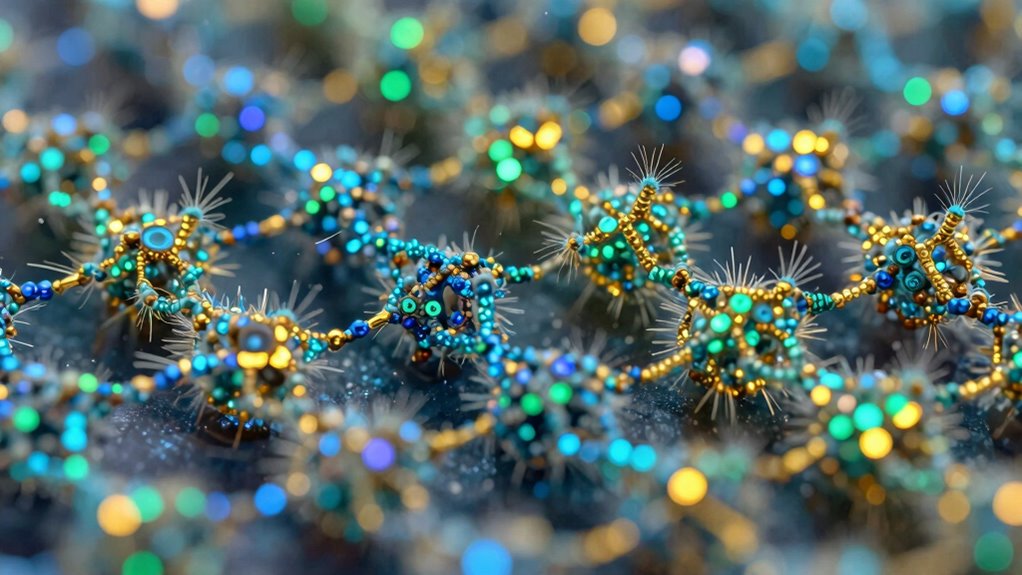

To tune nanomaterials for better selectivity, you can modify their surface chemistry by attaching specific ligands or functional groups that target your molecules of interest, preventing non-specific interactions. Additionally, controlling pore sizes during synthesis guarantees only certain molecules can pass or bind, providing physical discrimination. Combining these strategies creates a highly selective environment, improving sensing and separation performance. Keep exploring how these approaches work together to open even more effective nanomaterial applications.

Get the latest gadgets delivered free — and shop member deals
- Fast, free delivery on millions of items
- Access to Prime Big Deal Days deals on October 6–7
- Prime Video, Amazon Music and more included
Key Takeaways
- Surface modification with functional groups or ligands creates selective binding sites for target analytes.
- Adjusting pore size controls molecular size exclusion, enhancing physical discrimination.
- Combining surface chemistry and pore size tuning yields highly specific nanomaterials.
- Fine-tuning surface properties and pore dimensions balances chemical and physical selectivity.
- Application of these strategies improves detection accuracy in biomedical, environmental, and chemical systems.

Nanomaterials have revolutionized the field of selective detection and separation by offering unprecedented control at the molecular level. This control allows you to fine-tune materials to target specific molecules, making processes more efficient and accurate. One of the key strategies to achieve this level of precision involves surface modification. By altering the surface chemistry of nanomaterials, you can enhance their affinity for particular analytes, reduce nonspecific interactions, and improve overall selectivity. For example, attaching specific functional groups or ligands to the surface can create selective binding sites tailored to target molecules. This customization means you can design nanomaterials that recognize and capture only the molecules you’re interested in, even in complex mixtures.
Alongside surface modification, pore size optimization plays a critical role in enhancing selectivity. By controlling the pore size within nanomaterials, you effectively set a physical filter that only allows molecules of certain sizes to pass through or bind. If your target analyte is larger than the pores, it gets excluded, while smaller molecules are free to interact with the interior surface. Conversely, if you want to trap larger molecules, you can engineer the pores to match their size precisely. This level of control is especially useful in separation processes where you need to discriminate based on molecular dimensions. You can adjust pore sizes during synthesis or through post-synthesis modifications, ensuring that the nanomaterials perform with high specificity for your application.
Combining surface modification with pore size optimization provides a powerful toolkit for tailoring nanomaterials for enhanced selectivity. When you modify the surface to include specific chemical functionalities, and simultaneously optimize pore sizes to fit your target molecules, you create a highly selective environment. This dual approach minimizes interference from unwanted substances and maximizes binding efficiency for the analytes of interest. Furthermore, it allows you to develop sensors and separation systems that are both highly sensitive and specific, which is essential for applications in biomedical diagnostics, environmental monitoring, and chemical analysis.
In essence, tuning nanomaterials for better selectivity involves a precise balance between chemical and physical modifications. Surface modification gives you chemical specificity, while pore size optimization ensures physical discrimination. Achieving this balance relies on an understanding of nanomaterial properties and their influence on selectivity. By mastering these techniques, you can design nanomaterials that perform complex recognition tasks with ease, pushing the boundaries of what’s possible in detection and separation technologies.
nanomaterial surface modification kits
As an affiliate, we earn on qualifying purchases.
As an affiliate, we earn on qualifying purchases.
Frequently Asked Questions
How Do Environmental Factors Influence Nanomaterial Selectivity?
Environmental factors considerably influence nanomaterial selectivity by affecting surface modification and environmental stability. When you expose nanomaterials to humidity, temperature changes, or chemicals, their surface properties can alter, impacting their ability to target specific molecules. Proper surface modification enhances stability against these factors, ensuring consistent selectivity. To optimize performance, you need to tailor nanomaterials considering these environmental influences, maintaining their functionality in real-world conditions.
Can Nanomaterials Be Reused Without Losing Selectivity?
You can reuse nanomaterials without losing their selectivity by applying surface modification and functionalization techniques. Studies show that properly treated nanomaterials retain over 90% of their initial selectivity after multiple uses. These techniques enhance stability and prevent fouling, guaranteeing consistent performance. With careful surface treatment, you guarantee nanomaterials remain effective, making them a sustainable choice for repeated applications without sacrificing their ability to target specific molecules.
What Are the Safety Concerns of Tuning Nanomaterials?
Tuning nanomaterials raises safety concerns, mainly involving toxicity assessment and regulatory challenges. You need to carefully evaluate potential health and environmental impacts through thorough toxicity tests. Regulatory frameworks may lag behind technological advances, making it harder to guarantee safe use. As you develop new nanomaterials, stay aware of these issues and work closely with regulatory bodies to address safety and compliance, minimizing risks to users and ecosystems.
How Scalable Are These Tuning Techniques for Industrial Use?
Scaling these tuning techniques for industrial use presents significant challenges, including scaling challenges and cost considerations. You’ll find that laboratory methods often struggle to translate directly to large-scale production due to complexity, consistency, and resource demands. Overcoming these hurdles requires innovative approaches, streamlining processes, and reducing costs, so you can effectively implement nanomaterial tuning on an industrial level without sacrificing precision or safety.
Do Different Nanomaterials Require Unique Tuning Methods?
Yes, different nanomaterials often need unique tuning methods. You can accomplish this through surface modification to alter their chemical interactions, or electronic adjustment to change their conductivity and response. For example, metal nanoparticles might require specific surface coatings, while carbon-based nanomaterials benefit from electronic tuning. Tailoring these methods to each nanomaterial guarantees better selectivity for your application, maximizing efficiency and performance.
molecular size exclusion filters
As an affiliate, we earn on qualifying purchases.
As an affiliate, we earn on qualifying purchases.
Conclusion
By tuning nanomaterials, you can make them as precise as a skilled watchmaker, targeting specific molecules with ease. This customization enables better selectivity, reducing unwanted interactions and increasing efficiency. As you harness these tiny materials, you’ll find your applications become more accurate and reliable, like a laser pointer cutting through darkness. Embrace the potential of nanomaterials, and watch your innovations shine brighter with each tailored adjustment you make.
nanoporous materials for separation
As an affiliate, we earn on qualifying purchases.
As an affiliate, we earn on qualifying purchases.
As an affiliate, we earn on qualifying purchases.
Fall Picks
fall essentials
As an affiliate, we earn on qualifying purchases.