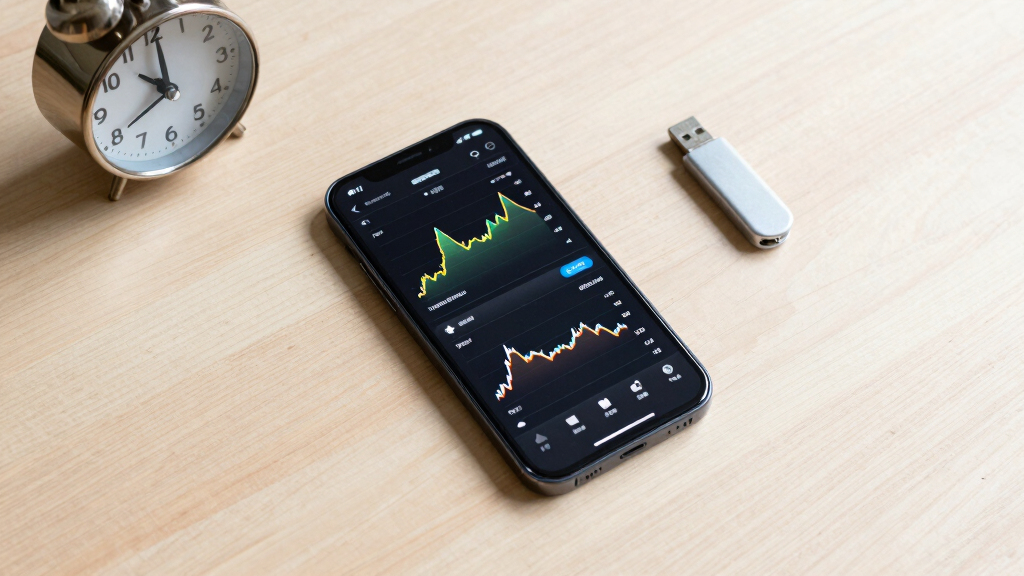

📊 Full opportunity report: Week Three — Foundation model vs Brownian motion. Kronos on five-minute BTC. on ThorstenMeyerAI.com — validation score, market gap, and execution plan.
Get ready for Prime Big Deal Days — try Prime free
Exclusive member deals on October 6–7, plus fast free delivery. Cancel anytime.
Start your free trialAs an affiliate, we earn on qualifying purchases.
TL;DR
A recent test comparing Kronos, a foundation model, to a Brownian motion baseline for 5-minute Bitcoin predictions found no statistically significant advantage. The experiment used historical trade data and out-of-sample testing to evaluate predictive accuracy.
Recent testing shows that Kronos, an open-source foundation model, does not outperform a traditional Brownian motion baseline in predicting 5-minute Bitcoin price movements on historical data.
Researchers compared Kronos-small, a 24.7 million-parameter model trained on global exchange data, against a geometric Brownian motion model used by a trading bot in a simulated environment. The evaluation involved 497 trades, with out-of-sample testing on the last 249 trades to ensure no overfitting. The results indicated that Kronos’s predictive performance, measured by Brier score and log-loss, was statistically indistinguishable from Brownian motion. Specifically, on the out-of-sample data, the Brier score difference was only 0.0011, well within the margin of noise, meaning Kronos did not demonstrate a meaningful advantage over the traditional model.
Implications for Using AI Models in Short-Term Crypto Trading
This finding suggests that, at least for 5-minute BTC predictions, modern foundation models like Kronos do not yet provide a reliable edge over classical stochastic models. It raises questions about the practical benefits of deploying complex AI models in high-frequency trading environments and highlights the importance of rigorous out-of-sample testing. For traders and developers, this underscores that more sophisticated models may not automatically translate into better trading signals, especially when market behavior remains largely unpredictable at such short horizons.
As an affiliate, we earn on qualifying purchases.
Background on Model Testing and Market Predictions
Previous efforts to improve short-term crypto trading have often relied on geometric Brownian motion as a baseline, due to its mathematical simplicity and historical use in financial modeling. The recent surge in foundation models trained on large datasets has generated optimism about their potential to outperform traditional methods. However, initial tests, including those by the author of this study, have shown that many so-called ‘edges’ are often mechanical artifacts that do not hold up in out-of-sample testing. This latest experiment builds on that work by directly comparing a state-of-the-art foundation model against a classical stochastic baseline in a real-world, simulated trading scenario.
“Kronos, despite its advanced training, does not outperform the Brownian baseline in predicting 5-minute BTC price movements on out-of-sample data.”
— Thorsten Meyer, researcher
As an affiliate, we earn on qualifying purchases.
Uncertainties in Model Performance and Market Dynamics
While the current results show no significant outperformance, it remains unclear whether different model sizes, training data, or market conditions could yield different results. The test was limited to a specific model checkpoint and a particular trading horizon. Additionally, the inherent unpredictability of short-term crypto price movements means that even the best models may struggle to consistently outperform simple stochastic baselines in live trading environments. Further research is needed to explore these variables and assess whether future model improvements could change the outcome.
short-term crypto trading software
As an affiliate, we earn on qualifying purchases.
As an affiliate, we earn on qualifying purchases.
Next Steps for Model Evaluation and Trading Strategies
Future work may involve testing larger or more diverse foundation models, experimenting with different training datasets, or extending the evaluation to longer or different trading horizons. Researchers and traders might also explore hybrid approaches that combine traditional stochastic models with learned features. Additionally, real-time live testing could provide insights into how these models perform under actual market conditions, beyond historical simulation. The current findings suggest caution in assuming that advanced AI models automatically translate into better trading signals at short timeframes.
As an affiliate, we earn on qualifying purchases.
Key Questions
Does this mean foundation models are useless for crypto trading?
No, the current study indicates they do not outperform traditional models in this specific setting. Future developments and different conditions might yield different results.
Could larger or more complex models perform better?
This remains an open question. Larger models or those trained on different data might show improved performance, but this has not yet been demonstrated convincingly in this context.
Is short-term BTC prediction fundamentally impossible?
Not necessarily; the high volatility and market noise make short-term prediction challenging. Even the best models may only achieve limited predictive power, especially at five-minute intervals.
What are the implications for traders using AI models?
Traders should be cautious about assuming AI models will automatically improve short-term trading outcomes. Rigorous out-of-sample testing remains essential.
Source: ThorstenMeyerAI.com
Evergreen bestsellers Picks
bestsellers
As an affiliate, we earn on qualifying purchases.