
TL;DR

Get the latest gadgets delivered free with Prime
- Fast, free delivery on millions of items
- Prime Video, Amazon Music and more included
- Member-only deals all year
IdeaClyst acts as a digital war room for founders, offering a structured space for idea validation, debate, and planning. It combines AI-driven insights with local-first data, ensuring your ideas stay yours while accelerating decision-making.
Ever sat in front of three promising ideas and felt the weight of indecision? That knot in your stomach is familiar. The truth is, the hardest part of launching isn’t building; it’s picking the right idea and sticking with it.
Imagine having a space—digital or physical—that turns chaos into clarity. A place where your ideas get tested, debated, and refined, all while staying safely on your own device. That’s what IdeaClyst offers: a digital war room tailored for founders who want confidence, speed, and control.
A war room for your next idea
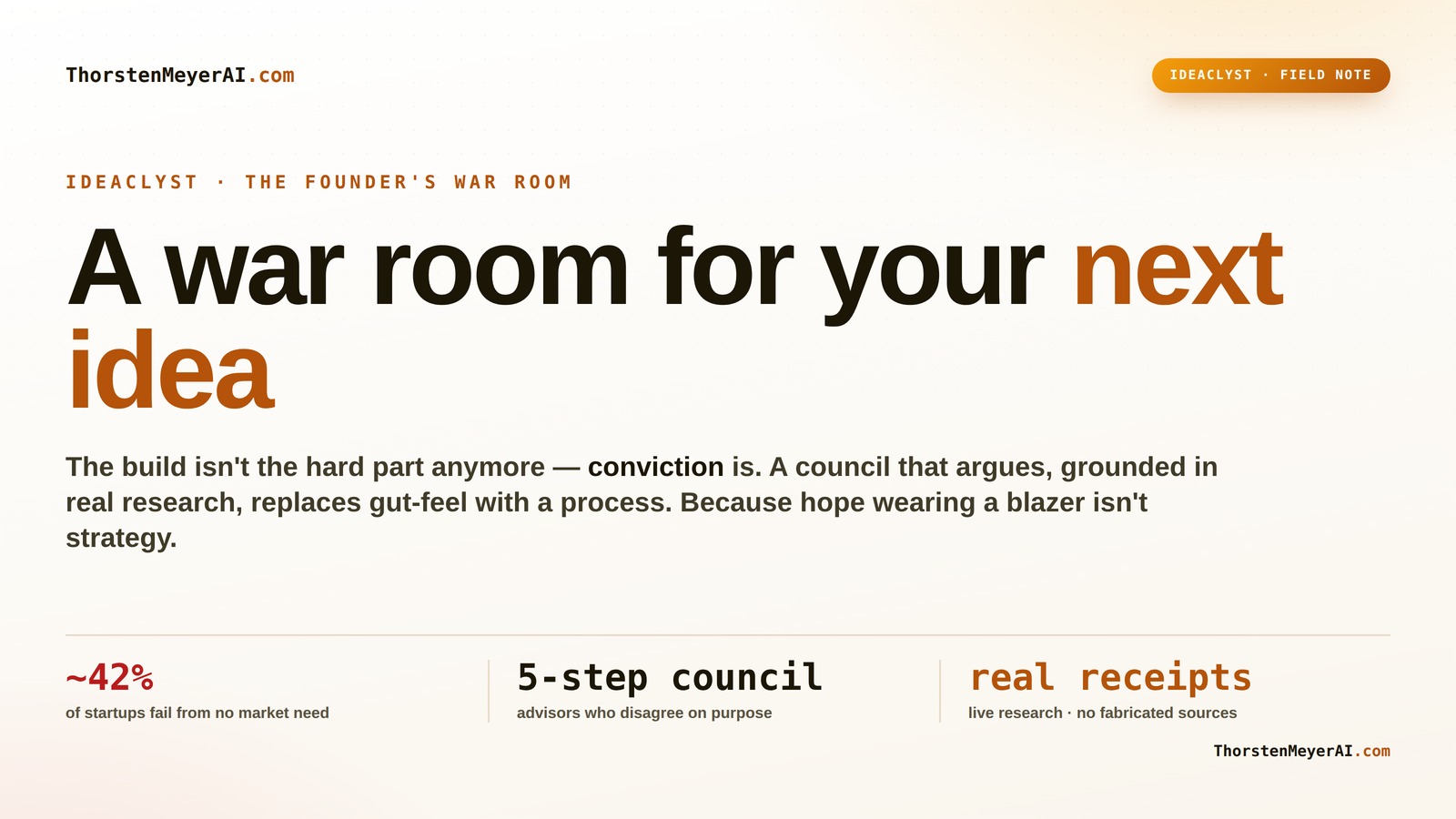
The build isn’t the hard part anymore — conviction is. Knowing which idea deserves the next six months, and being able to defend it. Most founders answer with gut feel and optimistic math. That’s hope wearing a blazer. IdeaClyst replaces it with a process.
The most expensive decision is what to build
The single most valuable thing a tool can do is talk you out of the wrong six months. The numbers make the case better than any pitch.
Three tools in one — on your own machine
Strip away the framing and IdeaClyst is three things at once, all running locally with nothing leaving your laptop.
An AI council
Pressure-tests an idea you bring it — advisors who argue on purpose.
A discovery engine
Finds ideas you didn’t know to look for by hunting real demand signals.
A founder’s workspace
Carries winners from “interesting” all the way to “ready to build.”
Advisors who disagree on purpose
Not one confident, agreeable answer — a structured five-step deliberation where models play different roles and turn on their own work. The disagreement is the feature.
The five-step deliberation
A council that leads with the bad news surfaces the objections you’d otherwise find the expensive way, on month five.
Product strategy
Who’s it for, what’s the wedge, why now, what’s the business model.
Technical architecture
What would it actually take to build — and where’s the risk.
Critique pass
The council turns on its own work. Where’s the hand-waving? What kills this?
Second, independent critique
A different voice, a different angle — so blind spots don’t survive.
Final synthesis
Everything into one coherent founder packet: strategy, architecture, validation, plan.
When IdeaClyst cites a source, it actually fetched it
The hard departure from “ask an AI what it thinks of my startup.” It runs in a strict, real-data-only mode — if it can’t gather genuine evidence, it says so plainly rather than inventing a plausible paragraph.
Confidence with receipts
No fabricated statistics, no imaginary competitors, no made-up citations. The packet survives a skeptical co-founder or a sharp investor because the reasoning has receipts.
Market research first
Scouts the landscape before the council reasons about anything.
Competitor read
Real positioning, pricing signals, feature claims — differentiation vs. reality.
Validation with links
Not “talk to customers” — concrete signals & sources you can click.
From the blank page to build-ready
Evaluation is half the problem; the blank page is the other half. And a plan is worthless if it dies in a tab you never reopen.
Bring a space, not an idea
“AI for accountants,” “tools for indie game studios” — plus your goal and real capacity. It hunts demand signals across HN, Reddit, Product Hunt, GitHub, pricing pages.
- An honest market read — leads with the bad news when a space is hard
- An opportunity map — high pain, thin competition
- Ranked candidates — wedge, who pays, effort, risk, confidence
- each with KILL CRITERIA — when to walk away
A home and a forward path
Every promising idea gets carried forward, with every artifact in plain files on your disk.
- Validation tooling — sprint board, interview list, evidence browser
- Founder profile — a personal-fit lens; same discovery, different advice
- Build workspaces — funnel, personas, landing draft, version history
- “Build this idea” → a PRD + task queue, ready for a coding agent
Key Takeaways
- IdeaClyst acts as a structured, local-first digital war room that helps founders validate ideas faster and more confidently.
- Its council process encourages structured disagreement, surfacing risks and blind spots early in the decision process.
- Grounding debates in real-time web research prevents false confidence and improves decision quality.
- All data remains on your machine, ensuring privacy, ownership, and control over your ideas.
- Use IdeaClyst repeatedly to build a visible, evolving roadmap—turning chaos into clarity.
As an affiliate, we earn on qualifying purchases.
What exactly is IdeaClyst — and why does it matter?
IdeaClyst is more than just a tool; it’s a structured, local-first platform that acts as your personal war room for ideas. It combines the raw power of AI with a disciplined process, helping you validate, critique, and plan—without ever uploading your data to the cloud.
For example, a bootstrap founder in a quiet coffee shop can brainstorm product ideas, then run them through IdeaClyst’s council. The AI models debate, critique, and synthesize, helping the founder see blind spots and opportunities. The result? Faster, more confident decisions that cut through the fog of uncertainty.
This local-first approach isn’t just about privacy—it’s about ownership. Your ideas, your plans, all stored safely on your machine, ready to be revisited or shared in a flash.
AI-powered startup planning software
As an affiliate, we earn on qualifying purchases.
As an affiliate, we earn on qualifying purchases.
How the IdeaClyst council challenges your ideas — and why that’s a game changer
The secret sauce of IdeaClyst is its council: five-step debates among AI models playing different roles. Instead of one AI spoon-feeding you an answer, you get a mini courtroom where ideas are torn apart and rebuilt.
Let’s say you pitch a new SaaS feature. The council asks: Who’s this for? What’s the real pain point? Could it backfire? Then, a second critique from a different angle questions your assumptions. Finally, the system synthesizes all that into a clear plan—highlighting risks and opportunities you might have missed.
This structured disagreement exposes weak spots early, saving months of costly missteps. It’s like having a board of skeptical advisors who never stop arguing, but in a way that’s fast and constructive.
Why does this matter? Because many entrepreneurs fall into the trap of confirmation bias—they tend to seek out information that supports their preconceived notions. The council’s diverse perspectives force you to confront blind spots, evaluate assumptions critically, and refine your ideas more robustly. This process reduces the risk of pursuing a flawed concept and accelerates the path to a viable product or business model.
local data research tool for entrepreneurs
As an affiliate, we earn on qualifying purchases.
As an affiliate, we earn on qualifying purchases.
Grounding your ideas in real research — not just model vibes
AI models can confidently spout market trends, but that’s often just hot air. IdeaClyst stands out by anchoring its council in live web research, ensuring your ideas are backed by current data. For instance, if you’re developing a health app, the system pulls recent stats, competitor updates, and user feedback from the web, then feeds that into the debate.
This focus on real-time research dramatically cuts down the false confidence that often comes from unchecked model guesses. It’s like having a research assistant who’s always on the ball, with no risk of data leaks or privacy breaches—because everything stays on your machine.
By integrating live data, IdeaClyst ensures your validation isn’t based on outdated or generic assumptions. This grounding in current, relevant information allows you to identify real market needs and potential pitfalls early. It helps you avoid the common trap of building solutions based on assumptions that no longer hold true, which is a primary cause of startup failure. The ability to incorporate fresh, factual research into your idea evaluation means your decisions are more likely to align with market realities, increasing your chances of success.
As an affiliate, we earn on qualifying purchases.
Transforming chaos into a clear, actionable plan
After the council debates and research, your idea emerges as a polished plan—ready for the next step. IdeaClyst compiles everything into a Markdown packet: strategy, architecture, critiques, validation tests, and a roadmap.
Imagine you’re working late, reviewing the final report. It clearly shows what’s solid, what’s risky, and what needs more validation. You can version control it, share it with your team, or paste it into your pitch deck—ownership remains entirely yours.
This step turns fuzzy ideas into concrete plans, helping founders move from ‘interesting’ to ‘ready to ship’ without second-guessing. By consolidating insights, it reduces ambiguity, aligns team understanding, and provides a clear path forward. This clarity is crucial because many startups falter in execution not due to lack of ideas but due to poor planning and miscommunication. The comprehensive plan generated by IdeaClyst acts as a roadmap, minimizing the risk of overlooked details and ensuring everyone is on the same page.
Why local-first matters — and how it keeps your ideas yours
Unlike cloud-based tools, IdeaClyst runs entirely on your machine. Your ideas, critiques, and plans stay private—no data leaks, no subscription fees. It’s open source under the MIT license, so you own your data completely.
Picture a founder working in a remote cabin, sketching out ideas on a laptop. All the work is stored locally, safe from hackers or service outages. This privacy-first approach makes it perfect for sensitive projects or early-stage concepts not ready for prime time.
Plus, your ideas aren’t locked behind a paywall or cloud account. You can version, back up, or move your files freely—giving you true control over your innovation process. This autonomy allows you to experiment without fear of losing access or exposing your intellectual property prematurely, which can be a critical advantage in competitive markets.
Turning your idea war room into a repeatable system
IdeaClyst isn’t just a one-off tool; it’s a system. Use it repeatedly to validate, critique, and refine multiple ideas over time. Each cycle builds on the last, creating a steady flow of progress.
For example, a product team might run weekly council sessions, turning vague concepts into concrete features. Over months, this creates a visible, evolving roadmap—like a war room where every brick builds toward a stronger product.
This iterative approach fosters continuous improvement, enabling teams to adapt quickly to new insights or market changes. By establishing a habit of regular review and refinement, you embed a culture of disciplined innovation. Additionally, since the system is open source, you can customize workflows, integrate with other tools, and scale it to fit your growing needs, making it a long-term asset rather than a temporary fix.
Avoid these common mistakes when using IdeaClyst
Don’t treat the AI council as a magic wand. It’s a powerful tool, but it won’t replace real customer conversations or market research. Use it as a guide, not the gospel. Over-reliance can lead to blind spots or overconfidence in flawed ideas. Remember, AI is a supplement, not a substitute for human insight.
Second, avoid rushing the final synthesis. Take the time to interpret critiques and validation results carefully. Rushing can cause you to overlook subtle risks or overvalue unverified positives, leading to costly mistakes down the line. Developing a disciplined review process ensures you extract meaningful insights and avoid jumping to conclusions.
Finally, don’t forget to update your ideas regularly. Markets evolve, user needs shift, and static plans quickly become obsolete. Cultivate a habit of revisiting and revising your war room content to keep your strategy aligned with reality. This ongoing process helps you stay agile and responsive, which is vital for startup success.
Measuring your war room’s success — and knowing it’s working
Set clear milestones: are your ideas getting clearer? Are validation tests reducing risk? Track how often you revisit and update your plans.
For example, a founder might measure success by how many validated features move from idea to implementation each quarter. Increased clarity and reduced uncertainty mean your war room is doing its job.
Regular check-ins and honest self-assessment turn your digital war room from a cluttered desk into a strategic powerhouse.
How remote teams can build their own digital war room
Remote teams don’t need a physical space. They can create a digital war room using tools like IdeaClyst, combined with collaborative platforms like Notion or Obsidian. The key is keeping everything centralized and accessible.
Imagine a distributed team running weekly standups where each member updates their ideas, critiques, and progress in their local copy of the war room. The shared Markdown packets keep everyone aligned without chaos.
This approach scales well, especially for startups with team members in different cities or countries.
Frequently Asked Questions
What is a war room, exactly?
A war room is a dedicated space—physical or digital—where teams organize ideas, track progress, and collaborate intensely. It’s like a command center, keeping everyone aligned and focused on the goal.
How is a war room different from a regular meeting or brainstorming session?
Unlike ad hoc meetings, a war room is a central hub that provides continuous visibility, structured collaboration, and a record of progress. It’s designed to be revisited regularly, turning scattered efforts into a coherent strategy.
Do I need a physical room, or can it be digital?
You can absolutely run a war room digitally, especially with tools like IdeaClyst. For remote or distributed teams, a digital space offers flexibility and constant access, making collaboration seamless regardless of location.
What should go inside a war room?
Visuals, prototypes, notes, progress markers, research data, and strategic plans all belong inside. The goal is to make everything visible, so your team can see how ideas evolve and where to focus next.
How do you keep a war room useful over time?
Regular updates are key. Make it the central place your team revisits, adds new insights, and refines plans. Over time, it becomes a living document of your project’s evolution.
Conclusion
Think of IdeaClyst as your personal command center for innovation. It turns the messy, uncertain process of ideation into a disciplined, collaborative effort—without sacrificing privacy or control.
In a world where speed and confidence make or break startups, having a dedicated war room—digital or physical—can be your secret weapon. Your next big idea deserves that kind of focused, structured support. Are you ready to give it a try?
Halloween Picks
halloween
As an affiliate, we earn on qualifying purchases.