

Biodegradable nanomaterials are quickly transforming from science fiction into practical solutions for medicine and the environment. Researchers develop these materials using biopolymers, natural components, and eco-friendly manufacturing to enable targeted drug delivery, resorbable implants, and pollution reduction. Although challenges remain around manufacturing and safety, innovations like stimuli-responsive carriers and predictable degradation pathways are advancing rapidly. Stay with us to explore how these promising materials are becoming a reality soon.
Prime for Young Adults — start your free trial
Fast free delivery, streaming and member deals for eligible 18–24 year olds.
As an affiliate, we earn on qualifying purchases.
Key Takeaways
- Advances in biodegradable polymers and bio-derived materials are enabling practical, environmentally friendly nanomaterials.
- Innovations like stimuli-responsive and enzyme-sensitive nanocarriers are nearing clinical and environmental applications.
- Challenges remain in standardization, scalable manufacturing, and ensuring consistent degradation and safety profiles.
- Current research demonstrates that biodegradable nanomaterials are transitioning from science fiction to real-world use.
- Increasing sustainability focus accelerates development toward reliable, eco-friendly nanomaterials for healthcare and environmental solutions.
biodegradable nanomaterials for medicine
As an affiliate, we earn on qualifying purchases.
As an affiliate, we earn on qualifying purchases.
The Promise of Biodegradable Nanomaterials in Medicine and Environment

Biodegradable nanomaterials hold significant promise for advancing both medicine and environmental sustainability. You can use them to develop targeted drug delivery systems that minimize side effects and improve treatment efficiency. These materials enable controlled release, ensuring medications reach their intended site and degrade safely afterward. In medical applications, they support resorbable implants—like screws and sutures—that provide mechanical support during healing and then break down, eliminating the need for removal surgeries. Environmentally, biodegradable nanomaterials help reduce pollution by offering eco-friendly alternatives to persistent synthetic nanomaterials. They can remove pollutants, aid in remediation efforts, and deliver nutrients more efficiently in agriculture. Additionally, European cloud innovation plays a crucial role in supporting research and development of sustainable nanotechnologies. Overall, these materials have the potential to revolutionize how we approach healthcare and environmental protection, making solutions safer and more sustainable.
As an affiliate, we earn on qualifying purchases.
Key Materials and Strategies Driving Degradation Control

To effectively control degradation rates in nanomaterials, researchers employ a variety of key materials and strategies that tailor the breakdown process. Biodegradable polymers like PLA and PLGA are widely used because their physical and chemical properties can be adjusted to modulate degradation and drug release profiles. Natural biopolymers such as chitosan and cellulose offer eco-friendly options with high biocompatibility and loading capacity. Surface modifications, including PEGylation and hybrid materials, enhance stability, circulation, and multifunctionality without hindering biodegradability. Chemical strategies like covalent modifications, cleavable linkers, and labile bonds enable predictable, site-specific degradation pathways. These approaches allow precise control over nanomaterial lifespan, ensuring they perform their functions before safely breaking down into non-toxic, environmentally benign products. Additionally, understanding cryptid mysteries and their folklore can inspire innovative biomimetic designs that improve material degradation pathways. Researchers are also exploring sustainable materials derived from renewable sources to further minimize environmental impact. Incorporating environmentally conscious synthesis methods further supports the goal of eco-friendly nanomaterials with controlled degradation profiles. Moreover, advancements in degradation monitoring techniques enable for real-time assessment and optimization of nanomaterial lifespan and safety. Developing targeted degradation mechanisms ensures that nanomaterials break down only in specific biological or environmental conditions, reducing unintended effects.
As an affiliate, we earn on qualifying purchases.
Overcoming Manufacturing and Regulatory Barriers

Manufacturing biodegradable nanomaterials at scale faces significant hurdles, including ensuring reproducibility, maintaining quality, and controlling costs. You need consistent processes to produce uniform particles and prevent batch-to-batch variation. Achieving stability during storage without sacrificing degradability requires careful formulation adjustments. Surface functionalization and stabilization techniques, like PEGylation, can improve circulation but may alter degradation profiles, adding complexity. Residual solvents and impurities from manufacturing must be tightly controlled to guarantee safety, demanding advanced purification methods. Additionally, analytical challenges in tracking nanoscale degradation and fate require sophisticated tools. Regulatory barriers further complicate commercialization. The lack of specific standards for nanoscale biodegradability hampers approval, and inconsistent guidelines across jurisdictions slow deployment. Overcoming these barriers demands integrated efforts in process optimization, safety assessment, and standardization. Moreover, establishing testing protocols to evaluate biodegradability accurately remains a critical step toward broader acceptance and commercialization. Developing robust analytical techniques is essential for assessing degradation pathways and environmental impact effectively. A comprehensive understanding of body piercing materials and their interactions can also inform safer nanomaterial design, ensuring compatibility and reducing adverse effects. Additionally, advances in scalable manufacturing methods are crucial for transitioning from laboratory research to commercial production. Furthermore, exploring innovative synthesis approaches can help reduce costs and improve reproducibility in large-scale manufacturing.
biodegradable polymers for drug delivery
As an affiliate, we earn on qualifying purchases.
As an affiliate, we earn on qualifying purchases.
Environmental Impact and Safety Considerations
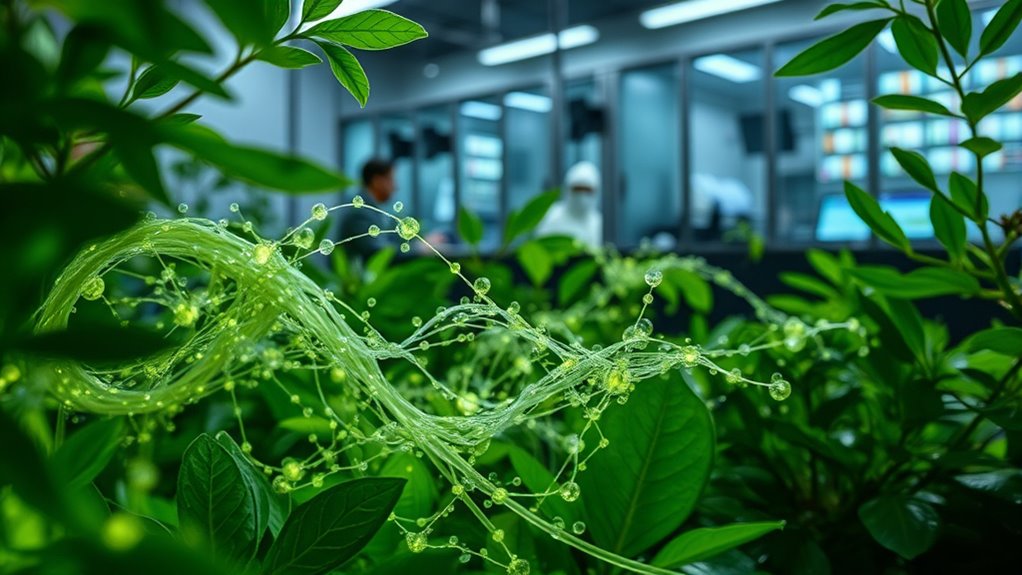
While biodegradable nanomaterials generally show reduced persistence in the environment compared to non-degradable synthetic counterparts, their ecological safety depends heavily on their specific material composition and degradation pathways. You need to contemplate how these materials break down and what byproducts they generate, as some intermediates may pose environmental risks. Smaller particles with high surface areas typically degrade faster, but shape and surface chemistry also influence their fate. Although many biodegradable nanomaterials exhibit low toxicity, outcomes vary depending on dose and degradation products. You should recognize gaps in testing standards which often don’t fully address nanoscale behaviors or long-term ecotoxicity. Additionally, Environmental fate studies are crucial to fully assess their long-term safety and impact, especially considering how different environmental conditions can alter their degradation and dispersal. Factors such as weathering processes can significantly influence how these materials behave in soil, water, and air, emphasizing the need for comprehensive environmental assessments. It is also important to consider degradation pathways to better understand how these materials decompose in various environments. Ultimately, understanding how these materials behave in soil, water, and air is essential to ensure they truly benefit the environment and don’t introduce new hazards.
Future Directions and Emerging Innovations
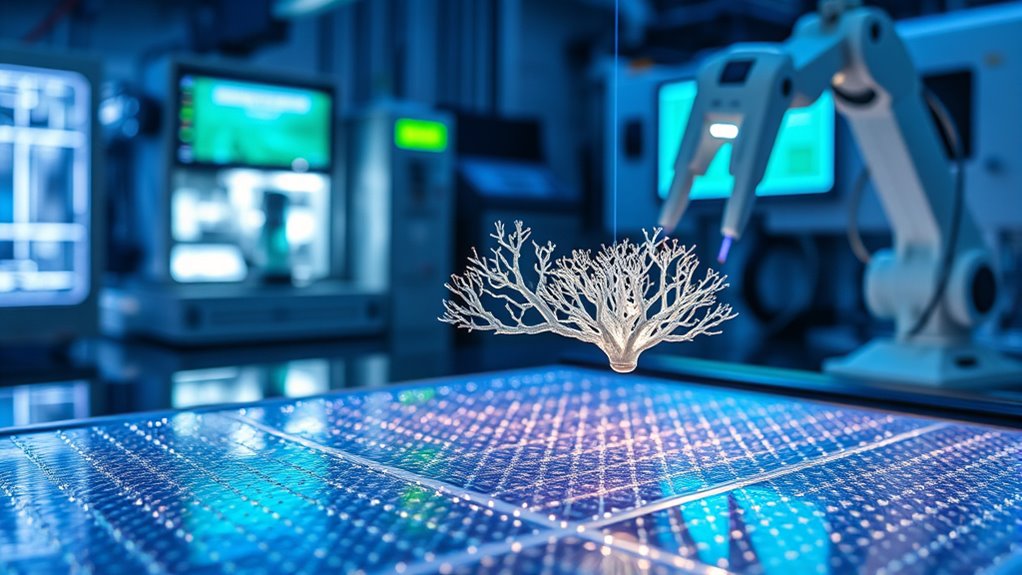
Advances in biodegradable nanomaterials focus on developing smarter, more sustainable systems that meet both medical and environmental needs. You’ll see innovations like stimuli-responsive carriers, which release payloads precisely where needed, and bio-derived feedstocks that enhance sustainability. Emerging research emphasizes predictable degradation pathways using cleavable linkers and enzyme-sensitive motifs, enabling site-specific breakdown. To support these developments, consider the following innovations:
| Innovation | Application | Impact |
|---|---|---|
| Multifunctional nanocarriers | Theranostics, stimuli-responsive systems | Better targeting, reduced side effects |
| Green manufacturing methods | Large-scale, eco-friendly production | Lower environmental footprint |
| Predictable degradation design | Drug release, environmental safety | Enhanced control, safety assurance |
| Bio-based composite materials | Sustainable, high-performance nanomaterials | Reduced reliance on synthetic sources |
Additionally, research into standardized testing protocols ensures consistent evaluation of biodegradable nanomaterials’ safety and efficacy across applications. Further advancements aim to improve degradation predictability, making these materials more reliable for diverse uses. Researchers are also exploring enzyme-sensitive motifs to facilitate targeted and controlled breakdown, aligning with the goal of predictable degradation pathways.
Frequently Asked Questions
How Do Biodegradable Nanomaterials Perform in Long-Term Clinical Applications?
You’ll find biodegradable nanomaterials perform well in long-term clinical applications when their design guarantees predictable degradation and biocompatibility. They effectively deliver drugs, support tissue regeneration, and reduce long-term toxicity. However, their success depends on factors like particle size, surface chemistry, and degradation rate. Ongoing research aims to optimize these parameters, address regulatory gaps, and assure safe, reliable performance over time in diverse clinical settings.
What Are the Main Challenges in Scaling up Biodegradable Nanomaterial Production?
Scaling up biodegradable nanomaterial production is like trying to tame a wild river—demanding precise control amid unpredictable currents. You face challenges in creating uniform particles at a large scale, balancing stability and degradability, and maintaining purity. Surface modifications and advanced characterization act as your navigational tools, but inconsistent processes and regulatory gaps remain hurdles. Overcoming these requires innovation, rigorous standards, and a steady hand to transform lab successes into real-world streams.
How Environmentally Stable Are Biodegradable Nanomaterials in Varying Conditions?
Biodegradable nanomaterials’ environmental stability varies markedly depending on conditions. You’ll find they degrade faster in moist, warm, and microbial-rich environments, like soil or water, while colder, dry, or less biologically active settings slow down degradation. Surface chemistry, particle size, and shape also influence stability, with smaller, more reactive particles degrading quicker. However, intermediate fragments may persist longer, and transformation products‘ ecotoxicity remains uncertain, so environmental behavior isn’t entirely predictable.
Are There Standardized Tests for Measuring Nanoscale Biodegradation Rates?
You’ll find that standardized tests for measuring nanoscale biodegradation rates are limited and still evolving. While some protocols exist for bulk polymers, they often don’t fully address nanomaterials’ unique properties. You should be aware that the field lacks universally accepted assays, making comparisons difficult. This gap highlights the need for developing specific, reliable testing methods to accurately evaluate how nanomaterials break down in various environments.
What Safety Concerns Exist Regarding Degradation Products in Ecosystems?
You should be aware that degradation products from nanomaterials can pose risks to ecosystems. These fragments might be toxic, bioaccumulate, or disrupt aquatic and soil organisms if they aren’t fully understood or properly regulated. Because their chemical nature varies, you need to contemplate potential ecotoxicity and long-term environmental impacts. Careful assessment of these byproducts is essential to prevent unintended harm and ensure that biodegradable nanomaterials truly benefit ecosystems.
Conclusion
As you explore the world of biodegradable nanomaterials, the potential is both exciting and uncertain. Will these innovations revolutionize medicine and the environment as promised, or are hurdles too great to overcome? The future hinges on breakthroughs yet to come, and the choices we make today could determine if this technology remains science fiction or becomes our reality. Stay tuned—what’s next might just change everything you thought you knew.
Fall yard work Picks
leaf blowers
As an affiliate, we earn on qualifying purchases.