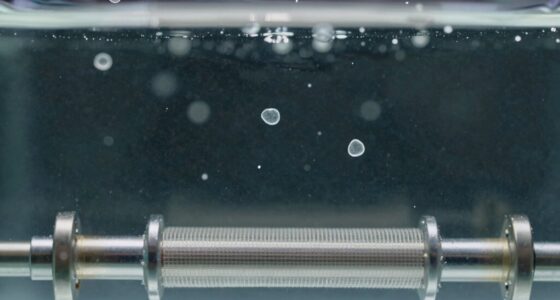

Nanoparticles show great promise in fighting pollution thanks to their high efficiency, targeted removal, and reusability. They can break down contaminants or adsorb heavy metals effectively, making cleanup faster and more sustainable. However, their potential environmental and health risks, such as toxicity and unintended release, raise concerns. Balancing these benefits with safety requires careful design, regulation, and management. To understand how science aims to make nanotechnology safe and effective, keep exploring the latest developments.
Key Takeaways
- Nanoparticles offer highly efficient, targeted pollutant removal, with capabilities exceeding 100 mg/g adsorption and 80-90% degradation rates.
- Their reusability via magnetic separation and photocatalysis makes them promising, but environmental stability and fouling challenges persist.
- Potential ecological and human health risks arise from nanoparticle release, toxicity, and long-term environmental impacts.
- Scaling up nanoparticle-based pollution control faces hurdles like manufacturing consistency, regulatory gaps, and environmental safety concerns.
- Overall, nanoparticles present promising pollution mitigation tools but require careful risk assessment and regulation to avoid unintended harm.
The Promise of Nanoparticles in Environmental Cleanup

Nanoparticles hold significant potential for transforming environmental cleanup efforts by offering highly efficient and targeted approaches to removing pollutants. Their tiny size and large surface area allow them to adsorb, degrade, or capture contaminants more effectively than traditional methods. For example, photocatalytic nanoparticles like TiO2 can break down organic pollutants under light, transforming harmful substances into less toxic ones. Magnetic iron-oxide nanoparticles enable easy separation from water streams, facilitating reuse and reducing waste. Carbon-based nanomaterials, such as CNTs and graphene oxide, excel at adsorbing heavy metals and organic compounds. These advancements promise faster, more precise cleanup, reducing environmental impact, and improving public health. Youngster Choice Despite challenges, ongoing research continues to reveal the vast potential of nanotechnology in tackling pollution more efficiently than ever before. Additionally, advancements in nanomaterial synthesis are enhancing the stability and functionality of these particles in real-world applications, with ongoing studies exploring environmentally safe nanomaterials to minimize potential risks. Moreover, efforts to develop biodegradable nanomaterials aim to address concerns about environmental persistence and toxicity.
Furthermore, understanding nanoparticle interactions with biological systems is crucial for ensuring safe and sustainable use in environmental applications.
How Different Nanoparticles Tackle Pollution

Different types of nanoparticles employ distinct mechanisms to combat pollution effectively. Carbon-based nanomaterials like CNTs and graphene oxide mainly adsorb pollutants through their high surface area and π–π interactions, trapping organic compounds and heavy metals. Metal and metal-oxide nanoparticles such as TiO₂ and ZnO utilize photocatalysis, generating reactive oxygen species that break down organic pollutants under light exposure. Magnetic nanoparticles like Fe₃O₄ enable rapid removal of contaminants by binding pollutants and allowing easy magnetic separation for reuse. Functionalized polymeric or silica nanoparticles provide selective binding sites, capturing specific heavy metals or ions via chelation or ion exchange. Metal–organic frameworks (MOFs) and porous polymers offer size-selective adsorption and catalytic sites, targeting persistent organics and gaseous pollutants efficiently. Each nanoparticle type harnesses unique properties to address different pollution challenges, and ongoing research continues to optimize their efficacy and safety. Advances in nanoparticle synthesis are helping develop more sustainable and targeted pollution solutions. For example, understanding nanoparticle environmental impact is crucial to ensure safe deployment in real-world applications. Additionally, research into sustainable nanomaterials is paving the way for more environmentally friendly pollution mitigation strategies.
Laboratory Successes and Performance Benchmarks
You’ll find that many nanoparticles demonstrate impressive adsorption capacities, often exceeding 100 mg/g in lab tests. Rapid photocatalytic degradation rates, frequently above 80–90%, show these materials can quickly break down pollutants. Plus, some nanoadsorbents can be regenerated and reused multiple times with minimal capacity loss, making them promising for sustainable pollution control. Advances in nanomaterial design continue to enhance the efficiency and applicability of nanomaterials in environmental remediation. Additionally, ongoing research into nanoparticle toxicity aims to ensure these solutions are both effective and safe for long-term environmental use. Understanding the environmental impact of nanomaterials is crucial for developing safe and sustainable applications. Furthermore, the development of high-performance nanomaterials is crucial for scaling these technologies from laboratory settings to real-world applications.
High Adsorption Capacities
Laboratory studies have demonstrated that engineered nanoparticles can achieve remarkably high adsorption capacities for various pollutants, setting new benchmarks for water and air purification. You’ll find that materials like CNTs and MOFs often exceed 100 mg/g in optimized conditions. Here’s what makes their performance stand out:
- Carbon-based nanomaterials rely on high surface areas and π–π interactions to adsorb organics effectively.
- Metal-oxide nanoparticles, such as TiO₂, use photocatalysis to break down pollutants rapidly.
- Magnetic nanoparticles enable quick separation of contaminants, facilitating reuse.
- Hybrid approaches combine adsorption and photocatalysis, boosting removal efficiency.
These benchmarks demonstrate impressive lab results, though real-world performance may vary due to environmental complexities. Nonetheless, high adsorption capacities highlight their potential for pollution control. Surface area is a critical factor in maximizing adsorption efficiency in these nanomaterials.
Rapid Degradation Rates
Nanoparticles such as TiO₂ and doped metal oxides have demonstrated remarkable rapid degradation rates of organic pollutants under controlled laboratory conditions. You’ll see these nanoparticles convert harmful compounds like dyes and pharmaceuticals into less toxic byproducts within hours, often achieving removal efficiencies exceeding 80–90%. Laboratory benchmarks show that photocatalytic reactions proceed swiftly when exposed to appropriate light sources, making them highly effective for wastewater treatment. Some nanomaterials, such as magnetic iron-oxide nanoparticles, enable quick separation from water after degradation, streamlining recovery. While these results are promising, be aware that real-world conditions—complex matrices and competing substances—can reduce their efficiency. Nonetheless, laboratory successes highlight the potential for nanotechnology to dramatically accelerate pollution cleanup, provided challenges like stability and scalability are addressed. Gold IRA markets continue to evolve, emphasizing the importance of thorough research before large-scale application.
Reusability and Regeneration
Reusability and regeneration are critical factors determining the practical viability of nanoparticle-based pollution treatment. You need to understand how well these materials can be recovered and reused without significant performance loss. Some nanoadsorbents, like CNTs and MOFs, achieve 3-5 reuse cycles with minimal capacity decline, making them promising for repeated use. Magnetic nanoparticles (e.g., Fe3O4) enable quick separation via magnets, facilitating multiple recovery cycles with consistent efficiency. Photocatalysts, such as TiO2, often sustain high degradation rates over several cycles, although fouling can reduce activity over time. Challenges like fouling, structural degradation, or surface poisoning may limit regeneration, requiring advanced cleaning or refunctionalization techniques to restore performance. Additionally, ongoing research into free floating nanoparticles aims to improve their stability and reusability in various environmental conditions. Exploring surface modification techniques can also enhance resistance to fouling and extend the lifespan of these nanomaterials. Incorporating advanced materials can further improve the durability and reusability of nanoparticle-based systems in pollution control. Moreover, understanding nanoparticle stability is essential for developing long-lasting and effective pollution mitigation solutions. Developing cost-effective regeneration methods remains a key goal to ensure widespread adoption of these technologies.
Challenges in Scaling Up Nanotech-Based Solutions
Scaling up nanotech-based solutions for pollution control faces significant hurdles, primarily due to the complex shift from controlled laboratory conditions to real-world environments. You’ll encounter issues like unpredictable contaminant matrices, which reduce nanoparticle efficiency, and catalyst deactivation caused by fouling or surface modifications. Manufacturing consistency becomes challenging, as batch-to-batch variability affects performance. Recovery and reuse strategies, such as magnetic separation, may not translate seamlessly at scale, risking nanoparticle release into ecosystems. Additionally, environmental factors like humidity, temperature fluctuations, and competing species can alter nanoparticle behavior, diminishing effectiveness. Regulatory uncertainties and safety concerns also complicate large-scale deployment. Overcoming these challenges requires robust engineering, thorough field testing, and integrated lifecycle approaches to guarantee safety, efficacy, and environmental compatibility at scale. Manufacturing consistency remains a critical factor in ensuring reliable performance across large quantities.
Potential Environmental and Health Hazards

You should be aware that nanoparticles can pose environmental and health risks, especially if they are released into ecosystems or the air. These particles may cause toxicity to aquatic life or humans through inhalation or contact, with long-term effects still essential. Managing disposal and exposure is vital to prevent unintended harm from nanotechnology applications. Additionally, understanding modern kitchen technology can help develop safer and more controlled uses of nanoparticles in various industries. Proper nanoparticle regulation is critical to minimize potential hazards and ensure responsible development and application of nanomaterials. Incorporating field‑of‑view considerations from imaging technology can also aid in assessing the spread and impact of nanoparticle dispersal in the environment.
Ecotoxicity Concerns Rise
As nanoparticle-based pollution control technologies become more widespread, concerns about their ecotoxicity are escalating. You should be aware that free nanoparticles, like metal oxides and CNTs, can cause oxidative stress, inflammation, or bioaccumulation in aquatic life. Here’s what to watch for:
- Leaching and release: Nanoparticles may detach from filters or escape during manufacturing, entering ecosystems.
- Transformation: They can aggregate, dissolve, or form secondary toxic species, changing their environmental impact.
- Bioaccumulation: Nanoparticles might accumulate in organisms, passing up the food chain and affecting ecosystems.
- Human exposure: Risks during production, handling, or disposal include inhalation, skin contact, or ingestion, posing health hazards.
Understanding these risks is vital for developing safer nanotechnologies and preventing unintended environmental harm.
Exposure and Disposal Risks
While the ecotoxicity of free nanoparticles raises significant concerns, understanding how exposure during disposal and handling impacts health and the environment is equally important. You risk nanoparticle release through leaching, effluent discharge, or airborne emissions during manufacturing and use. These pathways can lead to bioaccumulation, oxidative stress, and toxicity in aquatic life and humans. Proper disposal involves stabilization, recovery, and secure landfilling to prevent environmental release. Here’s an essential point:
| Exposure Pathway | Potential Impact | Mitigation Strategy |
|---|---|---|
| Leaching from filters | Soil and water contamination | Use stabilized, coated nanoparticles |
| Airborne emissions | Respiratory issues | Implement proper ventilation and controls |
| Effluent discharge | Ecotoxicity in water bodies | Advanced filtration and treatment |
| Sludge disposal | Bioaccumulation risks | Secure, monitored landfilling |
Addressing these risks ensures safer nanoparticle applications.
Regulatory Hurdles and Waste Management Concerns
Regulatory hurdles pose significant challenges to the widespread adoption of nanoparticle-based pollution control technologies. You face inconsistent international rules for nanomaterials, making compliance complex. Handling waste also becomes a concern, as spent nanomaterials need stabilization, recovery, or secure disposal to prevent environmental release.
- Fragmented regulations hinder standardization and slow approvals.
- Lack of clear guidelines complicates waste management and recycling efforts.
- Inadequate characterization of nanoparticles hampers risk assessment and labeling.
- Cost and resource demands for safe disposal affect economic viability.
These issues increase uncertainty, delay deployment, and raise safety concerns. You must navigate evolving policies and develop responsible waste strategies, ensuring nanotechnology benefits don’t come at environmental or health costs.
Balancing Benefits and Risks: The Current Debate
The debate over balancing the environmental and health benefits of nanoparticle-based pollution control with their potential risks is increasingly urgent. You recognize that nanoparticles can dramatically improve pollutant removal, such as heavy metals and organic contaminants, with high efficiency demonstrated in lab tests. However, concerns linger about the potential ecotoxicity of free nanoparticles, their release during use, and long-term environmental impacts. You also see that human exposure risks exist during manufacturing, handling, and disposal processes. While nanoparticles offer promising solutions, their lifecycle, potential toxicity, and regulatory gaps create uncertainties. Striking a balance requires not only optimizing performance but also implementing safety measures, monitoring, and responsible management to prevent unintended harm. This ongoing debate shapes how we deploy nanotechnology responsibly in pollution control.
Future Directions and Research Priorities
Advancing nanoparticle-based pollution control requires focused research to overcome current limitations and guarantee safe, effective deployment. To do this, you should prioritize:
- Developing standardized ecotoxicity testing protocols and environmental fate models to compare nanoparticle impacts across studies.
- Conducting long-term field trials in real-world conditions to validate lab results and identify failure modes.
- Creating containment and recovery strategies, like magnetic separation or immobilization, to prevent environmental release during use and disposal.
- Integrating lifecycle assessments and cost-benefit analyses early in development to ensure environmental gains outweigh resource investments.
Focusing on these areas will help address uncertainties, improve safety, and promote responsible innovation in nanoparticle pollution mitigation technologies.
Making Nanotechnology Safe and Sustainable

Ensuring nanotechnology remains safe and sustainable requires proactive measures throughout its development and application. You should prioritize designing nanoparticles with controlled size, surface chemistry, and stability to minimize environmental release and toxicity. Implement robust monitoring systems, like advanced sensors, to detect nanoparticle leaching and airborne emissions. Incorporate lifecycle assessments early in development to balance environmental benefits with resource use and energy consumption. You must also develop efficient recovery methods, such as magnetic separation, to prevent nanoparticle accumulation in ecosystems. Proper waste management and disposal protocols are essential, including stabilization and secure containment of spent nanomaterials. Additionally, adherence to international regulations and standardized testing guarantees safety for workers and ecosystems. By integrating these practices, you help create nanotechnologies that are both effective and environmentally responsible.
Frequently Asked Questions
How Do Nanoparticles Affect Ecosystems After Environmental Deployment?
You should know that after environmental deployment, nanoparticles can impact ecosystems by leaching into water and soil, causing oxidative stress or bioaccumulation in aquatic organisms. They may transform into secondary toxic species or aggregate, affecting their fate and toxicity. Release pathways include filter leaching, effluent discharge, and airborne emissions. These particles can harm wildlife, disrupt habitats, and pose risks to human health through trophic transfer, emphasizing the need for careful management and monitoring.
What Are the Long-Term Health Risks for Workers Handling Nanomaterials?
You face potential long-term health risks when handling nanomaterials, including inhalation, skin contact, and accidental ingestion. These particles can cause oxidative stress, inflammation, or bioaccumulation, especially if they become airborne or leach from waste. Chronic exposure might lead to respiratory issues, organ damage, or other health problems. To safeguard yourself, use proper personal protective equipment, follow safety protocols, and guarantee adequate ventilation during handling and disposal of nanomaterials.
Can Nanoparticle Pollution Be Effectively Monitored and Tracked in Real Time?
Think of tracking nanoparticle pollution like chasing fireflies at dusk. You can use advanced sensors like LIBS and ICP, which act as your lanterns, illuminating trace levels of particles in air or water. These tools detect nanoparticles in real time, helping you monitor their movement and concentration. While challenges remain, ongoing technological advances are making it increasingly possible to keep a close eye on nanoparticle pollution effectively and promptly.
How Cost-Effective Are Nanotech Solutions Compared to Traditional Cleanup Methods?
Nanotech solutions can be cost-effective compared to traditional methods, especially when considering their high efficiency and reusability. You save money on reagents and energy over multiple cycles, and they often require less space and infrastructure. However, upfront costs for synthesis and regulation can be high, and scaling up remains a challenge. Overall, with proper management, nanotech offers a promising, potentially economical alternative for pollution cleanup.
What Are the Best Practices for Safe Disposal of Nanoparticle-Laden Waste?
You should treat nanoparticle-laden waste as if it’s a ticking time bomb. Proper disposal involves stabilizing and immobilizing the particles, often through encapsulation or solidification techniques, to prevent leaching. Use magnetic separation for easy recovery, and follow regulations for hazardous waste. Always document and monitor waste streams, and consider recycling or reclaiming nanoparticles to reduce environmental impact. When in doubt, play it safe—it’s better to be cautious than sorry later.
Conclusion
Just as Pandora’s box once unleashed unforeseen troubles, nanotechnology offers incredible promise but also hidden risks. You must weigh the potential for groundbreaking environmental cleanup against the dangers lurking within tiny particles. Staying informed and advocating for responsible research guarantees we don’t repeat history’s mistakes. With careful oversight, nanotech can be a hero in fighting pollution—if you remain vigilant, like those who guarded Pandora’s box, safeguarding our future from unintended consequences.