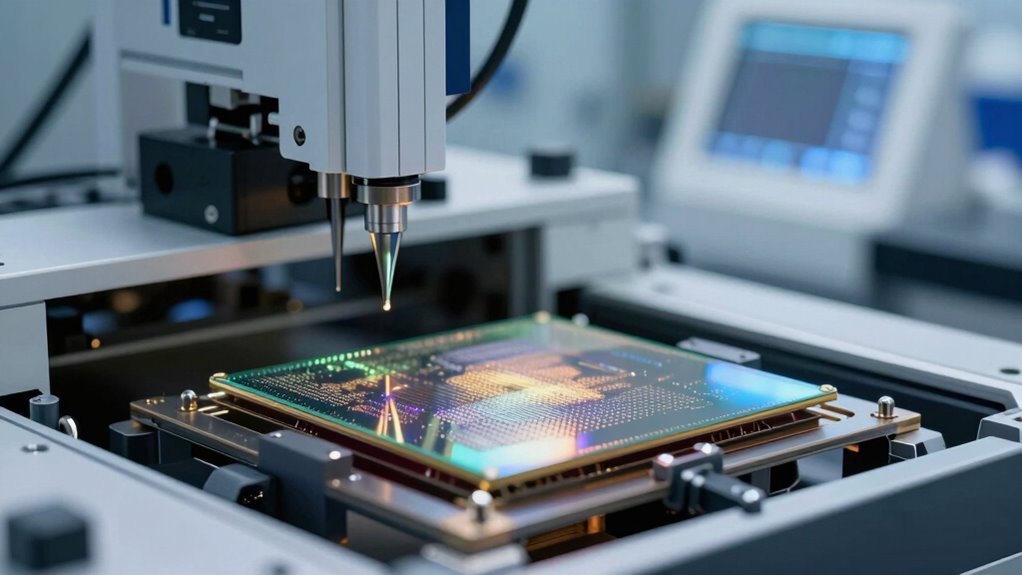

Nanofabrication remains a bottleneck because scaling lab techniques to large-scale, reliable production is still a challenge. You encounter issues with ensuring uniformity, precision, and repeatability across batches, which affects device performance. Material limitations, such as instability and high costs, also slow progress. These technical and economic hurdles prevent innovations from moving from prototypes to real-world applications. To understand how these obstacles could be overcome, keep exploring the latest developments in nanofabrication.

Get the latest gadgets delivered free — and shop member deals
- Fast, free delivery on millions of items
- Access to Prime Big Deal Days deals on October 6–7
- Prime Video, Amazon Music and more included
Key Takeaways
- Scaling lab techniques to mass production often compromises uniformity and precision, hindering consistent device performance.
- Material synthesis and stability issues limit the availability and reliability of advanced nanomaterials.
- Integration challenges prevent translating innovative nanomaterials into practical, scalable manufacturing processes.
- High costs and scarcity of nanomaterials slow down widespread adoption and commercialization.
- Developing new fabrication methods that ensure quality at scale remains a significant technical hurdle.
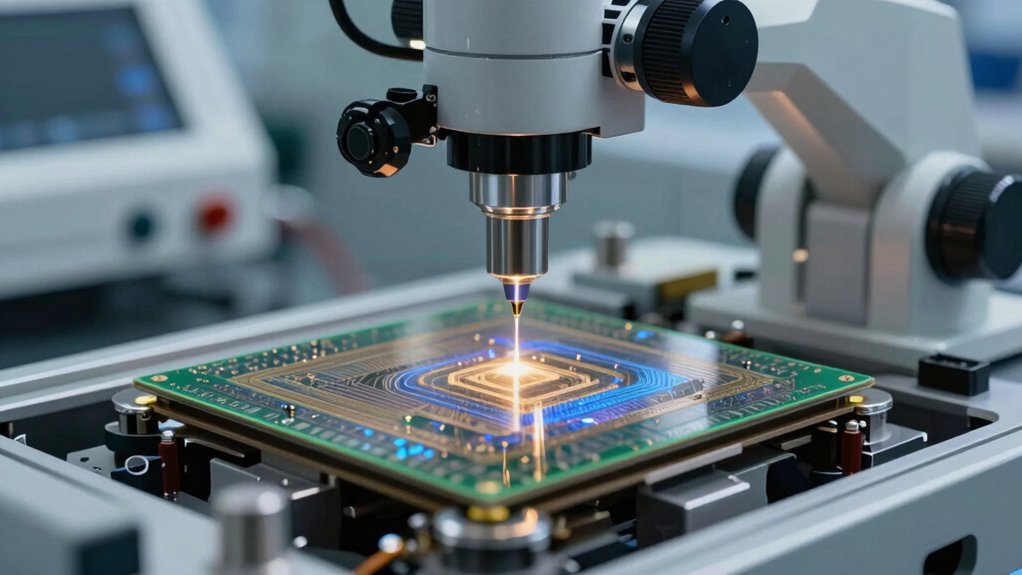
Have you ever wondered why developing next-generation nanodevices remains so challenging? The answer lies in the complex hurdles of nanofabrication, particularly the scalability challenges and material limitations that stand in the way of turning innovative ideas into practical applications. As you try to push the boundaries of what’s possible at the nanoscale, you quickly realize that techniques which work well in a laboratory setting often fall short when scaled up to mass production. Achieving uniformity, precision, and repeatability across large batches becomes a monumental task. Small variations in fabrication processes can lead to significant inconsistencies in device performance, making it difficult to produce reliable, high-quality nanodevices at commercial scales. This is a core aspect of the scalability challenges that continue to hinder rapid progress in the field. Additionally, fabrication techniques must continually evolve to meet these demanding requirements, highlighting the critical need for innovative process development. Material limitations further complicate the picture. Many promising nanomaterials, like certain semiconductors or novel two-dimensional substances, possess extraordinary properties in theory. However, when it comes to integrating them into fabrication processes, you encounter a host of issues. These materials might be difficult to synthesize consistently, unstable under certain conditions, or incompatible with existing manufacturing techniques. You may find that some materials degrade over time or under operational stresses, limiting their practical use. Additionally, the scarcity or high cost of some advanced nanomaterials makes large-scale deployment economically unfeasible, further stalling innovation. The interplay between scalability challenges and material limitations creates a significant bottleneck. For example, a breakthrough in nanomaterial design might promise revolutionary improvements in electronics or medicine, but if you can’t produce that material reliably at large scales, the innovation remains theoretical. Similarly, even if a scalable fabrication process exists, it might not be suitable for delicate nanomaterials that require highly controlled environments. This disconnect hampers the progression from lab prototypes to real-world devices, slowing down the shift from experimental concepts to practical applications. In essence, these challenges aren’t just technical—they influence economic viability and the pace of innovation. As you work to overcome them, you need to develop new fabrication methods, improve material stability, and find ways to manufacture at scale without sacrificing quality. Until these hurdles are addressed, nanofabrication will continue to be a bottleneck, preventing some promising innovations from reaching their full potential. The path forward demands both technical ingenuity and strategic problem-solving to reveal the full promise of nanoscale technology.
As an affiliate, we earn on qualifying purchases.
Frequently Asked Questions
What Emerging Techniques Could Overcome Current Nanofabrication Challenges?
You could leverage emerging techniques like quantum lithography, which uses entangled photons for ultra-precise patterning beyond traditional limits, and self-assembly methods, where molecules naturally organize into nanostructures. These approaches can bypass current resolution and scalability issues, accelerating innovation. By adopting quantum lithography and self-assembly techniques, you’ll push nanofabrication capabilities forward, enabling the creation of more complex, smaller, and efficient nanodevices.
How Does Nanofabrication Impact the Scalability of Innovative Technologies?
Have you ever wondered how tiny details can make or break a tech breakthrough? Nanofabrication impacts scalability by ensuring material precision, which is vital for consistent performance. However, high cost barriers often limit mass production, making it hard to bring innovations to market quickly. Without affordable, precise fabrication methods, scaling up remains challenging, slowing down the widespread adoption of cutting-edge technologies.
Are There Environmental Concerns Associated With Advanced Nanofabrication Processes?
Yes, advanced nanofabrication processes can pose environmental risks, including hazardous waste and chemical exposure. You might be concerned about high resource consumption, such as water and rare materials, which can strain ecosystems. These processes often require energy-intensive equipment, increasing carbon footprints. To address this, you should advocate for greener practices, improved waste management, and sustainable sourcing to minimize environmental impacts while still advancing nanotechnology.
What Industries Are Most Affected by Nanofabrication Limitations?
You’re most affected in industries like quantum manufacturing and biomedical applications. In quantum manufacturing, nanofabrication limits the development of precise quantum devices, slowing progress. Similarly, biomedical applications depend on ultra-fine nanostructures for targeted drug delivery and diagnostics, but fabrication challenges hinder innovation. These limitations stem from the difficulty in consistently producing complex nanostructures at scale, impacting the advancement of cutting-edge technologies in these fields.
How Long Might It Take to Resolve Current Nanofabrication Bottlenecks?
Could we see breakthroughs in nanofabrication within a decade? It’s possible if researchers achieve quantum precision, boosting accuracy and efficiency. As innovations demand cost reduction, progress may accelerate, but complex challenges remain. Developing better tools and techniques takes time, so resolving current bottlenecks might still take 5 to 15 years. Are we patient enough to wait for the technology that could transform industries?
As an affiliate, we earn on qualifying purchases.
Conclusion
You see, nanofabrication remains a bottleneck, much like trying to carve a sculpture from marble with a tiny chisel. While advances are promising, the precision and scale needed still challenge us, holding back some innovations. But just as a sculptor’s patience eventually reveals beauty, ongoing efforts and new techniques will eventually break through these barriers. Stay hopeful—these hurdles are just the rough edges before a remarkable new era of nanotech breakthroughs.
precision nanofabrication devices
As an affiliate, we earn on qualifying purchases.
As an affiliate, we earn on qualifying purchases.
scalable nanomanufacturing equipment
As an affiliate, we earn on qualifying purchases.
As an affiliate, we earn on qualifying purchases.
Fall Picks
fall essentials
As an affiliate, we earn on qualifying purchases.