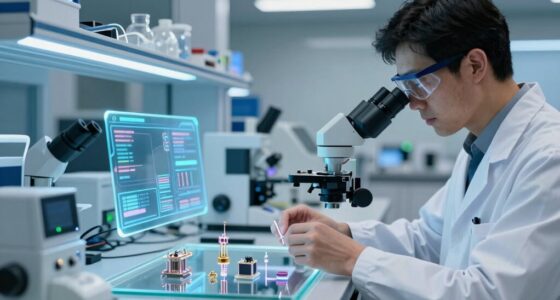
The grey goo nightmare, involving self-replicating nanobots consuming all matter, is a highly exaggerated scenario unlikely to happen anytime soon. Current technology makes creating uncontrolled nanomachines impossible, and natural environmental limits, resources, and safety measures act as strong deterrents. While it’s good to stay cautious, the risks are more science fiction than fact. If you want to understand why scientists don’t see it as an imminent threat, keep exploring the facts behind nanotech and ecological safeguards.
Key Takeaways
- Current technology makes creating self-replicating nanobots capable of causing gray goo highly unlikely.
- Natural environmental barriers and resource limitations prevent uncontrolled proliferation of nanomachines.
- Early detection methods and safety protocols significantly reduce the risk of runaway nanobot scenarios.
- Scientific consensus considers the gray goo scenario an improbable, hypothetical risk rather than an immediate threat.
- Proper regulation, safety measures, and ongoing research further mitigate potential dangers of nanotechnology.
nanotech safety kits
As an affiliate, we earn on qualifying purchases.
As an affiliate, we earn on qualifying purchases.
Understanding the Concept of Gray Goo

Have you ever wondered what the term “gray goo” really means? It describes a hypothetical scenario where self-replicating nanomachines out of control, consuming Earth’s biomass and transforming everything into a featureless, gray mass. Coined by Eric Drexler in *Engines of Creation* (1986), it paints a bleak picture of nanotechnology gone awry. These nanomachines could exponentially multiply, converting organic and inorganic matter into more replicators, creating a destructive, sludge-like substance. Imagine tiny machines that relentlessly consume everything in their path—soil, plants, animals—until the planet is filled with a uniform gray goo. The concept is rooted in fears of uncontrolled replication, where the machines’ ability to self-replicate spirals beyond human control, leading to catastrophic environmental collapse. Energy-efficient cloud servers could offer safer, more sustainable technological solutions that help prevent such scenarios from ever occurring. Additionally, ongoing research in nanotechnology safety aims to develop protocols to prevent unintended self-replication and ensure responsible innovation.
self-replicating nanobot models
As an affiliate, we earn on qualifying purchases.
As an affiliate, we earn on qualifying purchases.
The Science Behind Self-Replicating Nanomachines

Understanding what makes self-replicating nanomachines possible requires examining their core scientific principles. These machines rely on molecular components that can assemble themselves and utilize environmental resources for replication. They mimic biological processes like DNA copying but operate at a nanoscale with engineered precision. Their design involves programmable molecules capable of building new nanodevices from raw materials such as carbon, silicon, or metals. Replication occurs through a build-and-destroy cycle, where nanomachines produce copies of themselves, consuming surrounding matter. Efficient control mechanisms prevent uncontrolled growth. The table below highlights key aspects:
| Principle | Function | Material Used |
|---|---|---|
| Self-assembly | Builds new nanodevices | Molecular components |
| Resource utilization | Converts environment into replicators | Carbon, silicon, metals |
| Replication cycle | Exponential growth | Raw environmental matter |
| Control systems | Prevents runaway replication | Built-in safety protocols |
| Environmental impact | Potential for rapid consumption | Earth’s biomass and resources |
Furthermore, understanding the environmental impact of these nanomachines is crucial to assessing their safety and sustainability. The development of self-replication mechanisms raises important questions about long-term environmental consequences and the possible need for regulatory oversight. Studying the biological parallels of self-replication can provide insights into how to better control and utilize these nanodevices. Additionally, ongoing research into molecular programming is essential for ensuring safe implementation and preventing unintended outcomes. Advancements in nanotechnology safety protocols are critical for minimizing risks associated with self-replicating systems.
nanotechnology safety protocols book
As an affiliate, we earn on qualifying purchases.
As an affiliate, we earn on qualifying purchases.
Potential Pathways for Ecophagy to Occur

Several pathways could lead to ecophagy, primarily through the accidental or deliberate deployment of self-replicating nanomachines. You might accidentally release a small number of nanobots into the environment, which then find abundant biomass and begin replicating exponentially. Alternatively, malicious actors could intentionally *set loose* nanomachines designed to consume organic matter, perhaps as a weapon or a misguided project. These nanobots could initially remain hidden, replicating stealthily by sourcing local resources like carbon or silicon. If they gain a foothold, their populations could grow rapidly, converting ecosystems into gray goo. In some scenarios, environmental triggers like climate change or natural disasters could facilitate the release or spread of these nanomachines. Moreover, innovative storytelling can be employed to raise awareness and foster proactive measures against such technological threats. Understanding the self-replication process is crucial in developing safeguards and response strategies, especially given the potential for uncontrolled proliferation to spiral out of control. Recognizing the potential environmental impact of uncontrolled nanobot proliferation is vital for effective prevention. For instance, research into nano-safety protocols can help establish boundaries and containment measures to prevent disaster. Regardless of how it begins, once replication surpasses control measures, ecophagy could unfold swiftly.
environmental nanotech safety research
As an affiliate, we earn on qualifying purchases.
As an affiliate, we earn on qualifying purchases.
Realistic Timelines and Limitations of Nanotech Spread

The spread of nanotech capable of ecophagy faces significant real-world constraints that limit how quickly and extensively it can occur. You must consider resource availability, environmental barriers, and detection methods. Nanomachines need specific materials, like carbon or silicon, which aren’t evenly distributed worldwide, slowing their spread. Thermal signatures from replication can reveal their presence, prompting intervention. To stay undetected, they’d need to replicate slowly, making the process take years instead of months. Built-in safety controls and resource limitations further restrict rapid proliferation. Geographic obstacles, natural ecological checks, and the difficulty of designing universally adaptable nanodevices all hinder widespread ecophagy. These factors, combined with detection and mitigation strategies, mean that an uncontrolled gray goo scenario remains unlikely within short timelines. Additionally, understanding the contrast ratio and other technical limitations of nanodevices can help develop more effective detection and response measures, further reducing the risk of rapid, uncontrolled spread. Moreover, advancements in detection technology continue to improve our ability to identify nanotech threats early, providing an additional layer of security against potential disasters. Continued appliance testing and safety protocols are essential to stay ahead of emerging nanotech risks and improve our mitigation strategies. The ongoing development of monitoring systems also enhances our capacity to detect anomalies promptly, further mitigating potential risks.
Scientific Perspectives on the Likelihood of a Gray Goo Event

Many scientists consider the gray goo scenario highly improbable because current technological and environmental constraints prevent nanomachines from replicating uncontrollably on a large scale. They point out that:
- Building self-replicating nanomachines remains technologically unfeasible for now, requiring materials and precision beyond our reach.
- Natural environmental factors—like resource scarcity, temperature fluctuations, and geographic barriers—limit uncontrolled spread.
- Detection and intervention capabilities enable early response, often stopping potential threats before they escalate.
- Advances in nanotechnology safety research continue to improve our understanding and control measures, further reducing the likelihood of such events.
These factors create multiple hurdles, making a runaway gray goo event unlikely. While the concept sparks concern, scientific consensus suggests that with proper controls, risks can be managed effectively. The reality is that current science does not support the scenario’s plausibility at a global scale.
Strategies for Prevention and Containment

Preventing and containing a gray goo scenario requires proactive strategies that limit the growth and spread of self-replicating nanomachines. You should implement strict controls on replication capabilities, such as limiting the number of copies each nanomachine can produce. Requiring rare materials for assembly can act as a natural barrier, making large-scale proliferation difficult. Continuous monitoring is vital—early detection of replication activity allows for a swift intervention before exponential growth occurs. Developing and deploying countermeasures quickly, like nanoweapons or chemical inhibitors, helps contain outbreaks effectively. Designing nanomachines with built-in fail-safes or self-destruct mechanisms further minimizes risks. Incorporating security measures to prevent unauthorized access and tampering enhances overall safety. Additionally, establishing robust regulatory frameworks can help monitor and control nanotechnology development at a broader level. Implementing standardized safety protocols and ongoing risk assessments further strengthen preventative efforts. Building in risk mitigation strategies during the design phase can significantly reduce potential hazards. Incorporating redundant safety systems can provide an additional layer of protection against unintended proliferation. By combining these strategies, you create multiple layers of defense, reducing the likelihood of an uncontrollable gray goo event and ensuring better safety in nanotechnology development.
The Role of Environmental and Resource Constraints

Environmental and resource constraints considerably limit the potential for uncontrolled nanomachine proliferation. These natural barriers act like guardrails, preventing runaway growth. First, the uneven distribution of essential resources like carbon and silicon makes rapid, global ecophagy nearly impossible. Second, thermal pollution from replication processes can be detected and halted before causing catastrophic damage. Third, geographic features such as oceans, mountains, and deserts create natural barriers, slowing or halting the spread. Additionally, resource scarcity further limits the capacity for unchecked replication and spread. These factors combine to keep nanomachine growth in check, ensuring that even if replication begins, it’s unlikely to reach uncontrollable levels. Recognizing the importance of natural safety mechanisms, these environmental and resource-based barriers work together to mitigate the risks associated with a gray goo scenario. The resource scarcity and environmental barriers form a natural safety mechanism, mitigating the risks associated with a gray goo scenario. Your concerns about a gray goo scenario are mitigated by these environmental limits, which act as a built-in safety net, reducing the risk of an out-of-control disaster.
Why the Gray Goo Scenario Might Be More Fiction Than Fact

You might think creating uncontrollable nanomachines is easy, but current technology faces major hurdles. Building self-replicating machines that survive harsh environments and avoid detection remains beyond our reach. Plus, Earth’s natural ecological systems can often counter or limit the spread of such destructive processes, making the gray goo scenario less plausible.
Technological Feasibility Limits
Is it realistic to develop self-replicating nanomachines capable of producing a runaway gray goo? Probably not. First, designing nanomachines that can survive harsh environments and find necessary resources is an enormous challenge. Second, creating universal replicators that convert all organic matter efficiently remains beyond current technology, especially given resource scarcity and environmental variability. Third, building such complex, autonomous systems without oversight is practically impossible with today’s scientific understanding. These limits mean the technology needed for a gray goo catastrophe is far from achievable. Natural constraints, safety measures, and ongoing scientific skepticism further reduce the risk. While the idea fuels fears, the reality is that technological barriers make a runaway nanomachine scenario unlikely in the foreseeable future.
Natural Ecological Balance
The natural world has built-in mechanisms that help prevent unchecked consumption by invasive processes like hypothetical gray goo scenarios. Ecosystems are resilient, with multiple checks and balances that limit destructive growth. Predation, nutrient limitation, and environmental variability act as natural brakes, preventing runaway replication. These factors make it unlikely that self-replicating nanomachines could dominate globally. The table below illustrates how ecological resilience factors constrain potential gray goo spread:
| Natural Mechanisms | Impact on Gray Goo Scenario |
|---|---|
| Predation | Limits rapid, unchecked growth |
| Resource Scarcity | Restricts large-scale replication |
| Environmental Variability | Disrupts uniform expansion |
| Toxicity & Competition | Suppresses invasive nanomachine proliferation |
Frequently Asked Questions
Could Advanced AI Prevent or Trigger a Gray Goo Disaster?
Advanced AI can both prevent and trigger a gray goo disaster. If programmed with strict controls, monitoring, and fail-safes, it can detect early signs of uncontrolled nanomachine replication and deploy countermeasures swiftly. However, if malicious actors or errors cause AI to malfunction or intentionally stimulate replication, it could trigger ecophagy. Your best bet is developing transparent, robust AI systems with strong ethical guidelines to minimize risks and guarantee safety.
How Do Natural Ecological Processes Counteract Slow Ecophagy?
You might find it surprising that natural ecological processes can offset slow ecophagy by balancing carbon levels and biodiversity. When nanomachines gradually consume organic matter, ecosystems respond by increasing plant growth, attracting predators, and restoring nutrient cycles. These processes act as a buffer, preventing unchecked spread. fundamentally, nature’s resilience, through succession and ecological feedbacks, helps maintain stability, making a slow ecophagy less likely to cause catastrophic damage.
Are There Historical Precedents for Uncontrollable Self-Replication?
Yes, there are historical precedents for uncontrollable self-replication. You can look at biological examples like invasive species, which spread rapidly and disrupt ecosystems. Viruses also replicate quickly and can overwhelm host populations if unchecked. These natural instances show how self-replicating systems can spiral out of control, emphasizing the importance of monitoring and management to prevent ecological or societal harm.
What Are the Ethical Concerns Surrounding Nanomachine Development?
You should consider that developing nanomachines raises ethical concerns about safety, environmental impact, and potential misuse. You might worry about accidents leading to uncontrollable replication, causing ecological destruction. There’s also the risk of weaponization or unethical applications. Ensuring strict regulations, transparency, and extensive safety measures helps address these concerns. As you pursue nanotech, prioritize responsible innovation to prevent harm and protect future generations from unintended consequences.
How Feasible Is It to Detect Nanotech Replication Before Catastrophe?
Detecting dangerous nanotech replication before catastrophe is quite feasible if you stay vigilant. You can spot early signs through sensors monitoring thermal emissions, chemical changes, and unusual biomass activity. Rapid responses and rigorous research bolster detection efforts, making it unlikely that stealthy nanomachines slip past unnoticed. While some risks remain, proactive precautions, persistent monitoring, and prompt intervention considerably reduce the chance of a devastating runaway reaction.
Conclusion
While the gray goo nightmare looms like a potential apocalypse, it’s likely more science fiction than imminent threat. Staying informed and supporting responsible research can prevent this nightmare from becoming reality. Remember, unchecked fears can cloud judgment, but wise precautions keep us safe. If we treat nanotech with respect and caution, we won’t wake up to a world devoured in a self-replicating swarm—because, in the end, knowledge is our greatest shield.