

Hollywood’s depiction of Ant-Man’s shrinking relies on magic rather than real science. In reality, nanoscale size changes are limited by atomic structures, material strength, and energy constraints. Your body or objects can’t resize instantly without causing severe damage or heat. Quantum effects are fragile, and manipulating atoms requires precise, slow processes. If you want to understand how actual nanotech works and what’s myth versus reality, keep exploring these fascinating details.
Key Takeaways
- Continuous or instant resizing at the nanoscale is impossible due to atomic lattice constraints and abrupt environmental changes.
- Rapid size alterations would generate extreme heat and mechanical stresses, risking damage or destruction of materials or organisms.
- Maintaining quantum coherence at larger scales is highly challenging, requiring near-perfect isolation and cryogenic conditions.
- Atomic and molecular structures are discrete and irregular, preventing smooth, stepwise size reductions depicted in movies.
- Current nanotech relies on slow, energy-intensive processes like self-assembly, not cinematic instant manipulation.
nanotech self-assembly kits
As an affiliate, we earn on qualifying purchases.
As an affiliate, we earn on qualifying purchases.
The Illusion of Continuous Size Reduction

While movies often depict shrinking as a smooth, seamless process, this illusion ignores the discrete nature of atomic structures. In reality, atoms are arranged in fixed lattice spacings, making size reduction a stepwise, not continuous, process. You can’t simply scale down an object without encountering atomic boundaries that prevent perfect, smooth shrinking. As you approach atomic scales, the idea of a gradual decrease becomes unrealistic because atomic and molecular environments change abruptly, not gradually. Textures, porous structures, and internal forces don’t fade smoothly but pass through suddenly at specific scales. This means the concept of a sleek, uninterrupted shrinking process is a fiction; real-world atomic arrangements impose fundamental limits that no film magic can bypass. Additionally, the atomic lattice structure ensures that size reduction encounters natural barriers that cannot be overcome through simple scaling, emphasizing the discrete nature of atomic arrangements. Moreover, these atomic boundaries serve as natural checkpoints that prevent seamless size transitions, reinforcing the inherent limitations imposed by atomic physics. Recognizing these atomic-scale constraints is crucial to understanding why perfect, continuous miniaturization remains impossible in reality.

Swpeet 240 Pcs Organic Chemistry Molecular Model Student and Teacher Kit, Chemistry Molecular Model Student and Teacher Set – 86 Atoms & 153 Bonds & 1 Short Link Remover Tool
★ BETTER TO UNDERSTAND —This molecular model is very useful for both the teacher and the student. This…
As an affiliate, we earn on qualifying purchases.
As an affiliate, we earn on qualifying purchases.
Atomic and Molecular Structures: More Than Just Tiny
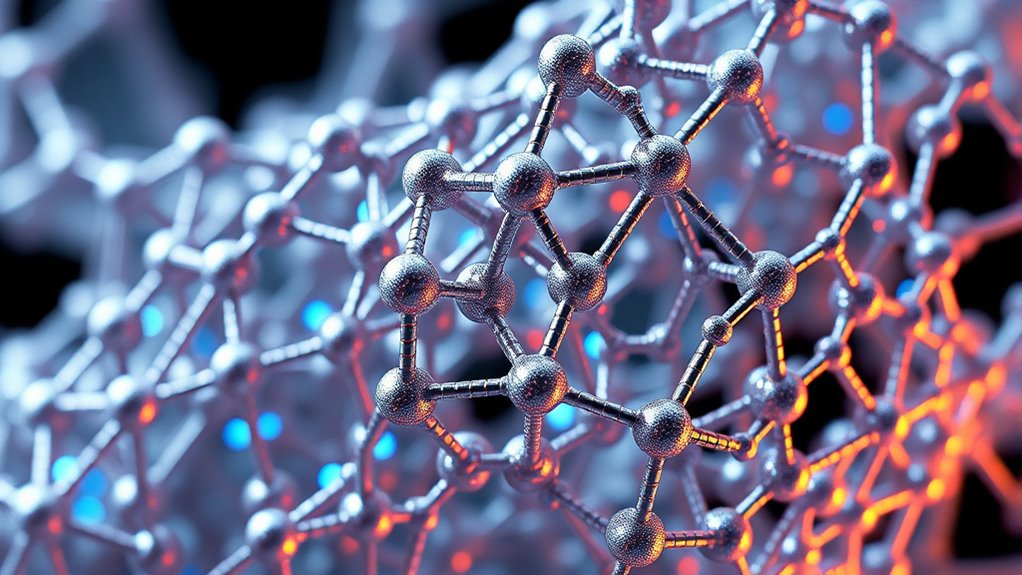
Atomic and molecular structures are fundamental to understanding the true complexity of matter, yet movies often treat them as simple, uniform objects. You might see scenes where materials shrink smoothly, with textures and pores vanishing seamlessly, but real atomic arrangements are discrete and lattice-based, preventing such smooth progressions. Biological organisms at tiny scales don’t operate normally; cellular processes, diffusion, and membrane mechanics change drastically below certain sizes. Textures at the atomic level aren’t homogeneous; they reflect varying forces, bonds, and structures. Additionally, the discrete nature of atoms imposes fundamental limits on how smoothly materials can transition at the nanoscale. The atomic lattice structure introduces irregularities that prevent perfectly uniform changes, further illustrating the complexity involved. Moreover, the interplay of atomic forces creates a dynamic environment that influences material properties in unpredictable ways. Recognizing these atomic-level details is crucial for a more accurate understanding of nanotechnology; oversimplifying these aspects leads to misconceptions about how nanomaterials behave in reality. In fact, the complexity of atomic interactions plays a significant role in determining the behavior of nanomaterials under different conditions.

Thames & Kosmos Nanotechnology Science Experiment Kit
The science of nanotechnology deals with the smallest structures, in the range of one to 100 nanometers in…
As an affiliate, we earn on qualifying purchases.
As an affiliate, we earn on qualifying purchases.
Conservation of Mass and Density in the Quantum Realm

In the world of quantum phenomena, the principles of mass and density remain firmly rooted in classical physics, even as the scale shrinks to atomic and subatomic levels. You can’t ignore that mass is conserved; shrinking an object doesn’t make it lighter. Instead, its density increases proportionally to the volume decrease, but inertia stays the same. Hollywood often depicts shrinking as reducing mass, which contradicts basic physics. To visualize this, consider the table below:
| Scale | Mass | Density | Inertia |
|---|---|---|---|
| Macroscopic | Constant | Variable | Standard |
| Atomic | Constant | Highly variable | Same as classical |
| Subatomic | Constant | Extreme | Same as classical |
| Quantum Domain | Constant | Variable | Same as classical |
This shows that, at any scale, mass stays constant, but density and other properties adapt accordingly. Additionally, understanding conservation of mass is essential for accurate scientific depiction at any scale. Moreover, the concept of density helps explain how properties change with scale without violating physical laws. An understanding of mass distribution is also important for correctly modeling how objects behave in different scenarios. A proper grasp of mass and density is crucial for realistic representations in science fiction involving nanotechnology or quantum effects. Recognizing these principles is crucial for accurate science fiction portrayals involving nanotechnology or quantum effects.

Bloch Sphere Quantum Model Ball – 3D Physics Teaching Aid for Quantum Mechanics | STEM Educational Gift for Students, Teachers & Science Enthusiasts
Visualize Quantum Concepts – Use this 3D Bloch Sphere to demonstrate qubits, superposition, and state rotation.
As an affiliate, we earn on qualifying purchases.
As an affiliate, we earn on qualifying purchases.
Quantum Effects at the Macroscopic Scale: Misconceptions

You might think quantum superposition can happen at human scales, but in reality, environmental noise causes rapid decoherence, destroying quantum states well before they reach macroscopic sizes. This rapid decoherence is primarily due to the environmental noise present in everyday surroundings, which prevents stable quantum effects at larger scales. In addition, thermal fluctuations in the environment further accelerate the loss of quantum coherence, making it exceedingly difficult to observe quantum phenomena outside controlled laboratory conditions. Understanding the environmental limitations is essential to grasping why quantum phenomena remain largely confined to tiny systems. Additionally, the air quality in our environments introduces noise that further inhibits the maintenance of quantum states at larger scales.
Quantum Superposition at Scale
Despite popular portrayals suggesting that quantum superposition can be observed at macroscopic scales, this idea is fundamentally misleading. In reality, quantum superpositions are fragile and easily destroyed by environmental interactions. You might think large objects could exist in multiple states simultaneously, but decoherence prevents this at everyday scales. Here’s why:
- Quantum superpositions require isolated, low-temperature environments; typical macroscopic surroundings cause rapid decoherence.
- Larger objects interact with countless particles, making sustained superposition practically impossible.
- Maintaining coherence at scale demands extreme measures, which are unfeasible outside laboratory conditions.
- The collapse of superposition states happens almost instantly at macroscopic levels, negating any observable quantum behavior.
- Environmental interactions continuously disrupt superposition states, ensuring classical behavior dominates at large scales.
Hollywood’s depiction of macroscopic superpositions ignores these fundamental barriers, exaggerating quantum effects at large scales.
Decoherence and Environmental Effects
Many Hollywood depictions of quantum effects at large scales overlook the critical role of environmental interactions that cause rapid decoherence. In reality, maintaining quantum coherence requires isolating systems from thermal vibrations, electromagnetic noise, and other environmental disturbances. At macroscopic or biological scales, these interactions quickly destroy delicate quantum states, making sustained superpositions impossible without advanced error correction and cryogenic conditions. Films often show characters or objects exploiting quantum effects freely, ignoring that decoherence limits practical applications. Real quantum systems need controlled environments, vacuum chambers, or ultra-low temperatures to function reliably. Ignoring these environmental constraints leads to exaggerated portrayals of quantum phenomena, giving the false impression that quantum effects are easily scalable or naturally occur in everyday settings. quantum coherence is highly sensitive to environmental factors, emphasizing the difficulty of harnessing such effects outside controlled laboratory conditions.
The Reality of Nanotechnology and Material Manipulation

Is nanotechnology as advanced as movies often suggest? Not quite. Current nanotech relies on chemical, physical, and self-assembly techniques rather than magical resizing. To understand its limits:
- Manipulating atomic structures requires precision tools like scanning tunneling microscopes, not instant resizing devices. Additionally, the complexity of atomic interactions makes precise atomic control a significant challenge in practical applications.
- Material properties depend on atomic arrangements; changing them on demand isn’t feasible without complex processes. The intricacies of atomic interactions make dynamic modifications extremely difficult.
- Nanoscale systems face thermodynamic and energy constraints, making rapid, reversible transformations impractical. The challenges of energy efficiency further limit their capabilities.
- Many nanosystems are fragile and sensitive to environmental factors, limiting their stability and function outside controlled labs.
- The process of achieving energetic alignment in nanosystems involves careful control over conditions and energy inputs, highlighting the complexity beyond cinematic portrayals.
- Researchers must often work within strict environmental limitations, which are rarely depicted in Hollywood films.
While nanotech has made significant strides, it’s far from the effortless, all-encompassing manipulation shown in films. Real advances involve meticulous, energy-intensive processes, not cinematic shortcuts.
Environmental Factors and the Fragility of Quantum States

Have you ever wondered why maintaining quantum states outside specialized environments is so challenging? Quantum states are incredibly fragile and easily disturbed by environmental factors like temperature, electromagnetic noise, and vibrations. In real life, even tiny interactions with surrounding particles can cause decoherence, collapsing quantum superpositions. In addition, sticking wall decor and other environmental influences can introduce disturbances that affect quantum coherence. Furthermore, the presence of environmental disturbances can generate errors that are difficult to correct, complicating practical applications. Unlike movies, where quantum effects appear stable and controllable, actual quantum systems require strict isolation—often at near-zero temperatures and in vacuum chambers—to function properly. Thermal noise and stray electromagnetic fields rapidly destroy delicate quantum coherence. Environmental disturbances introduce errors, making reliable quantum control difficult outside lab conditions. This fragility explains why practical quantum technologies, such as quantum computers and sensors, demand complex infrastructure to shield and stabilize their quantum states. Hollywood’s portrayal of resilient, environment-resistant quantum phenomena oversimplifies and misrepresents current scientific realities.
Energy Demands and Material Strength at Nanoscale

When you think about resizing objects at the nanoscale, consider the enormous energy needed to overcome atomic forces and change material structures. The strength of materials also varies dramatically; what holds at a larger scale might fracture or deform easily when scaled down. Additionally, thermodynamic challenges, like heat buildup and chemical reactions, make rapid, reversible size changes practically impossible without significant energy input.
Energy Costs of Resizing
Resizing objects at the nanoscale requires an immense amount of energy because changing their size involves altering atomic bonds, phase states, and surface structures, all of which are governed by thermodynamic principles. You’d need to overcome energy barriers associated with breaking and reforming atomic interactions, which are significant at small scales. Additionally, surface energy increases as objects shrink, demanding more power to stabilize new configurations.
- Breaking atomic bonds consumes energy proportional to bond strength and number.
- Reconfiguring surface atoms requires overcoming surface energy barriers.
- Phase changes, such as melting or solidifying, involve latent heat.
- Controlling temperature and dissipation demands substantial power input.
These factors make rapid, reversible resizing at the nanoscale energetically prohibitive with current technology.
Material Strength Limits
Did you know that at the nanoscale, materials often behave very differently from their macroscopic counterparts due to strength limitations and energy demands? When you shrink objects down, their atomic bonds and surface effects become dominant, often weakening structural integrity. The increased surface area exposes more atoms to external forces, making materials more prone to fractures and surface defects. Unlike in films, you can’t simply assume smaller means stronger—materials may become more fragile or brittle at tiny sizes. Additionally, energy required to maintain or alter structures escalates because atomic bonds resist deformation, and surface energy impacts stability. These factors limit how much you can push materials without causing failure, and they challenge the idea of seamless, damage-free resizing or super-strong nanostructures in real-world applications.
Thermodynamic Challenges
At the nanoscale, thermodynamic principles impose significant energy demands on material transformations. You’d need vast amounts of energy to alter atomic arrangements or change sizes rapidly. This challenges the film’s depiction of effortless resizing and stable nanostructures. Consider these points:
- Energy Costs: Changing size involves overcoming atomic binding energies, generating heat and requiring power sources often omitted in movies.
- Material Stability: Increased surface area during resizing accelerates chemical reactions, risking melting or corrosion.
- Heat Dissipation: Tiny objects generate heat faster than it can disperse, risking structural failure or deformation.
- Entropy and Disorder: Maintaining order at the nanoscale demands energy to counteract natural entropy increases, making reversible transformations complex and energy-intensive.
These thermodynamic hurdles highlight the gap between cinematic fiction and real-world nanotech limitations.
The Myth of Instantaneous Resizing Without Consequences

Although movies often depict characters shrinking or enlarging instantly and effortlessly, this idea ignores the real-world consequences of such drastic size changes. In reality, resizing involves complex atomic and molecular rearrangements that cannot happen instantly. Rapid size shifts would cause extreme stress on materials, risking fractures, deformation, or melting due to thermal and mechanical forces. The conservation of mass and energy means that sudden changes would generate massive heat and impact forces, potentially destroying the object or organism. Biological systems, in particular, rely on finely tuned cellular processes that wouldn’t survive rapid size alterations. furthermore, the energy required for instant resizing is enormous, and current technology cannot bypass the physical limits of thermodynamics, making such effortless transformations physically impossible.
Misrepresenting the Physics of Impact and Momentum

When characters shrink or grow rapidly in movies, the impact and momentum physics often get simplified or overlooked, creating a misleading sense of how forces work at different scales. In reality, conservation of momentum and impact forces don’t change just because size does. You might think a tiny punch is harmless, but with constant mass, the velocity and resulting force could be enormous. Here are key points to contemplate:
- Momentum remains conserved during impact, so a small character’s collision can generate significant force.
- Smaller objects have less inertia, but if mass stays constant, impact energy doesn’t diminish with size.
- Collisions at tiny scales involve high accelerations, leading to destructive forces unrepresented in films.
- Structural integrity and energy transfer don’t scale linearly, so impacts could cause catastrophic damage, not minor bounces.
Bridging the Gap: What Real Nanoscience Can and Cannot Do
You might think nanotechnology offers instant control over matter, but in reality, manipulating atomic structures requires complex, precise methods like lithography or self-assembly, not magic devices. While quantum effects play a role in some nanosystems, they’re highly sensitive to environmental noise and usually need extreme conditions like low temperatures or isolation to work reliably. Understanding these limitations helps set realistic expectations for what nanoscience can achieve today and in the near future.
Limitations of Quantum Control
Quantum control at the nanoscale faces fundamental limitations that prevent it from achieving the precise, large-scale manipulation often depicted in movies. You can’t simply command atoms or molecules like movie characters manipulate objects. Several challenges exist:
- Decoherence: Environmental noise destroys quantum states quickly, making sustained control nearly impossible outside controlled labs.
- Scaling Issues: Quantum effects are difficult to scale up; controlling many particles simultaneously introduces errors and unpredictability.
- Measurement Back-Action: Observing quantum states disturbs them, limiting real-time control and manipulation.
- Limited Quantum Resources: Creating and maintaining macroscopic quantum superpositions or entanglement at human scales remains technologically out of reach.
These constraints show that quantum control, while promising in theory, is far from the cinematic precision often portrayed.
Realistic Nanotech Capabilities
While nanotechnology has advanced considerably, current capabilities are far from the magical resizing and control often shown in movies. Today, nanotech mostly involves manipulating matter through chemical synthesis, lithography, or self-assembly, not instant resizing. We can design nanostructures with specific properties, but we can’t reprogram materials on demand or instantly change their size. Nanoparticles and nanosystems can perform targeted drug delivery or improve materials, yet they require precise manufacturing, error correction, and energy input. The idea of mobile nanoswarms acting with autonomous intelligence is still speculative. Real nanotech faces limitations like thermodynamic constraints, fabrication errors, and environmental effects. Such systems can’t yet match the flexible, on-the-fly control depicted in films, making current nanoscience more about incremental progress than cinematic feats.
Frequently Asked Questions
Can Objects Really Shrink or Grow Instantly Without Energy Costs?
Objects can’t really shrink or grow instantly without energy costs. When you change an object’s size, you need energy to break or form atomic bonds, rearrange structures, and overcome thermodynamic barriers. This process involves heat, work, and possibly material deformation, all of which consume energy. So, in reality, size changes are slow, complex, and require significant energy input—far from the quick, effortless resizing seen in movies.
Do Quantum Effects Allow Macroscopic Objects to Behave Like Particles?
A picture is worth a thousand words, but quantum effects don’t turn big objects into particles. You might see films suggest that macroscopic objects behave like particles, but in reality, quantum phenomena dominate at tiny scales. The larger an object, the less its quantum behavior influences it. Macroscopic objects follow classical physics, where quantum effects are negligible. So, no, quantum effects don’t make large objects act like particles in everyday life.
Is It Possible to Manipulate Atomic Structures With a Handheld Device?
No, manipulating atomic structures with a handheld device isn’t currently possible. Real nanotechnology involves precise methods like chemical synthesis, lithography, or self-assembly, which require controlled environments and complex equipment. While research is advancing, the idea of a simple, portable device that directly rearranges atoms or molecules on demand is science fiction. Achieving such control would demand overcoming enormous technical and physical challenges, including thermodynamic limits and error correction.
How Realistic Are Nanoswarms Functioning as Autonomous Agents?
Nanoswarms acting as autonomous agents are more sci-fi fantasy than reality. Think of them as tiny, conscious clouds with minds of their own—something current nanotechnology can’t achieve. They lack the complexity, coordination, and self-awareness needed for true autonomy. Real nanosystems are limited by environmental noise, control challenges, and fabrication constraints. So, while fascinating to imagine, these swarms remain a distant dream, not a tomorrow’s reality.
Can Biological Systems Reliably Exploit Quantum Phenomena at Room Temperature?
Biological systems can’t reliably exploit quantum phenomena at room temperature yet. The environment causes decoherence, destroying delicate quantum states quickly. While some evidence suggests certain biological processes may use quantum effects, they work only under specific conditions and are challenging to control. You shouldn’t expect everyday biological functions to harness quantum mechanics reliably at room temperature, as environmental noise and thermal energy remain significant obstacles.
Conclusion
Imagine nanotech as a delicate, intricate garden—each tiny plant carefully crafted, not a magic wand that instantly reshapes everything. Hollywood often shows you a quick cut-and-paste world, but in reality, you’re tending a complex ecosystem where every change matters. True nanoscience isn’t about instant transformation; it’s about understanding the subtle dance of atoms and energy. So, next time you see a sci-fi fix, remember: real science grows patiently, like a garden in bloom.