📊 Full opportunity report: Is A Skincare Measurement App Right For Your Grooming Routine? on IdeaNavigator AI — validation score, market gap, and execution plan.

Get the latest gadgets delivered free with Prime
- Fast, free delivery on millions of items
- Prime Video, Amazon Music and more included
- Member-only deals all year
TL;DR
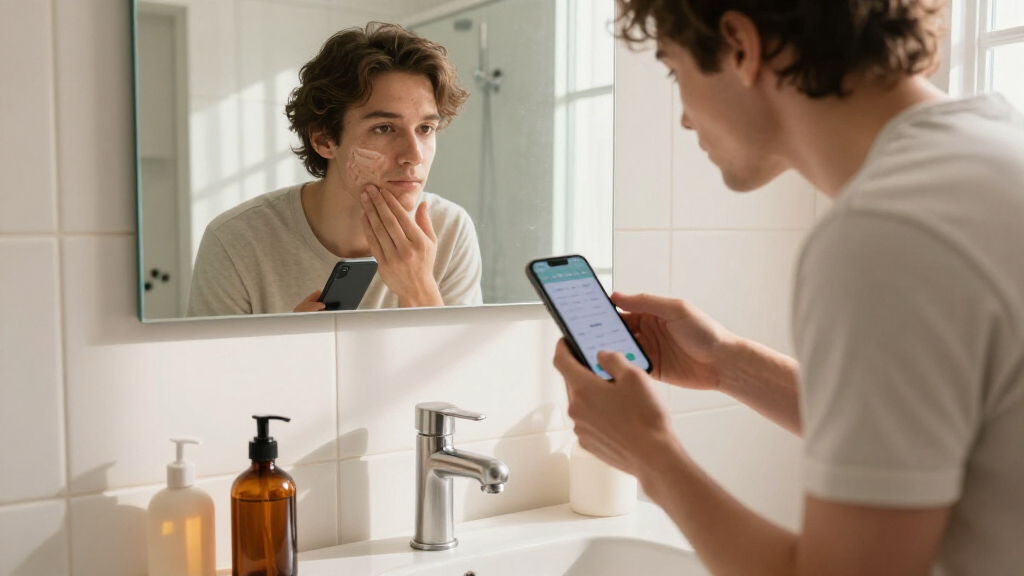
IdeaNavigator AI has proposed a skincare progress-tracking app aimed at men who want to measure whether a new routine is working. The concept includes guided weekly selfies, routine logs and progress cards, but the material describes a product opportunity and a validation plan—not a launched app or evidence that the approach works.
IdeaNavigator AI has proposed testing a skincare measurement app for men who are new to routines and want visible evidence of progress. The concept calls for weekly guided selfies, routine logging and progress cards, but no app launch, clinical validation or customer test results are reported.
In its proposal, IdeaNavigator AI identifies men newly invested in skincare as the initial audience: people who want an easy way to answer whether their routine is helping. The idea frames the problem as both practical and presentational: users may want a record of changes, while existing beauty apps may not feel designed or marketed for them. The proposal offers this as a product hypothesis, not evidence that men broadly avoid those apps.
IdeaNavigator AI suggests a minimum product that would ask users to take guided weekly selfies and track skin clarity, texture and dark circles. It would pair those images with routine logs, streaks and progress cards described in the language of training metrics. The proposal also suggests a subscription business and affiliate product recommendations linked to perceived skincare gaps. It does not specify pricing, how scores would be calculated, or how recommendations would be checked for suitability.
For validation, IdeaNavigator AI recommends comparing the same image-capture technology under men’s-training branding and neutral branding, then measuring conversion and retention by audience segment. The proposal gives no sample size, test results or launch plan. The central development is therefore a proposed experiment—not a confirmed product release or demonstrated market opportunity.
Testing Demand Before Building
The proposal matters because it turns a broad claim about men’s grooming into a testable product question: does framing routine tracking as training make prospective users more likely to try and keep using it? IdeaNavigator AI proposes comparing branding while holding the capture technology constant, which could help distinguish interest in the underlying tool from interest in its presentation.
If users find tracking useful, a regular record could help them notice gradual changes and keep track of what products they use. But the same features could create misplaced confidence if scores are inconsistent or recommendations imply a diagnosis. Conversion and retention alone would not establish that an app measures skin accurately or improves skin health. Those outcomes would need separate evaluation.
The commercial model also creates a question about trust. IdeaNavigator AI suggests affiliate links tied to measured gaps, which could make product discovery easier, but recommendations that generate revenue may not be neutral. Users would need clear disclosure and a way to distinguish a tracking feature from a medical assessment. The proposal specifies none of those safeguards or product details.
men's skincare progress tracking app
As an affiliate, we earn on qualifying purchases.
As an affiliate, we earn on qualifying purchases.
A Narrow Grooming-Tech Concept
IdeaNavigator AI describes the opportunity as a men’s grooming technology product, aimed at a customer who wants a scoreboard for skincare progress. Its proposal says men’s skincare is growing and points to looksmaxxing culture as a reason users may respond to metrics and gamification. It provides no market figures or independent evidence for those claims, so they should be treated as the proposal’s rationale rather than established market measurements.
The suggested approach is deliberately narrow: begin with one user group and one recurring task rather than attempt to build a broad beauty platform. IdeaNavigator AI proposes weekly capture, routine records and streaks as the initial workflow. It recommends a branding test comparing a men’s-training presentation with a neutral one, but does not say how skin images would be scored or whether scores would be reviewed against a reliable standard.
This distinction matters because recording a selfie is straightforward, while interpreting changes over time can be affected by lighting, camera angle, expression and other conditions. IdeaNavigator AI’s proposal identifies features and a business model, but gives no technical specifications, privacy policy, clinical evidence or operating company details.
As an affiliate, we earn on qualifying purchases.
Accuracy, Privacy and Demand
IdeaNavigator AI’s proposal confirms no app or test results. It remains unknown whether men in the intended audience would use weekly selfies, whether men’s-training branding would improve sign-ups or retention, and whether any effect would persist beyond initial curiosity.
The measurement method is also unspecified in the proposal. It provides no information about image standards, score reliability, the handling of changes in lighting or how the app would distinguish ordinary variation from meaningful progress. It reports no clinical review or evidence that the proposed categories—clarity, texture and dark circles—can be assessed consistently by the planned tool.
Privacy and commercial details remain open as well. IdeaNavigator AI does not explain how facial images would be stored, protected or deleted, nor how affiliate recommendations would be selected and disclosed. The proposal gives no pricing, launch timeline or evidence that a subscription model would be acceptable to users.
skin routine logging journal for men
As an affiliate, we earn on qualifying purchases.
As an affiliate, we earn on qualifying purchases.
The Proposed Branding Test
IdeaNavigator AI’s proposed next step is to test men’s-training branding against neutral branding using the same capture technology. The comparison would track conversion and retention across audience segments. The proposal announces no schedule, recruitment plan or results, so it is not clear whether or when that test will take place.
Before a public launch, a developer would also need to define how progress scores work and test whether they remain consistent across repeated captures. Clear image-handling rules, transparent affiliate disclosures and a distinction between cosmetic tracking and medical advice would address questions the proposal leaves unanswered. For now, the idea is at the validation stage: its appeal and measurement claims have not been established.
Source: IdeaNavigator AI’s proposal for a men’s skincare tracker
As an affiliate, we earn on qualifying purchases.
Key Questions
Has a men’s skincare measurement app launched?
No launch is reported. IdeaNavigator AI presents a product concept and a suggested validation test, not a released app.
What would the proposed app track?
IdeaNavigator AI’s suggested version would use weekly guided selfies to track skin clarity, texture and dark circles, alongside routine logs, streaks and progress cards. The scoring method is not described.
Would the app prove that a skincare routine works?
That has not been established. IdeaNavigator AI’s proposal provides no evidence that its scores would be accurate or that using the app would improve skin. A tracking record would not, by itself, confirm a product’s effectiveness.
How does the proposal suggest testing demand?
IdeaNavigator AI recommends comparing the same capture technology presented with men’s-training branding and neutral branding, then comparing conversion and retention by segment. No results or test dates are provided.
How might the app make money?
IdeaNavigator AI suggests a model combining a subscription with affiliate product recommendations connected to tracked needs. Pricing, recommendation criteria and disclosure practices are not specified.
Source: IdeaNavigator AI
Halloween Picks
halloween
As an affiliate, we earn on qualifying purchases.