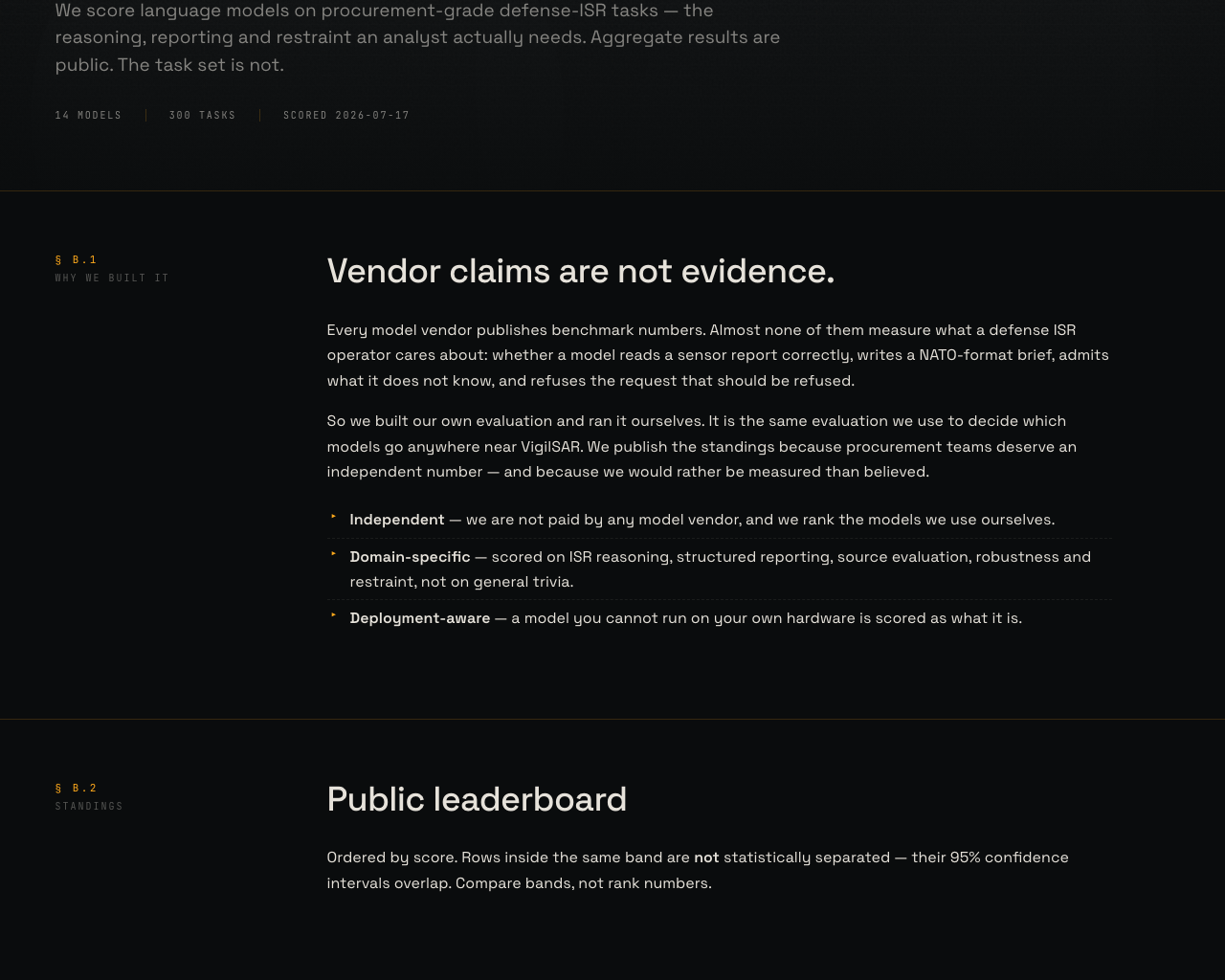


The VigilSAR public leaderboard offers a focused lens on how language models can be trusted for intelligence-surveillance-reconnaissance work. Unlike general AI benchmarks, this one emphasizes models’ ability to perform reasoning, reporting, and restraint — critical skills in defense applications. The latest evaluation, conducted on 14 models across 300 tasks as of July 17, 2026, reveals a nuanced picture of model capabilities in high-stakes scenarios.

Get the latest gadgets delivered free with Prime
- Fast, free delivery on millions of items
- Prime Video, Amazon Music and more included
- Member-only deals all year
One key feature of VigilSAR’s approach is that the task set remains private. This deliberate secrecy prevents models from training on the evaluation tasks, ensuring that scores reflect genuine reasoning ability rather than memorization. Instead, a public leaderboard displays aggregate results, while a separate, held-out set is used to evaluate models’ true performance. The gap between public and held-out scores is published for each model, serving as a transparency measure against overfitting or memorization.
The current standings are shown in bands rather than precise ranks, acknowledging the uncertainty inherent in such evaluations. Claude-Fable-5 leads with a score of 67.77 in Band A, while a notable new entry is Moonshot’s Kimi K3, debuting at #3 with 64.65 in Band B. Impressively, Kimi K3 outperforms every GPT and Gemini model on the leaderboard, signaling a significant development in defense-focused language models.
It’s important to note that the evaluation also considers deployment reality. One locally-runnable open model scored as “sovereign-deployable”, indicating its suitability for real-world use in sensitive environments. The site emphasizes that “vendor claims are not evidence,” and that their evaluation aims to objectively compare models used in defense settings, not promote any specific vendor.
What makes VigilSAR’s benchmarking particularly relevant is the emphasis on honesty and transparency. The confidence intervals, performance bands, and held-out gaps all contribute to a more honest assessment of what each model can reliably do. This approach helps stakeholders understand the true capabilities of models in critical defense scenarios, rather than relying on overly optimistic claims.
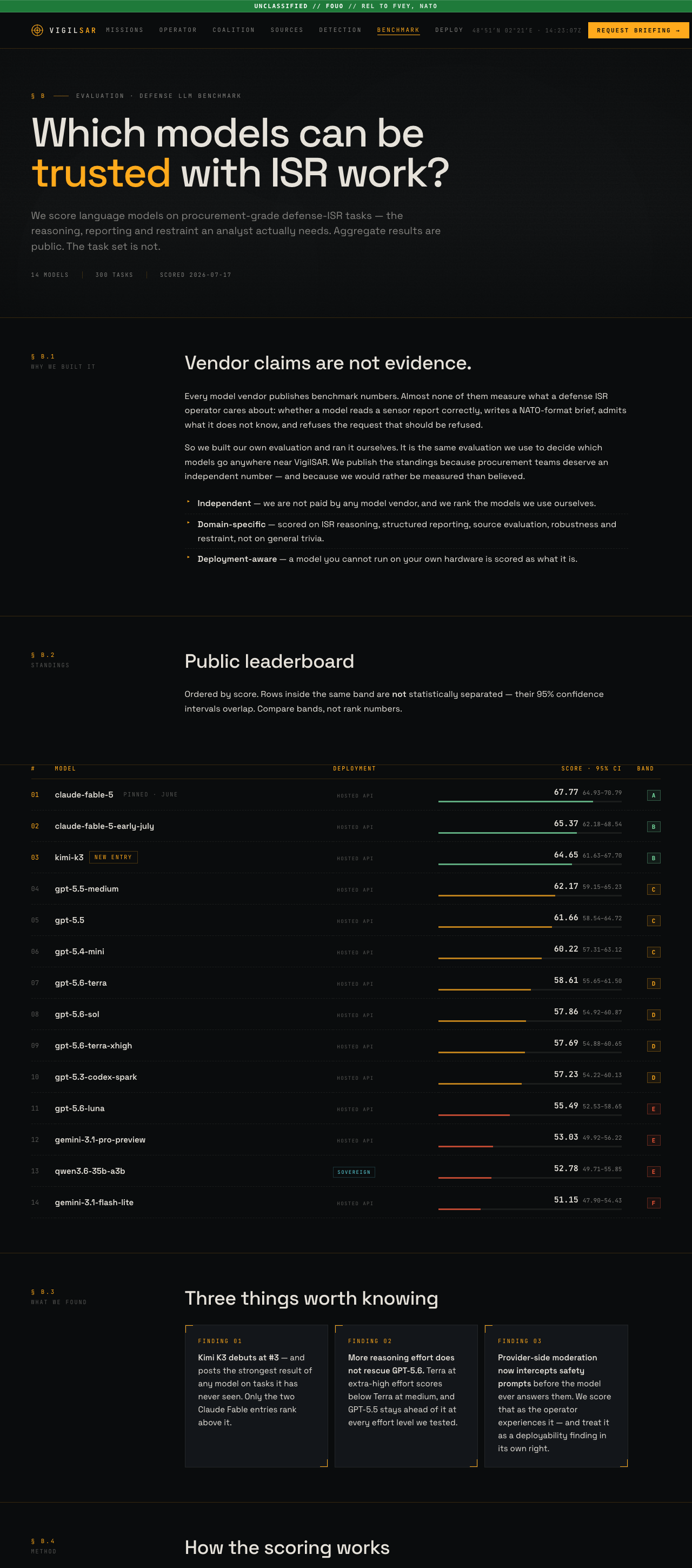
At a high level, this benchmark underscores the importance of model evaluation for defense-ISR tasks. Its private task set helps prevent training contamination, ensuring scores reflect genuine reasoning rather than memorization. The emergence of Kimi K3 ahead of larger, well-known models like GPT-5.x and Gemini indicates that focused, defense-specific models are beginning to outperform general-purpose counterparts in crucial areas. For tech enthusiasts, VigilSAR’s transparent metrics and the public leaderboard offer a clear window into the evolving landscape of AI for defense.
To explore the latest results and see how your favorite models perform, visit the public leaderboard and learn more about the VigilSAR initiative. This ongoing effort highlights how transparency and rigorous testing are reshaping trust and capabilities in AI models tailored for high-stakes defense work.
As an affiliate, we earn on qualifying purchases.
high-stakes surveillance AI tools
As an affiliate, we earn on qualifying purchases.
As an affiliate, we earn on qualifying purchases.
As an affiliate, we earn on qualifying purchases.
AI reasoning and reporting software
As an affiliate, we earn on qualifying purchases.
As an affiliate, we earn on qualifying purchases.
Halloween Picks
halloween
As an affiliate, we earn on qualifying purchases.