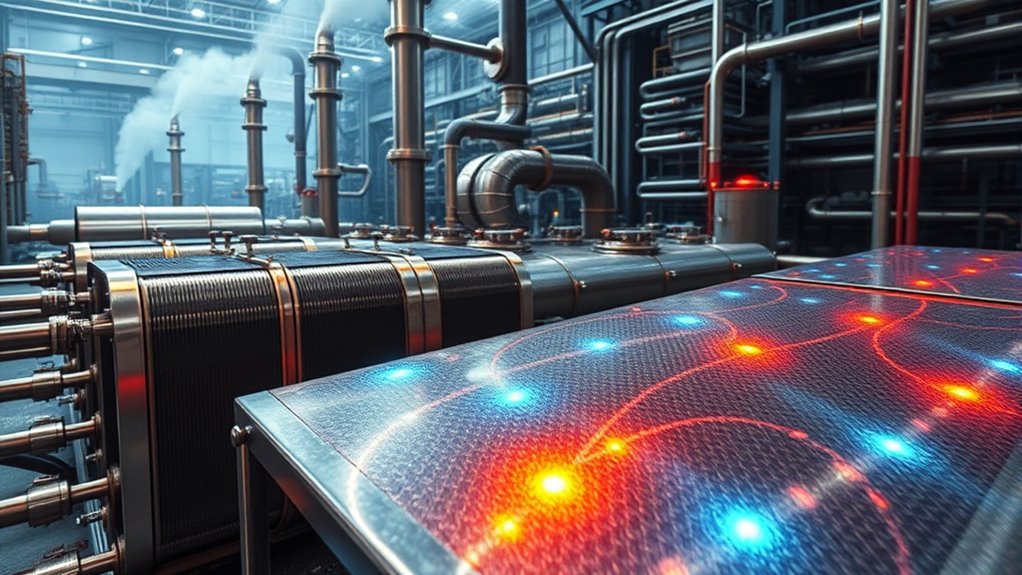

Using nanotechnology for industrial waste heat recovery lets you boost energy efficiency and cut costs. Nanoparticles enhance heat transfer processes, allowing your systems to recover more heat at various temperatures. They withstand extreme conditions and improve system longevity, making your operations more sustainable. As nanotech solutions become more affordable and customizable, they’re transforming how industries reduce waste and emissions. Continue exploring to discover how these innovations can help you maximize your energy recovery potential.
Key Takeaways
- Nanoparticles enhance heat transfer efficiency in industrial waste heat recovery systems.
- Incorporating nanotech materials improves system durability and performance at high temperatures.
- Nanoparticle-enriched fluids enable faster, more effective energy recovery from waste heat sources.
- Advances in nanotechnology are making waste heat recovery solutions more cost-effective and scalable.
- Implementing nanotech in heat exchangers reduces operational costs and supports sustainable industrial practices.

Industrial waste heat represents a significant and often overlooked energy resource that industries generate daily. Many manufacturing processes release heat at temperatures that, if captured effectively, could provide a valuable source of energy. The challenge lies in finding ways to extract this heat efficiently and convert it into usable power or thermal energy. This is where nanotechnology, particularly the use of nanoparticles, can make a real difference. By improving nanoparticle efficiency, engineers can develop advanced materials that enhance heat transfer processes, making waste heat recovery more practical and cost-effective.
Nanoparticles are tiny particles, typically less than 100 nanometers in size, that possess unique thermal properties compared to bulk materials. When incorporated into heat transfer fluids or surfaces, they substantially boost heat transfer efficiency. This heat transfer enhancement means that heat can be captured, transferred, and utilized more quickly and with less energy loss. As a result, industries can recover a larger portion of their waste heat, reducing overall energy consumption and lowering operational costs. The key lies in optimizing nanoparticle efficiency, ensuring that these particles maximize their thermal conductivity without causing undue system complexity or cost.
Nanoparticles boost heat transfer efficiency, enabling industries to recover more waste heat with less energy loss.
Implementing nanoparticles in heat exchangers, for example, allows for faster and more effective heat exchange between hot industrial fluids and secondary systems. This leads to higher thermal performance and better energy recovery rates. Additionally, nanoparticles can be engineered to withstand extreme temperatures and corrosive environments typical of industrial settings, further improving their practicality. As a result, heat transfer enhancement through nanotech not only improves efficiency but also extends the lifespan of heat recovery systems, providing long-term benefits. Furthermore, ongoing research into vetted nanoparticle materials helps ensure that these solutions are both safe and environmentally sustainable.
Another advantage of using nanotechnology for waste heat recovery is the potential for customization. Different industries produce varying types and temperatures of waste heat, and nanoparticles can be tailored to meet specific thermal requirements. This flexibility means that industries can adopt nanotech solutions that are precisely suited to their processes, maximizing energy recovery and minimizing waste. With ongoing advancements, nanoparticle technology is becoming increasingly affordable and scalable, making it more accessible for widespread industrial use.
Top picks for "industrial waste heat"
Open Amazon search results for this keyword.
As an affiliate, we earn on qualifying purchases.
Frequently Asked Questions
How Cost-Effective Is Nanotech for Waste Heat Recovery?
Nanotech for waste heat recovery can be cost-effective, especially when you consider the cost analysis showing long-term savings through increased efficiency. While initial investments might be higher, rapid market adoption is driving down prices and improving performance. You’ll likely see a good return on investment over time, making nanotech a promising solution for reducing energy costs and boosting sustainability in industrial processes.
What Environmental Impacts Do Nanomaterials Have?
You should consider that nanomaterials can pose environmental impacts, mainly due to nanomaterial toxicity and environmental pollution. These tiny particles might harm ecosystems if released into water or soil, and their toxicity could affect human health. When handling or disposing of nanomaterials, it’s essential to follow proper safety protocols to minimize risks. Ongoing research aims to better understand and reduce these potential environmental hazards associated with nanotech use.
Can Nanotech Be Integrated Into Existing Industrial Systems?
Yes, nanotech integration is feasible in existing industrial systems, but it requires careful industrial adaptation. You can upgrade current equipment by incorporating nanomaterials to enhance efficiency, durability, and heat recovery. This process involves modifying components and optimizing processes, which may need some planning and investment. With proper adaptation, nanotech can seamlessly improve industrial operations, making them more sustainable and energy-efficient without overhauling entire systems.
What Are the Long-Term Durability Concerns of Nanomaterials?
Like a delicate spider’s web, nanomaterials face long-term durability concerns. You should watch for nanomaterial degradation, which affects their long-term stability and performance over time. Environmental factors, such as moisture, temperature fluctuations, and chemical exposure, can weaken these tiny materials. Ensuring their durability requires ongoing research and protective coatings, so you can confidently use nanotech solutions without fearing premature failure or loss of efficiency.
How Scalable Are Nanotech Solutions for Large Industries?
You’ll find that nanotech solutions face significant scalability challenges due to manufacturing hurdles. Producing nanomaterials at a large industry scale requires advanced, cost-effective methods, which are still developing. While initial lab results are promising, scaling up involves ensuring consistent quality and integrating these solutions into existing systems. Overcoming these hurdles is essential for widespread adoption, but progress is steady as research continues to address these scalability challenges.
Conclusion
So, next time you’re marveling at how industries waste heat, just remember—it’s not like we’re already harnessing every drop of energy, right? With nanotech, maybe we can finally catch that elusive leftover warmth, turning it into gold—or at least a little more efficiency. But hey, who needs progress when ignoring waste keeps us comfortably complacent? After all, why fix what’s not broken, especially when it’s so much easier to just keep ignoring the heat?