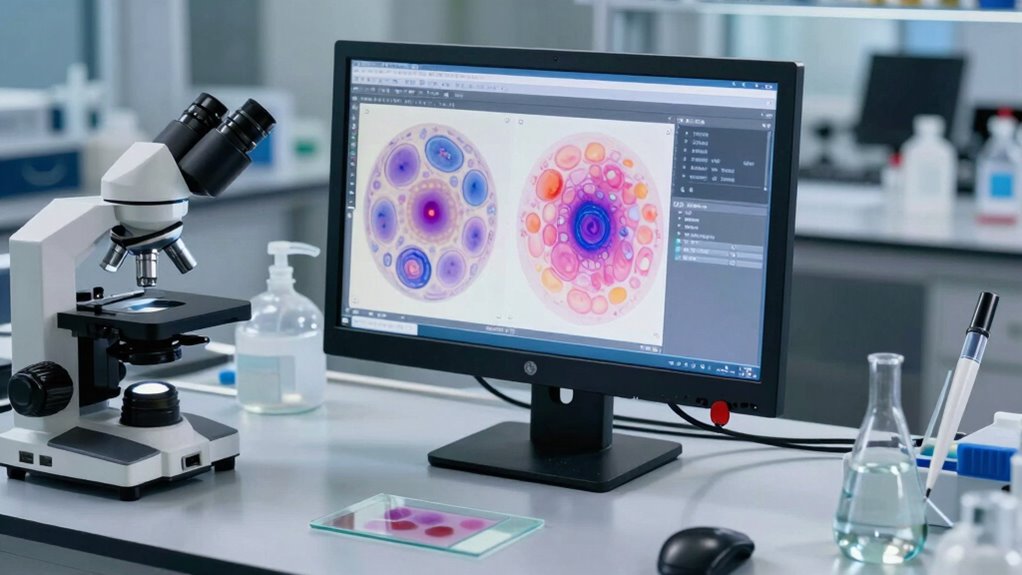

Microscope monitor systems in modern labs give you high-resolution screens that replace traditional eyepieces, making it easier to see and analyze specimens. They improve your comfort with adjustable, ergonomic designs that reduce fatigue during long hours. Plus, seamless connectivity and automation boost your workflow, allowing quick data sharing and more precise results. These advancements are transforming lab work by combining clarity, comfort, and efficiency—keep exploring to discover how these systems can enhance your research.
Key Takeaways
- Microscope monitor systems enhance image clarity, documentation, and sharing, improving accuracy in modern laboratory workflows.
- Ergonomic features reduce physical strain, enabling longer, more comfortable examination sessions.
- Seamless integration with digital tools streamlines data management, collaboration, and automation.
- They significantly boost productivity by speeding up image capture, analysis, and reporting processes.
- Continuous technological advancements ensure these systems evolve to support precise, efficient, and user-friendly lab operations.

In today’s modern laboratories, microscope monitor systems have become essential tools that enhance precision and efficiency. These systems replace traditional eyepieces with high-resolution screens, allowing you to view specimens more clearly and collaborate seamlessly with colleagues. One of the most significant advancements is digital imaging, which transforms how you analyze and document your observations. With digital imaging, you can capture detailed images and videos of samples, making it easier to analyze features, compare results, and share findings instantly. This technology reduces the need for physical slide handling, minimizes errors, and accelerates the workflow. Plus, digital images can be stored, annotated, and retrieved effortlessly, streamlining your research or diagnostic processes. Incorporating digital imaging into your workflow also enables automated analysis techniques, further increasing productivity and accuracy.
Equally important is the ergonomic design built into these monitor systems. Long hours at the microscope can strain your eyes, neck, and back, but ergonomic features help mitigate these issues. Adjustable monitor stands and tilting screens allow you to position the display at a comfortable viewing angle, reducing neck and eye fatigue. The interface is typically intuitive, with user-friendly controls that eliminate the need for complex adjustments, so you can focus on your work rather than wrestling with hardware. The placement of controls and the size of the display are optimized for ease of use, which means less physical strain and better concentration during detailed examinations. An ergonomic design isn’t just about comfort; it directly impacts your accuracy and productivity, especially during extended sessions. User-friendly interfaces further enhance ease of operation, making the system accessible to users with varying levels of technical expertise. Incorporating ergonomic features is crucial for maintaining health and efficiency during prolonged laboratory tasks. Additionally, ongoing advancements in metaphysical topics are inspiring new ways to optimize laboratory environments for holistic well-being and technical excellence.
These systems also integrate seamlessly with other lab equipment, promoting a more efficient workflow. For example, digital imaging capabilities allow you to connect directly to computers or cloud storage, enabling quick sharing of data with team members or remote collaborators. The intuitive interface often includes touchscreens or programmable buttons, which speed up routine tasks like adjusting contrast, zooming, or capturing images. Additionally, the compact design of many systems doesn’t take up excessive space in your workspace, helping you maintain an organized lab environment. Overall, the combination of digital imaging and ergonomic design in microscope monitor systems offers a tangible upgrade to traditional microscopy, giving you sharper images, greater comfort, and faster results. They empower you to work more precisely and comfortably, ultimately advancing your research or diagnostics with less frustration and more confidence.
![[Infinity-Corrected] Trinocular Compound Microscope with 10" 24MP Monitor, 40-1000X Magnification, Infinity Achromatic Objectives FL10X Eyepieces,Large Mechanical Stage, One-click taking photo & video](https://m.media-amazon.com/images/I/41DIZde6CrL._SL500_.jpg)
[Infinity-Corrected] Trinocular Compound Microscope with 10" 24MP Monitor, 40-1000X Magnification, Infinity Achromatic Objectives FL10X Eyepieces,Large Mechanical Stage, One-click taking photo & video
[Infinity Optical System Objective & 22mm Flat Field Eyepiece]: The objective optical path is parallel, offering wide, flat…
As an affiliate, we earn on qualifying purchases.
As an affiliate, we earn on qualifying purchases.
Frequently Asked Questions
How Do Microscope Monitor Systems Impact Lab Workflow Efficiency?
Microscope monitor systems considerably boost your lab workflow efficiency by streamlining sample preparation and data management. You can quickly view and analyze samples on high-resolution monitors, reducing time spent switching between microscopes and screens. Integrated data management allows you to store, organize, and access images effortlessly, minimizing errors and enhancing collaboration. Overall, these systems help you work faster, more accurately, and with better organization, optimizing your entire lab process.
Are Microscope Monitor Systems Compatible With All Microscope Brands?
You’ll find that microscope monitor systems aren’t compatible with all microscope brands, as brand compatibility varies. Before purchasing, confirm the system supports your specific microscope brand and model. Additionally, check if the monitor system requires equipment calibration to function correctly, preventing issues like image distortion. Proper calibration and verifying brand compatibility help you optimize your lab’s workflow, ensuring seamless integration and accurate results.
What Are the Long-Term Maintenance Costs for These Systems?
Long-term maintenance costs for microscope monitor systems depend on your cost analysis and durability concerns. You’ll find that investing in high-quality, durable components reduces frequent repairs and replacements, ultimately lowering costs. Regular cleaning, software updates, and timely hardware inspections are essential. While initial expenses might seem high, focusing on durability guarantees fewer breakdowns, saving money over time. Be proactive with maintenance to keep your system running smoothly and cost-effectively.
Can These Systems Be Integrated With Existing Lab Software?
Imagine your lab’s existing software as a well-oiled machine. You can seamlessly integrate these microscope monitor systems, especially if they support flexible user interfaces. They often come with compatibility features for image calibration and data sharing, making the shift smooth. You’ll find that these systems adapt to your workflow, allowing you to manage images effortlessly and enhance collaboration without disrupting your current setup.
How Do Microscope Monitor Systems Enhance Research Accuracy?
Microscope monitor systems boost your research accuracy by providing real-time imaging calibration, ensuring clear and precise visuals. They help you verify sample preparation quality instantly, reducing errors. With integrated software, you can adjust settings on the fly, improving image fidelity. This combination streamlines your workflow, minimizes misinterpretations, and increases confidence in your findings, ultimately leading to more reliable, reproducible results in your experiments.

TOMLOV DM9 7" Digital Microscope: 1080P 1200X Coin Microscope Magnifier, 12MP Ultra-Precise Focusing LCD Soldering Microscopes for Adults, PC View, 32GB
Tons of Fun and Applications: With easy-to-use operation and a wide range of applications, from micro soldering and…
As an affiliate, we earn on qualifying purchases.
As an affiliate, we earn on qualifying purchases.
Conclusion
Just as the eagle’s keen eyesight transforms how it surveys the landscape, modern microscope monitor systems elevate your lab’s precision and efficiency. By embracing these innovations, you’re not just observing — you’re seeing the unseen, opening new domains of discovery. In a world where clarity is key, these systems serve as your vigilant eye, guiding you through the intricacies of your research with unwavering focus and insight. The future of microscopy is truly within your reach.

White JYF-10B Lab Wall Mounted Imaging Digital System Unit 60KV Color
Use the international advanced technology, high-efficiency, clear imaging
As an affiliate, we earn on qualifying purchases.
As an affiliate, we earn on qualifying purchases.

Max 21-inch Adjustable Universal Stand for Digital Microscopes – 360° Rotating Arm, Table Clamp Included – Supports Up to 6cm Diameter USB/WiFi Microscopes – Ideal for Lab, Electronics, and DIY
21-Inch Height Adjustability: Effortlessly raise or lower the stand from 0 to 21 inches (53.3cm) using dual gas…
As an affiliate, we earn on qualifying purchases.
As an affiliate, we earn on qualifying purchases.