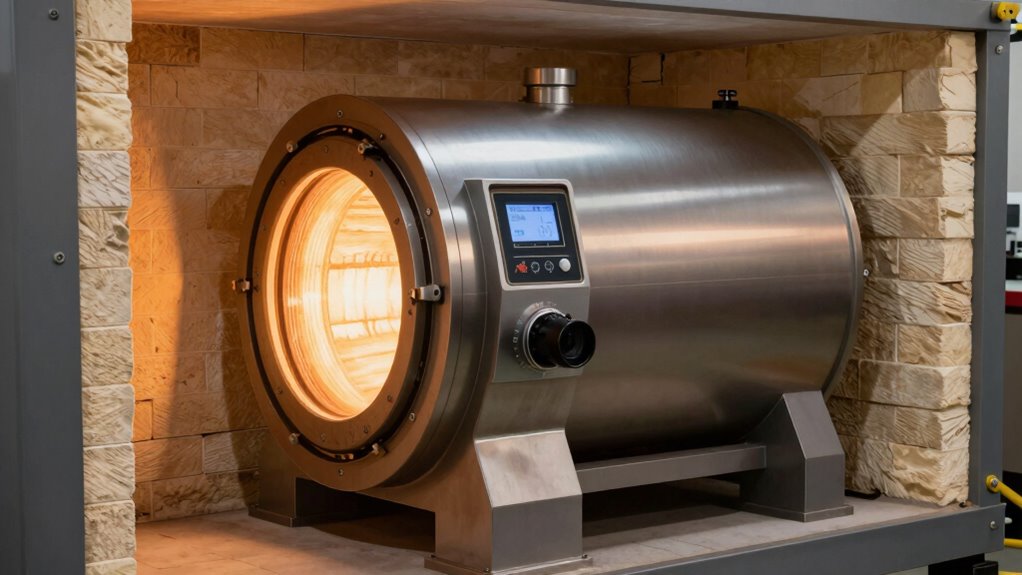
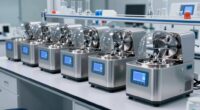
Choosing between these two 1100°C laboratory furnaces comes down to process format and the details you need specified. The EQCOTWEA Mini Tube Furnace is the clearer choice for controlled inert-gas work: its listing gives a 120 mm constant-temperature zone, programmable heating rate, and leakage and temperature alerts. The Yokoma Vacuum Furnace instead emphasizes a hinged chamber, vacuum hardware, and a broader stated application range. Both specify ±1°C control, but neither is described as suitable for extended operation at its maximum temperature. I would match the equipment to the sample geometry, atmosphere, and duty cycle before treating either as a general-purpose solution.

Get the latest gadgets delivered free with Prime
- Fast, free delivery on millions of items
- Prime Video, Amazon Music and more included
- Member-only deals all year
Complete the kit


Key Takeaways
- The EQCOTWEA is the more specifically documented choice for tube-based inert-atmosphere processes, with a 120 mm constant-temperature zone and support for nitrogen, argon, and other inert gases.
- The Yokoma is the better fit when hinged chamber access and listed vacuum applications such as annealing or CVD are central to the workflow.
- Both listings state ±1°C temperature control and a 1100°C ceiling, while describing that maximum as a short-term limit rather than an extended operating point.
- EQCOTWEA specifies a 30-segment PID controller, adjustable heating rate, leakage alerts, and a pressure ceiling below 0.02 MPa; these details help define its process boundaries.
- Yokoma lists a 55.1 lb weight and 29.5 x 13 x 15.1 inch dimensions, while the EQCOTWEA listing supplies more tube and process specifications but omits overall dimensions.
| EQCOTWEA Laboratory Mini Tube Furnace, 1100°C, Programmable PID, 2 kW, 220 V |  | Best Overall for Defined Tube Processes | Maximum temperature: 1100°C, short-term use | Temperature accuracy: ±1°C | Temperature-field uniformity: ±3°C | VIEW ON AMAZON | See Our Full Breakdown |
| Yokoma High Temperature Laboratory Vacuum Furnace, Max 1100°C, AC220V Single-Phase |  | Best for Vacuum Access and Chamber Handling | Maximum temperature: 1100°C | Temperature control precision: ±1°C | Power: AC220V, single phase | VIEW ON AMAZON | See Our Full Breakdown |
| tube furnace | Maximum temperature | Temperature accuracy | Temperature-field uniformity | Controller |
|---|---|---|---|---|
| EQCOTWEA Laboratory Mini Tube | 1100°C, short-term use | ±1°C | ±3°C | 30-segment programmable PID |
| Yokoma High Temperature Labora | 1100°C | — | — | — |
More Details on Our Top Picks
EQCOTWEA Laboratory Mini Tube Furnace, 1100°C, Programmable PID, 2 kW, 220 V
The EQCOTWEA Mini Tube Furnace earns the first spot because its listing gives buyers more of the details needed to judge a tube-based setup. It specifies a 120 mm constant-temperature zone, a SiO₂ working tube, a 30-segment PID program, and a 0–15°C/min heating rate. Those figures help a buyer compare the furnace to sample length and ramp requirements; Yokoma’s description gives a broader laboratory application range but does not state a tube-zone length or working-tube material.
For atmosphere work, EQCOTWEA names nitrogen, argon, and other inert gases, and lists leakage protection and temperature-deviation alerts. These are useful process controls, though the published positive-pressure ceiling is below 0.02 MPa. That makes this a low-pressure setup, not a basis for assuming pressurized operation. The Yokoma listing, by comparison, calls out a stainless-steel high-vacuum valve and quick-release flanges, which may matter more when vacuum hardware is the deciding factor.
Temperature control is listed at ±1°C, with 0.1°C display resolution and ±3°C temperature-field uniformity. Those are different measures: the display’s decimal place does not mean the full heated zone stays within a tenth of a degree. Its 1100°C maximum is for short-term use, so a process that holds near the ceiling for long periods needs careful confirmation. I would choose it over Yokoma for a compact, programmable inert-atmosphere workflow with a defined heated length; I would skip it if the sample needs a longer uniform zone, substantial pressure, or continuous maximum-temperature duty.
Pros:- States a 120 mm constant-temperature zone and SiO₂ working tube.
- 30-segment PID program and adjustable 0–15°C/min heating rate.
- Supports nitrogen, argon, and other inert gases.
- Lists leakage protection and temperature-deviation alerts.
Cons:- The 1100°C ceiling is specified for short-term use.
- Positive pressure is limited to below 0.02 MPa.
- The listing does not provide overall dimensions or weight.
Best for: Researchers and process operators who need a programmable mini tube furnace for short samples and low-pressure inert-atmosphere work.
Not ideal for: Buyers who need a long constant-temperature zone, pressure above the stated limit, or extended operation at 1100°C.
- Maximum temperature:1100°C, short-term use
- Temperature accuracy:±1°C
- Temperature-field uniformity:±3°C
- Controller:30-segment programmable PID
- Constant-temperature zone:120 mm
- Working tube:SiO₂
- Power and voltage:2 kW, 220 V, single phase
- Compatible gases:Nitrogen, argon, and other inert gases
- Maximum positive pressure:Below 0.02 MPa
Our verdict“I would start with EQCOTWEA for programmable, short-sample inert-gas work, provided its 120 mm zone and low pressure limit fit the process.”
Yokoma High Temperature Laboratory Vacuum Furnace, Max 1100°C, AC220V Single-Phase
Yokoma’s laboratory furnace takes second place because it offers a different kind of flexibility: its description centers on vacuum and atmosphere work, with a 304 stainless-steel high-vacuum valve, quick-release flanges, and a chamber that opens 90 degrees. That hinged access can make loading, sample retrieval, and cleaning less awkward than a fixed tube arrangement. EQCOTWEA is the more clearly specified tube-furnace pick, however, because it states its working tube and 120 mm uniform zone.
The Yokoma listing claims ±1°C PID control and names sintering, gas reduction, CVD experiments, and vacuum annealing as intended applications. A molybdenum-doped alloy heating element is presented as a way to distribute heat uniformly, but the supplied details do not quantify a constant-temperature zone or field uniformity. Buyers comparing it with EQCOTWEA should treat that missing zone information as a real selection gap, especially when sample placement within a known heated length matters.
Physical handling is another tradeoff. At 55.1 lb and 29.5 x 13 x 15.1 inches, the unit has a defined footprint and is not especially light to reposition. Its maximum is also 1100°C, with the listing warning against extended use at that temperature. I would favor Yokoma over EQCOTWEA when the hinged opening and stated vacuum hardware better match the workflow; I would pass if I needed published tube-zone dimensions, a clearly stated inert gas list, or detailed operating limits for repeated high-temperature runs.
Pros:- 90-degree split-hinged chamber supports access and cleaning.
- 304 stainless-steel high-vacuum valve with quick-release flanges.
- PID temperature control listed at ±1°C.
- Applications include sintering, gas reduction, CVD, and vacuum annealing.
Cons:- The listing does not state a constant-temperature zone or field uniformity figure.
- Extended operation at the 1100°C maximum is not recommended.
- At 55.1 lb, it is relatively heavy to reposition.
Best for: Laboratories that prioritize an opening chamber, vacuum fittings, and the listed sintering, reduction, CVD, or annealing applications.
Not ideal for: Buyers who need a specified tube working zone, quantified temperature uniformity, or a lightweight unit they can move frequently.
- Maximum temperature:1100°C
- Temperature control precision:±1°C
- Power:AC220V, single phase
- Dimensions:29.5 x 13 x 15.1 inches
- Weight:55.1 lb
- Vacuum valve:304 stainless steel
- Heating element:Molybdenum-doped alloy
- Chamber access:Split-hinged, opens 90 degrees
- Display:Intelligent LCD screen
Our verdict“I would choose Yokoma when the hinged chamber and vacuum fittings matter more than a published tube-zone specification.”

How We Picked
I ranked these options by how well their stated features answer the practical questions a tube-furnace buyer faces: what sample and working zone fit, how temperature programs are controlled, which atmospheres are supported, and what limits apply near maximum temperature or pressure. I also considered the usability details that distinguish the listings: EQCOTWEA provides a constant-temperature-zone length, gas compatibility, heating rate, and safety alerts, while Yokoma emphasizes vacuum fittings and a 90-degree opening chamber.
The ranking reflects the specificity of the supplied information, not independent performance testing. Both products claim ±1°C control and a 1100°C maximum, so those shared headline figures do not settle the choice. I give EQCOTWEA the tube-furnace lead because its listing identifies the working tube material and heated zone. Yokoma remains a strong alternative for workflows centered on its vacuum configuration and chamber access. I treat maximum temperature as a boundary to verify against the intended dwell time, since both listings restrict use at that point.
Factors to Consider When Choosing Tube Furnaces
I would begin by matching the furnace’s physical working area and operating limits to the actual process. A shared 1100°C headline does not tell me whether a long sample fits, whether its entire heated section is uniform, or how long the unit can safely hold temperature.Check the heated length against the sample
For a tube furnace, the usable uniform zone matters as much as the outside dimensions. EQCOTWEA states a 120 mm constant-temperature zone, which gives a concrete starting point for checking sample length and position. Yokoma provides an overall footprint but no comparable zone length in the supplied description. If the sample or reaction area extends beyond the stated uniform region, temperature variation may affect the result. Ask for the usable tube dimensions and temperature profile before choosing either model for a geometry-sensitive process.
Separate control accuracy from uniformity
Both listings state temperature control around ±1°C, but that figure does not describe how evenly heat is distributed along the tube. EQCOTWEA separately lists ±3°C temperature-field uniformity and 0.1°C display resolution. Display resolution is the smallest displayed increment, while control accuracy and field uniformity describe other aspects of performance. Yokoma claims uniform distribution from its heating element but supplies no numerical zone-uniformity figure. For repeatable experiments, compare the measurement conditions and the length over which the claimed values apply.
Match atmosphere hardware to the process
EQCOTWEA names nitrogen, argon, and other inert gases, and gives a maximum positive pressure below 0.02 MPa. Those details make its boundaries more visible for low-pressure atmosphere work. Yokoma describes a high-vacuum valve and quick-release flanges, positioning it toward vacuum and mixed atmosphere laboratory applications. The two descriptions do not provide enough information to assume identical vacuum levels, flow rates, seals, or gas delivery accessories. Confirm the required pump, tubing, fittings, gas controls, and permitted operating pressure for your installation.
Plan around maximum temperature and duty cycle
Each furnace lists a maximum of 1100°C, but the supplied descriptions limit operation at that point: EQCOTWEA says short-term use, while Yokoma says extended maximum-temperature use is not recommended. If the process requires long holds close to that ceiling, the headline figure is not enough to establish suitability. Check the recommended dwell time, ramp rate near the limit, cooling procedure, and expected element life with the supplier. EQCOTWEA’s adjustable ramp rate is specified; Yokoma’s supplied details do not state one.
Account for access, footprint, and utilities
Yokoma’s 90-degree hinged chamber can simplify access and cleaning, but the stated 55.1 lb weight and roughly 29.5 x 13 x 15.1 inch body need a stable space. EQCOTWEA lists 2 kW and 220 V single-phase power but no overall dimensions or weight in the provided specifications. Before ordering, confirm bench space, electrical supply, ventilation, clearance around hot surfaces, and the placement of gas or vacuum equipment. Access is especially relevant when samples are changed often or the setup needs regular cleaning.
Frequently Asked Questions
Which of these two is the better tube furnace for inert-gas work?
I would shortlist the EQCOTWEA first because its listing explicitly names nitrogen, argon, and other inert gases, along with a 120 mm constant-temperature zone. Its positive-pressure limit is below 0.02 MPa, so the process must stay within that boundary. Yokoma describes vacuum and atmosphere applications and supplies vacuum-valve details, but the provided description does not give the same explicit gas list.
Does ±1°C accuracy mean the full tube stays within ±1°C?
No. The stated ±1°C control accuracy and temperature uniformity along a heated zone are separate specifications. EQCOTWEA lists ±3°C temperature-field uniformity in addition to its accuracy figure, while Yokoma does not provide a numerical uniformity value in the supplied details. I would request the length and test conditions behind any uniformity claim before using the equipment for tightly controlled sample comparisons.
Can either furnace run continuously at 1100°C?
The supplied descriptions do not support assuming continuous operation at 1100°C. EQCOTWEA specifies that its maximum is for short-term use, and Yokoma warns against extended operation at its maximum. If a process needs long holds near that temperature, I would ask the manufacturer for the permitted dwell cycle and operating guidance at the intended setpoint.
When does Yokoma make more sense than EQCOTWEA?
Yokoma may be the stronger match when its hinged chamber, high-vacuum valve, and quick-release flanges suit the sample-handling or vacuum workflow. Its description also names CVD experiments, gas reduction, sintering, and vacuum annealing. EQCOTWEA offers more specific tube-related data, including a working tube and uniform-zone length, so I would choose it when those measurements are central to the setup.
What should I confirm before buying either model?
I would confirm the usable tube dimensions, uniform-zone test conditions, maximum dwell time, temperature ramp limits, and the included fittings and accessories. For EQCOTWEA, check that the 120 mm zone and below-0.02 MPa pressure limit suit the sample and atmosphere. For Yokoma, request a numerical heated-zone specification and clarify vacuum performance. Also verify the 220 V supply, available bench space, and clearance for safe operation.
Conclusion
For a buyer who needs a programmable tube furnace for inert-atmosphere processing and whose sample fits within a 120 mm constant-temperature zone, I would choose EQCOTWEA. It gives the clearer process specifications, including gas compatibility, heating rate, and alerts, though its pressure ceiling and short-term 1100°C limit narrow its use. For a lab that puts more weight on vacuum fittings and chamber access, Yokoma is the more relevant fit, especially for the applications named in its description. I would request its heated-zone data before relying on it for temperature-sensitive tube work. In either case, match the real duty cycle and sample geometry to the manufacturer’s limits before committing the furnace to a process.
Halloween Picks
halloween
As an affiliate, we earn on qualifying purchases.