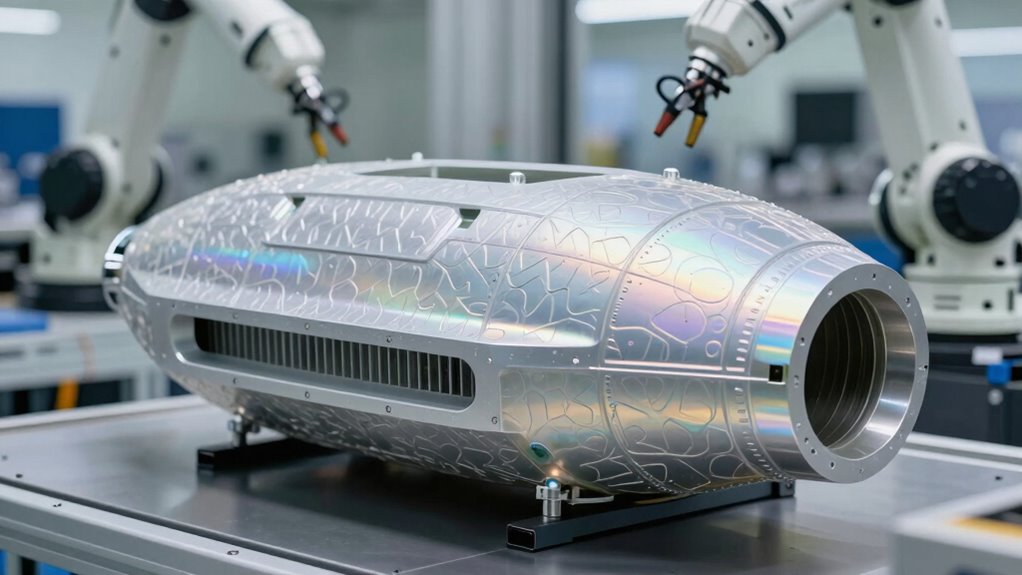

Nanocomposites are transforming lightweight product design by allowing you to create stronger, more durable materials without adding weight. They incorporate nanometer-sized particles into base materials like polymers, metals, or ceramics, resulting in enhanced properties such as increased strength, toughness, and resistance to wear and environmental factors. This technology enables the development of thinner, lighter components that can still withstand demanding conditions. To discover how this innovation can benefit your projects, keep exploring the possibilities.

Get the latest gadgets delivered free with Prime
- Fast, free delivery on millions of items
- Prime Video, Amazon Music and more included
- Member-only deals all year
Key Takeaways
- Nanocomposites enable the creation of stronger yet lighter materials for aerospace, automotive, and sports equipment.
- They allow for thinner, durable components, reducing overall product weight without compromising performance.
- Enhanced properties like increased toughness and wear resistance extend product lifespan and durability.
- Nanocomposite technology supports innovative designs with complex geometries and integrated functionalities.
- They facilitate advanced manufacturing processes, leading to high-performance, lightweight, and sustainable products.

Nanocomposites are transforming lightweight design by substantially enhancing material performance without adding bulk. When you explore how nanocomposite fabrication works, you’ll see that it involves integrating nanometer-sized particles into base materials like polymers, metals, or ceramics. This process creates a composite with properties far superior to traditional materials. The tiny particles—such as carbon nanotubes, nanoclays, or metal oxides—distribute evenly throughout the matrix, resulting in a structure that’s stronger, tougher, and more resistant to wear. This means you can achieve impressive strength-to-weight ratios, which is vital for applications where reducing weight is indispensable, like aerospace, automotive, or sports equipment.
Nanocomposites enhance performance and strength-to-weight ratios in lightweight, durable materials for aerospace, automotive, and sports applications.
As you investigate nanocomposite fabrication, you’ll notice that it allows for precise control over material properties. You can tailor the composition to meet specific needs, whether that’s increased stiffness, improved thermal stability, or enhanced barrier properties. This customization is a game-changer for designers who want to push the boundaries of lightweight product design. Because the nanomaterials are so small, they integrate seamlessly into the host material without considerably increasing weight or volume. The result is a lightweight yet durable product that performs better under stress and environmental challenges.
Material durability stands out as one of the most compelling advantages of using nanocomposites. When you incorporate nanomaterials, you’re fundamentally boosting the resilience of your product. These tiny particles can improve resistance to fatigue, corrosion, and UV degradation, extending the lifespan of your designs. This means fewer repairs and replacements, which ultimately lowers maintenance costs and supports sustainability goals. The enhanced durability also allows for thinner, lighter components that still hold up over time, giving you the flexibility to design sleek, lightweight products without sacrificing strength.
Furthermore, the ability to enhance material durability through nanocomposite fabrication doesn’t just benefit end-users; it also fosters innovation in manufacturing. You can develop more complex geometries or integrate multifunctional properties—like self-healing capabilities or electrical conductivity—without adding weight or compromising integrity. The advancements in nanocomposite technology enable you to rethink traditional design constraints, opening new avenues for creating lightweight products that don’t just meet expectations but surpass them in performance and longevity.
As an affiliate, we earn on qualifying purchases.
Frequently Asked Questions
How Cost-Effective Are Nanocomposites Compared to Traditional Materials?
Nanocomposites can be cost-effective when you consider their enhanced performance, but the initial cost comparison shows they’re often pricier than traditional materials. However, as market adoption grows, production costs decrease, making them more affordable. You’ll find that over time, the durability and lightweight benefits of nanocomposites can lead to savings in fuel, energy, and maintenance, ultimately balancing out the higher upfront investment.
What Are the Environmental Impacts of Producing Nanocomposites?
You can’t judge a book by its cover, and similarly, producing nanocomposites impacts the environment more than it seems. Their environmental footprint involves energy-intensive manufacturing and potential nanoparticle release, which may affect ecosystems. However, they also promote resource sustainability by enabling lighter, durable products that reduce material use and emissions over their lifespan. Responsible production practices are key to minimizing environmental impact while harnessing nanocomposites’ benefits.
How Do Nanocomposites Perform Under Extreme Temperature Conditions?
You’ll find that nanocomposites excel under extreme temperature conditions, thanks to their superior thermal stability. They maintain material resilience, resisting deformation or degradation when exposed to high or low temperatures. This makes them ideal for applications like aerospace and automotive industries, where materials must perform reliably in harsh environments. Their ability to withstand temperature fluctuations ensures durability and safety, markedly enhancing the performance of lightweight products in demanding conditions.
Are There Any Health Risks Associated With Nanocomposite Manufacturing?
Absolutely, health hazards hover over nanocomposite manufacturing. You should stay vigilant about health concerns linked to nanoparticle exposure, which can pose risks like respiratory issues or skin irritation. Following strict safety protocols, such as proper ventilation, protective gear, and handling procedures, helps mitigate these risks. Staying informed about latest safety standards guarantees you can work securely, safeguarding your health while harnessing nanocomposites’ innovative benefits.
What Are the Recyclability Options for Nanocomposite Materials?
You can recycle nanocomposite materials through specialized recycling processes that focus on material recovery. These processes involve breaking down the nanocomposite to separate the nanomaterials from the matrix, allowing reuse or repurposing. While recycling options are expanding, they often require advanced techniques to efficiently recover valuable components. Implementing these recycling processes helps reduce waste and promotes sustainability, making nanocomposites a more environmentally friendly choice for lightweight product design.
carbon nanotube reinforced composites
As an affiliate, we earn on qualifying purchases.
As an affiliate, we earn on qualifying purchases.
Conclusion
You now see how nanocomposites are revolutionizing lightweight design, making products stronger and more efficient. By integrating these advanced materials, you can achieve performance that once seemed impossible. Remember, “A little knowledge is a dangerous thing,” so stay informed about these innovations to stay ahead. Embrace nanocomposites, and you’ll open new possibilities in creating lighter, smarter products that push the boundaries of what’s achievable.
As an affiliate, we earn on qualifying purchases.
lightweight durable automotive components
As an affiliate, we earn on qualifying purchases.
As an affiliate, we earn on qualifying purchases.
Halloween Picks
halloween
As an affiliate, we earn on qualifying purchases.