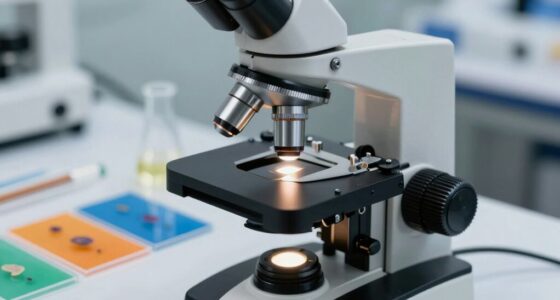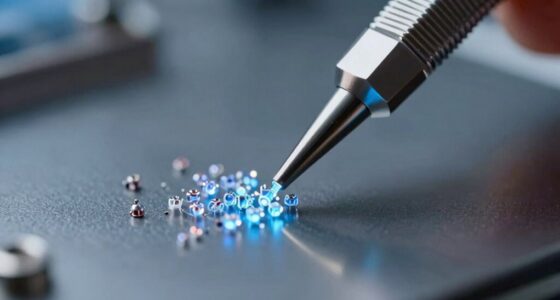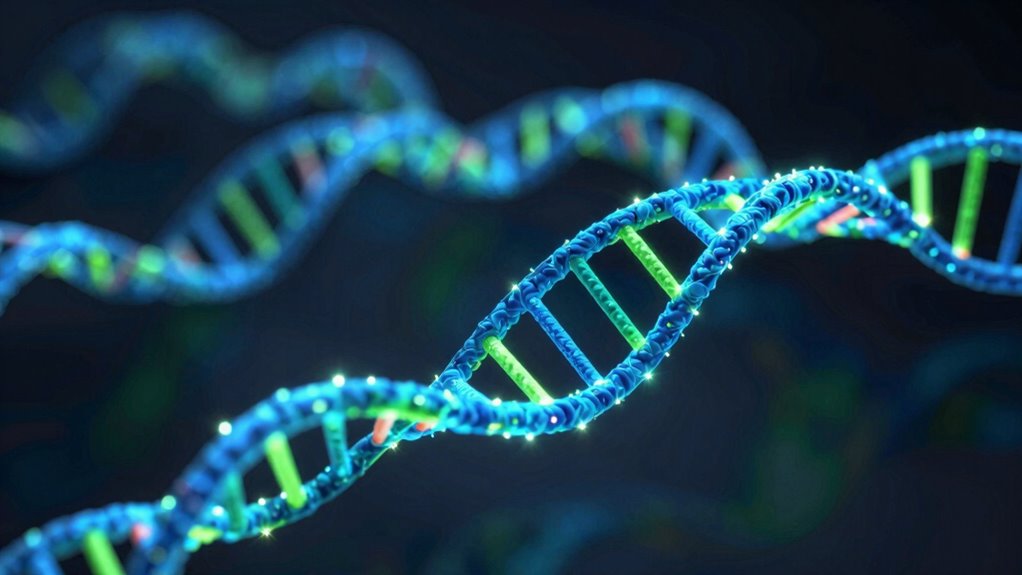

DNA nanotechnology is promising because it allows you to create precise molecular systems by leveraging DNA’s natural ability to program and form predictable base pairs. Its stability and nanoscale versatility let you design complex, self-assembling structures like nanoribbons and boxes with high accuracy. This approach also offers scalable, cost-effective methods for building advanced devices in medicine and electronics. If you want to discover how these innovations could shape the future, there’s more to explore.

Get the latest gadgets delivered free with Prime
- Fast, free delivery on millions of items
- Prime Video, Amazon Music and more included
- Member-only deals all year
Key Takeaways
- DNA’s natural programmability enables precise design of complex, nanoscale structures.
- Self-assembly allows cost-effective, scalable fabrication of highly accurate molecular systems.
- The ability to create dynamic, environmentally responsive nanodevices enhances functionality.
- DNA nanotechnology facilitates integration into real-world applications like drug delivery and biosensing.
- Its potential to develop advanced nanoelectronics and materials drives innovative solutions across fields.

DNA nanotechnology is rapidly emerging as a transformative field with the potential to revolutionize medicine, materials science, and computing. Its promise lies in the ability to manipulate DNA molecules to create highly precise molecular assemblies, enabling you to craft complex structures at an unprecedented scale. This technology taps into the natural properties of DNA—its programmability, stability, and predictable base pairing—to design nanoscale components that can assemble themselves into intricate configurations. When you harness these properties, you open the door to nanoscale fabrication processes that are both highly accurate and adaptable, making it possible to produce structures that were once thought impossible to achieve.
DNA nanotechnology enables precise, self-assembling molecular structures with vast potential across medicine, materials, and computing.
The core advantage of DNA nanotechnology is its capacity for molecular assembly with exacting control. Unlike traditional manufacturing methods, which often involve bulk processes and random assembly, DNA-based techniques allow you to program molecules to assemble into predefined shapes and patterns. This level of precision is essential when working at the nanoscale, where even tiny deviations can compromise functionality. By designing specific DNA sequences, you can direct the formation of structures such as nanoribbons, boxes, and lattices, all built from DNA itself. These molecular assemblies are not just static; they can be engineered to respond to environmental cues, enabling dynamic systems that can adapt or change function in real time. Programmability is the key to creating versatile nanosystems that can be tailored for various applications.
Nanoscale fabrication becomes more feasible with DNA because of its inherent ability to form predictable and programmable structures. You can create complex, three-dimensional objects at a scale that surpasses traditional top-down fabrication techniques. This bottom-up approach allows for the construction of devices with atomic precision, which is *vital* when developing advanced drug delivery systems, biosensors, or nanoelectronics. Self-assembly also plays a critical role in reducing manufacturing costs and complexity, making it a practical choice for scalable production. Additionally, understanding the contrast ratio and how it impacts the visibility of nanoscale structures is essential for designing effective imaging and detection systems. As you refine techniques for molecular assembly, you’ll find that DNA nanotechnology offers a versatile platform for building customized nanosystems, opening new avenues in medicine, electronics, and materials science.
In essence, what makes DNA nanotechnology so promising is its unique ability to combine the principles of molecular assembly and nanoscale fabrication into a cohesive toolkit. This empowers you to design and construct highly specific, functional nanostructures with ease and precision, pushing the boundaries of what’s possible at the smallest scales. As research advances, you’ll likely see these structures integrated into real-world applications that can dramatically improve health care, manufacturing, and information technology.
As an affiliate, we earn on qualifying purchases.
Frequently Asked Questions
How Does DNA Nanotechnology Compare to Other Molecular Assembly Methods?
DNA nanotechnology outperforms other molecular assembly methods by offering exceptional molecular precision and reliable self-assembly mechanisms. You can design DNA structures with exact shapes and functions, thanks to predictable base pairing. Unlike traditional methods, it allows for programmable, bottom-up construction of complex nanostructures. This high level of control enables you to create intricate devices and systems, making DNA nanotechnology a powerful, versatile tool in molecular engineering.
What Are the Main Challenges in Scaling up DNA Nanodevices?
Ever wonder if we can truly scale DNA nanodevices? The main challenges lie in overcoming scalability hurdles and fabrication limitations. You might face difficulties in maintaining precise control over larger structures, ensuring consistency, and reducing costs. These issues require innovative solutions to enable mass production and practical applications. Overcoming these barriers will bring DNA nanotech closer to revolutionizing fields like medicine and materials science.
Can DNA Nanostructures Be Used in Living Organisms Safely?
Yes, DNA nanostructures can be used safely in living organisms, but biocompatibility concerns remain. You need to minimize immune responses by designing structures that avoid triggering immune activation, such as using protective coatings or modifying DNA sequences. Researchers are actively working on immune response mitigation strategies, ensuring these structures can perform their functions without adverse effects. Proper design and thorough testing are essential for safe in vivo applications.
What Is the Future Potential of DNA Nanotechnology in Medicine?
The future of DNA nanotechnology in medicine is bright, and it’s your ticket to revolutionizing healthcare. You could see personalized treatments tailored precisely to an individual’s needs and targeted drug delivery that minimizes side effects. Imagine tiny DNA structures acting like precision-guided missiles, delivering medicine exactly where it’s needed. This technology holds the potential to transform diagnostics, therapy, and even regenerative medicine, truly changing the game in healthcare.
How Cost-Effective Is the Production of Complex DNA Nanostructures?
The production of complex DNA nanostructures is becoming increasingly cost-effective thanks to advances in synthesis techniques and automation, which improve cost efficiency. You’ll find that production scalability is also improving, allowing larger quantities to be made more quickly and affordably. These developments make DNA nanotechnology more accessible for various applications, reducing costs and enabling broader research and practical uses across medicine, materials science, and beyond.
self-assembling DNA nanostructures
As an affiliate, we earn on qualifying purchases.
As an affiliate, we earn on qualifying purchases.
Conclusion
So, it’s clear that DNA nanotechnology isn’t just a fancy science experiment—it’s the future’s secret weapon for building tiny, brilliant machines. Who knew that the same molecule that encodes your genes could also run a microscopic factory? As you marvel at this marvel, remember: in the grand scheme of things, we’re just tiny architects playing with nature’s most elegant toolkit, proving once again that sometimes, the smallest things really do make the biggest impact.
As an affiliate, we earn on qualifying purchases.
As an affiliate, we earn on qualifying purchases.
Halloween Picks
halloween
As an affiliate, we earn on qualifying purchases.