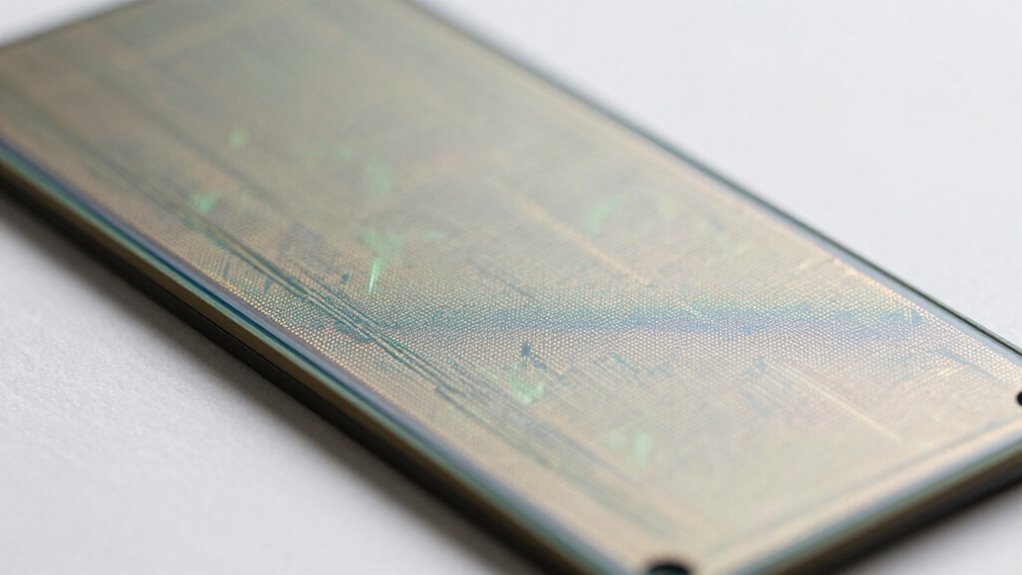

Nano materials improve sensitivity without increasing size by utilizing quantum effects and their large surface area. These tiny structures respond sharply to small environmental changes, like chemicals or temperature shifts, making detection more precise. The increased surface area means more active sites for interactions, boosting performance without bulky parts. This synergy allows you to develop compact, highly sensitive sensors that outperform traditional ones. Keep exploring to discover how these innovations can transform sensing technology further.

Get the latest gadgets delivered free with Prime
- Fast, free delivery on millions of items
- Prime Video, Amazon Music and more included
- Member-only deals all year
Key Takeaways
- Nanoscale quantum effects enhance material responsiveness to external stimuli, boosting sensitivity without increasing size.
- Increased surface area at the nanoscale provides more active sites for interactions, improving detection capabilities.
- The synergy of quantum effects and surface area amplification enables highly sensitive, compact sensors.
- Nanoscale properties allow for ultra-sensitive detection while maintaining device portability and small form factors.
- Leveraging nanoscale behaviors leads to innovative, efficient sensors that outperform larger traditional counterparts.

Have you ever wondered how tiny materials can detect even the slightest changes in their environment? The secret lies in the remarkable world of nano materials, where size isn’t the only factor that boosts sensitivity. Instead, quantum effects and surface area enhancement play pivotal roles. When materials are scaled down to the nanoscale, they exhibit quantum effects—strange behaviors that don’t appear in larger counterparts. These effects make their electronic and optical properties highly responsive to external stimuli, meaning even minor environmental shifts can cause noticeable changes in their behavior. For instance, a slight temperature variation or the presence of a specific chemical can considerably alter how these nano materials conduct electricity or absorb light. This heightened responsiveness allows sensors to detect minute quantities of substances with astonishing precision, all without increasing their overall size.
Surface area enhancement is another key factor. As you reduce a material to the nanoscale, its surface area relative to its volume skyrockets. Think of it like a tiny sponge; it offers vastly more surface for interactions than a bulk material of the same mass. This increased surface area means more active sites are available for molecules to bind or interact with, making the nano material incredibly sensitive to environmental changes. For sensors, this translates into a heightened ability to pick up even trace amounts of chemicals or biological agents. The larger the surface area, the more opportunities there are for interactions, and the better your nano sensor can detect subtle signals without needing to get bigger or more complex. Additionally, the quantum effects at the nanoscale not only enhance responsiveness but also allow for tuning the properties of nano materials for specific sensing applications.
What’s truly fascinating is that these properties allow you to develop highly sensitive devices without resorting to larger, bulkier components. Instead, you leverage the inherent physics at the nanoscale—quantum effects—and the extensive surface area—to amplify responsiveness. This means you can maintain the compactness and portability of your sensors while dramatically improving their sensitivity. The surface area enhancement and quantum effects work together to create a synergy that enables nano materials to outperform traditional materials in detecting tiny environmental changes. Furthermore, ongoing research continues to uncover new ways to manipulate these properties, paving the way for even more innovative sensing technologies in the future.
In essence, by harnessing the unique behaviors at the nanoscale, you tap into a universe where size isn’t a limitation but an advantage. You get ultra-sensitive detection capabilities without the need for larger, more complicated devices. This approach not only makes sensors more efficient but also opens up possibilities for innovative applications across medicine, environmental monitoring, and industrial safety. Nano materials offer a powerful way to improve sensitivity, proving that sometimes, less really is more.
nano sensor for environmental detection
As an affiliate, we earn on qualifying purchases.
As an affiliate, we earn on qualifying purchases.
Frequently Asked Questions
How Do Nano Materials Compare Cost-Wise to Traditional Materials?
You’ll find that nano materials often have a higher initial cost compared to traditional materials due to complex manufacturing processes and specialized production. However, their material affordability improves over time because of their enhanced performance and durability, which can reduce the need for replacements and maintenance. The overall cost comparison depends on your application, but nano materials can offer cost-effective benefits by boosting efficiency and lifespan despite higher upfront expenses.
Are Nano Materials Environmentally Safe for Widespread Use?
Imagine nano materials as tiny guardians, delicate yet powerful. They can be environmentally safe if you follow strict safety regulations and assess their environmental impact carefully. While some nano materials pose risks if mishandled, ongoing research guarantees safer applications. It’s essential to monitor their use, minimize waste, and develop eco-friendly alternatives. With responsible practices, nano materials can protect our environment while revealing advanced technological benefits.
What Are the Challenges in Integrating Nano Materials Into Existing Devices?
You face challenges like surface modification and compatibility issues when integrating nano materials into existing devices. You need to adapt surfaces to guarantee proper bonding and stability, which can be complex. Compatibility problems may arise if nano materials don’t match the device’s current components, leading to performance degradation. Overcoming these hurdles requires careful engineering, precise surface treatments, and testing to ensure seamless integration without compromising device functionality.
How Durable Are Nano Materials Under Extreme Conditions?
Nano materials showcase impressive nano stability, standing firm like steel against extreme conditions. You’ll find their extreme durability allows them to resist high temperatures, corrosive environments, and mechanical stress, almost like a shield that absorbs shocks without cracking. Their resilience guarantees they maintain functionality, even when pushed to the limits. This durability makes them reliable for demanding applications, promising longevity and performance in the harshest environments you can imagine.
Can Nano Materials Be Recycled or Reused Effectively?
Yes, nano materials can be recycled and reused effectively. You can recover nano materials through processes like filtration, chemical treatment, or centrifugation, which improve nano material recycling. The reuse efficiency depends on the material’s stability and the cleaning process used, but with proper methods, you can maintain high reuse efficiency. This helps reduce waste and makes nano technology more sustainable for future applications.
high sensitivity chemical sensor
As an affiliate, we earn on qualifying purchases.
As an affiliate, we earn on qualifying purchases.
Conclusion
By incorporating nano materials, you can boost sensor sensitivity without making devices bulky. Imagine a healthcare device that detects cancer markers at incredibly low concentrations, thanks to nanostructured sensors. This means quicker, more accurate diagnoses without sacrificing portability. As you explore nano materials, you’ll see how they enable high performance in compact forms, transforming fields like medical diagnostics and environmental monitoring. Embrace nanotechnology, and you’ll unleash powerful, miniaturized sensing solutions for real-world challenges.
compact nanoscale temperature sensor
As an affiliate, we earn on qualifying purchases.
As an affiliate, we earn on qualifying purchases.
As an affiliate, we earn on qualifying purchases.
Fall Picks
fall essentials
As an affiliate, we earn on qualifying purchases.