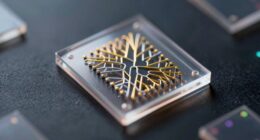
Flexible electronics with nanotech transform how devices work by making them ultra-thin, stretchable, and durable. Nanowire transistors and nanostructured sensors allow gadgets to bend, stretch, and conform without losing performance. These advancements support wearables, medical implants, and smart clothing, offering high sensitivity and low power use. As technology continues to evolve, you’ll discover even more innovations. Keep exploring to see how nanotech enables a new era of flexible, integrated systems.
Key Takeaways
- Nanotechnology enables the fabrication of ultra-thin, flexible nanowire transistors for durable, bendable electronic devices.
- Flexible electronics incorporate nanostructured sensors for real-time, high-sensitivity environmental and health monitoring.
- Nanotech enhances the performance of stretchable devices, allowing them to bend, stretch, and conform without loss of function.
- Integrating nanowire transistors into flexible substrates supports lightweight, low-power wearable gadgets and medical implants.
- Ongoing nanotech research improves material durability, extending the lifespan and reliability of flexible electronic systems.

Flexible electronics are transforming technology by making devices more adaptable and durable, thanks to advancements in nanotechnology. This field leverages tiny structures like nanowire transistors to create circuits that bend, stretch, and conform to various surfaces without losing functionality. Unlike traditional rigid electronics, flexible devices can be integrated into wearable tech, medical implants, and even clothing, opening new possibilities for how we interact with technology daily.
Nanowire transistors are at the heart of these innovations. These are incredibly small, wire-like components made from semiconductor materials, often just a few nanometers in diameter. Because of their size, nanowire transistors offer excellent electrical properties, such as high mobility and low power consumption, which are essential for flexible electronics. Their flexibility stems from their ability to be embedded into stretchable substrates, maintaining performance even when bent or deformed. This means you can have devices that not only bend with your body movements but also maintain consistent operation, making them ideal for wearable health monitors, flexible displays, and foldable smartphones.
Nanowire transistors are tiny, flexible components with high mobility and low power use, ideal for wearable electronics.
Alongside nanowire transistors, flexible sensors play an indispensable role in this technological leap. These sensors can detect various stimuli like temperature, pressure, strain, or biochemical signals while remaining pliable. Imagine a flexible health band that not only fits comfortably around your wrist but also continuously monitors your vital signs without discomfort. These sensors are often made with nanostructured materials that enhance sensitivity and responsiveness, giving you real-time data with high accuracy. Their flexibility allows them to be integrated into clothing, bandages, or even directly onto the skin, providing seamless health monitoring and environmental sensing.
The combination of nanowire transistors and flexible sensors enables the development of smart, wearable devices that seamlessly blend into daily life. They can withstand daily wear and tear, bending and stretching without breaking or losing functionality. This resilience is essential for applications like sports performance tracking, elderly care, or remote health diagnostics, where durability and comfort are fundamental. Furthermore, these nanotech-based systems consume less power, making battery life longer and devices more efficient. Additionally, ongoing research aims to improve material durability, ensuring these flexible systems last even longer under real-world conditions.

Semiconductor Nanomaterials for Flexible Technologies: From Photovoltaics and Electronics to Sensors and Energy Storage (Micro and Nano Technologies)
As an affiliate, we earn on qualifying purchases.
As an affiliate, we earn on qualifying purchases.
Frequently Asked Questions
What Are the Environmental Impacts of Nanotech-Based Flexible Electronics?
You should be aware that nanotech-based flexible electronics can have environmental impacts, like increased manufacturing emissions and toxicity concerns. During production, tiny particles may be released into the environment, affecting air and water quality. Additionally, some nanomaterials could pose health risks if not properly managed. To minimize these effects, it is crucial to develop safer manufacturing processes and improve disposal methods for these innovative devices.
How Durable Are Nanotech Flexible Electronics Under Daily Wear and Tear?
Like Icarus flying too close to the sun, your nanotech flexible electronics face challenges with daily wear and tear. They’re designed for durability, but material fatigue can weaken their structure over time, and adhesive durability might decrease with constant bending. However, advances in nanomaterials are improving resilience, meaning your gadgets are becoming more reliable despite frequent use. Still, regular care extends their lifespan, keeping them as resilient as mythic heroes.
Can Nanotech Flexible Electronics Be Recycled or Reused Effectively?
You can recycle nanotech flexible electronics, but recycling challenges exist due to their complex materials and tiny components. These factors make it harder to recover and reuse materials efficiently. However, their reuse potential remains promising; designers are developing ways to upgrade or repurpose these devices, reducing waste. With ongoing research, improved recycling methods will likely emerge, making nanotech flexible electronics more sustainable and environmentally friendly in the future.
What Are the Current Limitations in Scaling Nanotech Flexible Electronics Production?
You face manufacturing challenges when scaling nanotech flexible electronics, mainly due to material scalability issues. Producing large quantities while maintaining precision and quality proves difficult because nanomaterials often require complex, costly processes. Additionally, integrating these materials into flexible devices without compromising performance or durability strains current manufacturing capabilities. Overcoming these limitations requires advances in scalable production techniques and better control over nanomaterial properties to enable widespread commercial use.
How Do Nanotech Flexible Electronics Compare Cost-Wise to Traditional Electronics?
You’ll find that nanotech flexible electronics generally cost more than traditional electronics due to advanced materials and specialized manufacturing processes. However, as you focus on cost reduction and improve manufacturing efficiency, these costs are decreasing. Innovations in scalable production techniques are making nanotech flexible electronics more affordable, helping you benefit from their unique advantages like flexibility and lightweight design, ultimately narrowing the price gap with traditional electronics over time.
Flexible, Wearable, and Stretchable Electronics (Devices, Circuits, and Systems)
As an affiliate, we earn on qualifying purchases.
As an affiliate, we earn on qualifying purchases.
Conclusion
As you explore flexible electronics powered by nanotech, you’ll find that innovation often surprises us in unexpected ways. The tiny advancements, seemingly small at first, often align perfectly with your needs, making devices more adaptable and durable. It’s almost like the universe conspired to bring these technologies together just when you needed them most. So, keep an eye on this exciting field—you might just stumble upon the next big breakthrough that changes everything.

Slimpal Smart Body Measuring Tape, Tape Measure for Body Waist Arms Hip Bust Measurements Device with App, Retractable Bluetooth Monitoring Body Fat BMI Tool for Fitness Shape & Weight Loss
Smart Body Fat Calculation: With a patent-pending algorithm, this tape measure calculates your body fat percentage when you…
As an affiliate, we earn on qualifying purchases.
As an affiliate, we earn on qualifying purchases.

wisecoco 7.8 inch Flexible Display Curved Bendable Screen FHD 1440 * 1920 AMOLED Display with HDMI Driver Board OLED Monitor Without Enclosure Kit for DIY Prototype Demo
【Super Specs】Type: 7.8" AMOLED, Res: 1440X1920, PPI: 308, Aspect: 4:3, Brightness: 300cd/㎡, C/R: 100K:1, NTSC: 100%, Colors: 16.7M,…
As an affiliate, we earn on qualifying purchases.
As an affiliate, we earn on qualifying purchases.