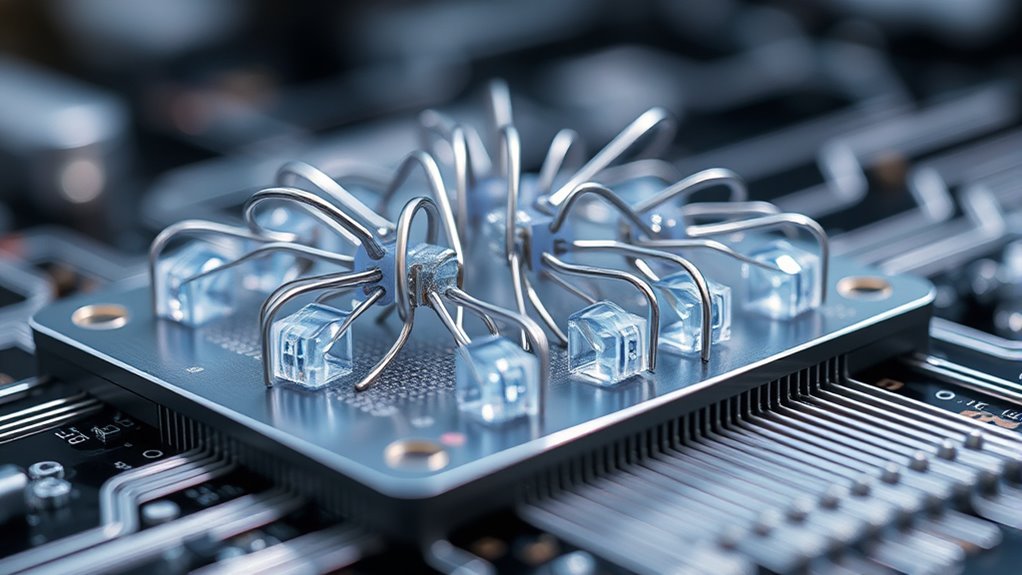

Nano-actuators powered by molecular motors let you control tiny movements with incredible precision, opening new possibilities in robotics. These devices convert chemical or electrical signals into mechanical work at a molecular level, making them ideal for medical applications or micro-assembly in confined spaces. They enable you to navigate complex environments safely and perform delicate tasks that traditional actuators can’t handle. If you continue exploring, you’ll discover how these innovations are shaping the future of nanorobotics.
Key Takeaways
- Nano-actuators utilize molecular motors to enable precise, atomic-scale movements in robotic systems.
- They convert chemical or electrical stimuli into mechanical work for controlled actuation.
- Suitable for medical applications like targeted drug delivery and microsurgery in delicate environments.
- Their small size allows operation in inaccessible or sensitive areas beyond traditional robotics.
- Advances in nanotechnology enhance their responsiveness, adaptability, and potential for complex robotic functions.

Ever wondered how tiny devices can control large robotic movements with remarkable precision? The answer lies in the fascinating world of nano-actuators, where molecular motors play an essential role. These molecular motors are the engines behind nanoscale control, enabling movements at an unimaginably small scale that translate into precise actions in larger systems. Unlike traditional actuators, which rely on macroscopic mechanisms, nano-actuators harness the power of molecular interactions to manipulate objects with extraordinary accuracy. This capability opens new frontiers in robotics, especially in fields requiring delicate handling or intricate operations, such as medical procedures or micro-assembly.
Tiny molecular motors enable precise control of large-scale robotic movements at the nanoscale.
In essence, molecular motors are specialized molecules that convert chemical energy into mechanical work. They function similarly to biological motors, like those found in cells, but are engineered for artificial applications. When integrated into nano-actuators, these motors can be triggered by various stimuli—light, chemical signals, or electrical inputs—to produce controlled movements. Because their operation occurs at the molecular level, they offer nanoscale control that’s impossible to achieve with traditional mechanical parts. This level of control means you can design robotic systems that respond to tiny signals or perform actions with atomic precision, making them ideal for tasks that demand high accuracy and minimal invasiveness.
The real advantage of nano-actuators powered by molecular motors is their ability to operate in environments where larger actuators would be ineffective or damaging. For example, in medical nanorobotics, these actuators can maneuver through blood vessels or cellular structures without causing harm. Their small size allows them to reach places that are inaccessible to conventional machinery, and their nanoscale control ensures movements are smooth and precise. This precision is essential for targeted drug delivery, microsurgery, or even repairing damaged tissues at the cellular level.
Moreover, the integration of molecular motors into nano-actuators paves the way for highly adaptable systems. Since the operation can be finely tuned by altering chemical or electrical inputs, you can create robots that respond dynamically to changing conditions. This adaptability makes nano-actuators invaluable in environments where real-time adjustments are necessary. Advances in nanotechnology continue to enhance these capabilities, pushing the boundaries of what nanoscale control can achieve. As research advances, these tiny devices are poised to revolutionize robotics by providing a level of control and finesse that was once thought impossible, all achieved through the clever use of molecular motors and nanoscale control.
Top picks for "nano actuator robotic"
Open Amazon search results for this keyword.
As an affiliate, we earn on qualifying purchases.
Frequently Asked Questions
How Do Nano-Actuators Compare to Traditional Actuators in Efficiency?
Nano-actuators are more efficient than traditional actuators because they consume less power and have faster response speeds. You’ll notice they operate with minimal energy, making them ideal for compact, energy-sensitive applications. Their quick response times enable precise control, which improves overall performance. So, if you’re aiming for high efficiency and rapid actuation in your robotics projects, nano-actuators offer significant advantages over conventional options.
What Are the Safety Concerns Associated With Nano-Actuator Deployment?
You should be aware that deploying nano-actuators raises safety concerns like biocompatibility issues and nanoscale toxicity. Imagine tiny devices interacting with biological systems; if not properly managed, they could cause unintended damage or immune responses. Ensuring these actuators are safe involves rigorous testing for biocompatibility and understanding nanoscale toxicity, so they don’t harm humans or the environment during their use or disposal.
Can Nano-Actuators Operate in Extreme Environmental Conditions?
Nano-actuators can operate in extreme environmental conditions, but their performance depends on nano durability and environmental resilience. You need to select materials that withstand high temperatures, corrosive substances, and mechanical stresses. Proper design and protective coatings are essential to guarantee they maintain functionality without degradation. While some nano-actuators are specially engineered for harsh environments, others may require additional modifications to perform reliably under extreme conditions.
How Scalable Are Nano-Actuator Manufacturing Processes?
Manufacturing scalability for nano-actuators faces significant hurdles, yet advancements are promising. While production challenges like precision and consistency persist, new techniques are improving scalability, making mass production more feasible. You can expect increased efficiency and reduced costs as research continues, although current processes still struggle with uniformity and integration. Overall, the potential for scalable manufacturing exists, but overcoming these technical obstacles remains essential to widespread application in robotics.
What Are the Potential Medical Applications of Nano-Actuators?
You can use nano-actuators for targeted drug delivery, allowing precise medication release directly at disease sites, which minimizes side effects. They also enable minimally invasive surgery by maneuvering through tiny blood vessels or tissues, reducing patient recovery time. These innovations could revolutionize healthcare by making treatments safer and more efficient. As you develop these applications, you’ll find nano-actuators transforming how medicine is administered and surgeries are performed, improving patient outcomes markedly.
Conclusion
Imagine wielding the power of tiny giants, where nano-actuators become the beating heart of your robotic creations. They’re like the delicate brushstrokes on a masterpiece, turning dreams into reality. As you harness their potential, you’re not just building machines—you’re sculpting the future’s symphony of innovation. Embrace these tiny titans, and watch your innovations soar beyond the horizon, whispering promises of a world where robotics and imagination dance in perfect harmony.