
Nanocrystal memory devices use tiny semiconductor particles embedded in dielectric layers to store data efficiently and reliably. They offer advantages like longer data retention, higher storage density, and greater endurance compared to traditional flash memory. Advances in fabrication techniques, material engineering, and controlling quantum effects help overcome current challenges. As research progresses, these innovations could enable next-generation storage solutions with enhanced capacity and durability. Exploring further will reveal how nanocrystals are shaping future memory technologies.
Open a free Amazon Business account
Business pricing, bulk buying and tax-exempt orders.
As an affiliate, we earn on qualifying purchases.
Key Takeaways
- Nanocrystal memory devices enable high-density, non-volatile storage with improved data retention and endurance through quantum tunneling and charge trapping.
- Precise fabrication techniques like ALD, CVD, and self-assembly ensure uniform nanocrystal size and placement, critical for device reliability.
- Advances in materials and dielectric engineering enhance charge confinement, reduce leakage, and improve thermal stability for next-generation storage.
- Scalability challenges include maintaining nanocrystal uniformity and material compatibility at smaller device dimensions.
- These technologies offer promising applications in high-capacity data storage, quantum computing, medical imaging, and integrated spintronics.
nanocrystal memory storage devices
As an affiliate, we earn on qualifying purchases.
As an affiliate, we earn on qualifying purchases.
Fundamentals of Nanocrystal Memory Technology
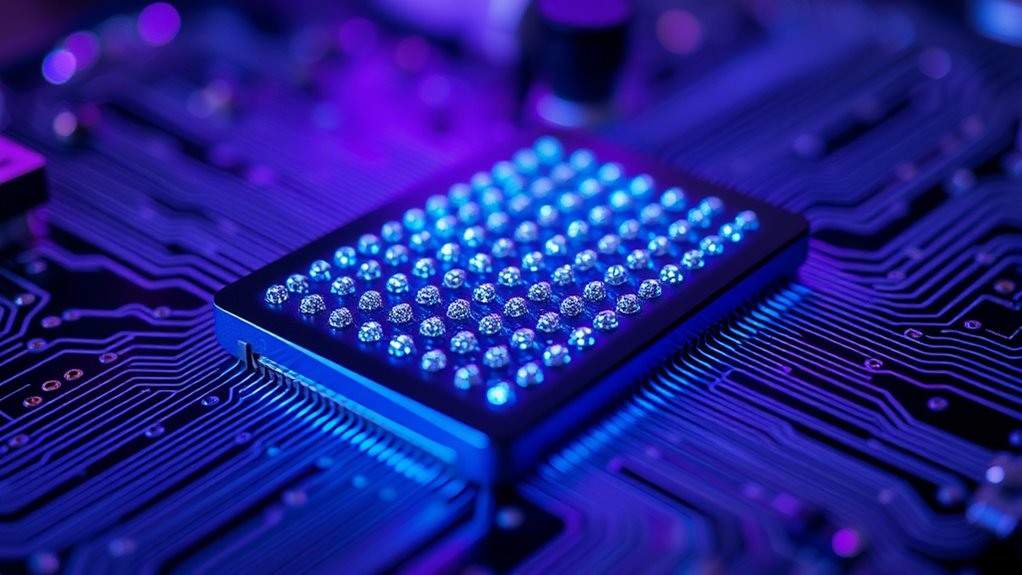
Nanocrystal memory technology relies on embedding tiny semiconductor particles within a dielectric layer to store data. When you program the device, electrons tunnel quantum mechanically through the barrier, a process called quantum tunneling, which allows charge to move into the nanocrystals. During operation, a strong electric field can cause dielectric breakdown if the voltage exceeds certain limits, damaging the insulating layer and compromising data integrity. To prevent this, materials are carefully chosen to balance ease of tunneling with resistance to breakdown. This delicate interplay ensures reliable charge trapping within the nanocrystals, enabling non-volatile storage. Understanding how quantum tunneling and dielectric breakdown influence device performance is fundamental to optimizing nanocrystal memory for durability and efficiency. Additionally, selecting appropriate materials helps in managing the material properties critical for device longevity and performance.
As an affiliate, we earn on qualifying purchases.
Fabrication Techniques for Nanocrystal Arrays
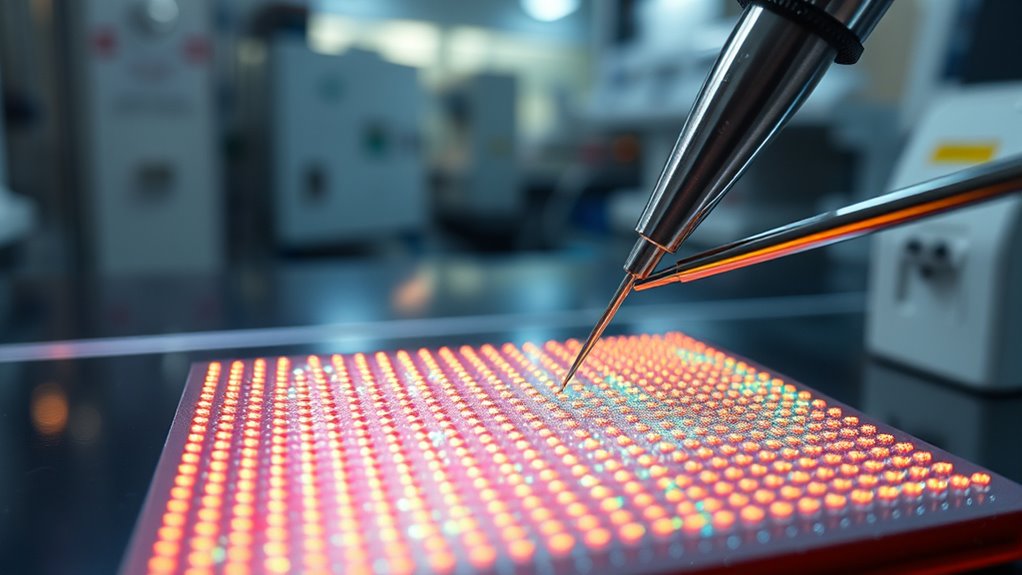
To create effective nanocrystal arrays, you need precise deposition methods that control size, placement, and density. Self-assembly strategies also play a key role in forming uniform, well-organized structures without complex processes. Understanding these techniques helps you optimize device performance and reliability. Additionally, careful selection of payment security measures ensures protection against potential cybersecurity threats impacting the nanocrystal memory devices.
Precise Deposition Methods
Achieving uniform and well-controlled nanocrystal arrays requires precise deposition techniques that can accurately position tiny structures on a substrate. Atomic layer deposition (ALD) offers atomic-scale control, enabling you to deposit nanocrystals with uniform size and spacing. Chemical vapor deposition (CVD) also provides a versatile method for creating ordered arrays by controlling reaction parameters. These techniques guarantee nanocrystals are evenly distributed, improving device performance and reliability. Consider the following methods:
| Technique | Key Feature | Advantage |
|---|---|---|
| Atomic Layer Deposition | Layer-by-layer control | High precision, uniformity |
| Chemical Vapor Deposition | Gas-phase process | Scalability, versatility |
| Electrophoretic Deposition | Electric field-driven placement | Precise positioning |
Using these approaches helps you achieve the consistency needed for next-generation nanocrystal memory devices.
Self-Assembly Strategies
Self-assembly strategies harness natural molecular forces to organize nanocrystals into ordered arrays without extensive external intervention. These methods rely on processes like ligand-controlled assembly, capillary forces, or electrostatic interactions to achieve uniform spacing and alignment. By leveraging self assembly strategies, you can improve the uniformity of nanocrystal placement, which is vital for device performance. Additionally, these strategies help mitigate defects by reducing the likelihood of aggregation or misalignment that often occurs with manual fabrication techniques. Proper defect mitigation ensures consistent electrical properties and enhances device reliability. Overall, self-assembly offers a scalable, cost-effective approach to fabricating high-quality nanocrystal arrays, making it a promising technique in advancing next-generation memory devices.
high-density flash memory modules
As an affiliate, we earn on qualifying purchases.
As an affiliate, we earn on qualifying purchases.
Electrical Properties and Charge Storage Mechanisms
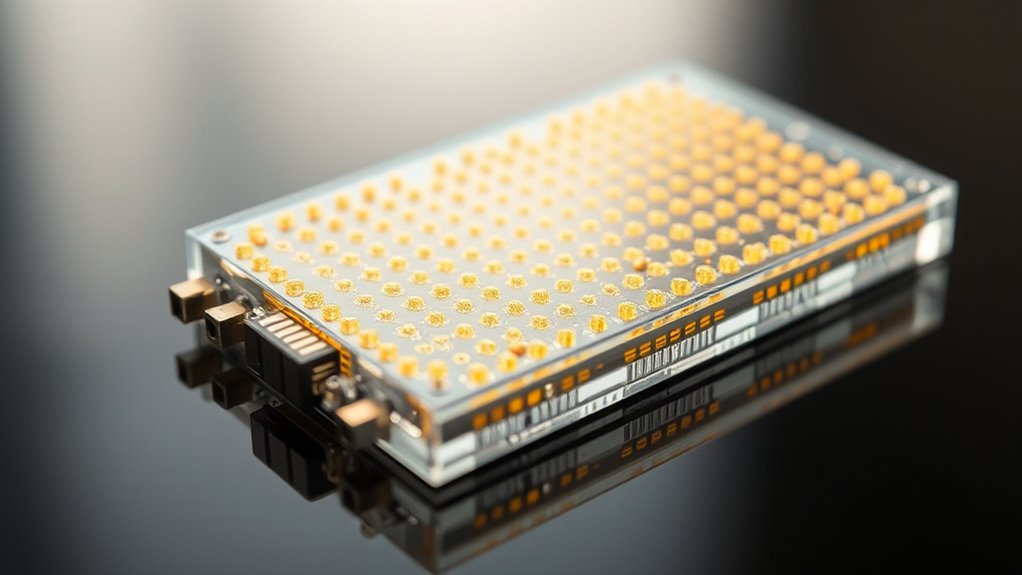
Understanding the electrical properties and charge storage mechanisms of nanocrystal memory devices is essential for optimizing their performance. Quantum tunneling plays a vital role, enabling electrons to pass through energy barriers between the nanocrystals and electrodes, influencing programming and erasing speeds. Charge trapping occurs when electrons are confined within the nanocrystals, creating stable charge states that represent information bits. The size, distribution, and material of nanocrystals directly impact their ability to trap and retain charge efficiently. Additionally, the dielectric environment affects the tunneling probability, balancing data retention with ease of access. By controlling these properties, you can improve device endurance, minimize leakage currents, and enhance overall reliability, paving the way for more robust, high-density memory solutions. Color accuracy and the characteristics of the dielectric material also significantly influence the tunneling behavior and charge retention capabilities.
As an affiliate, we earn on qualifying purchases.
Advantages Over Traditional Flash Memory
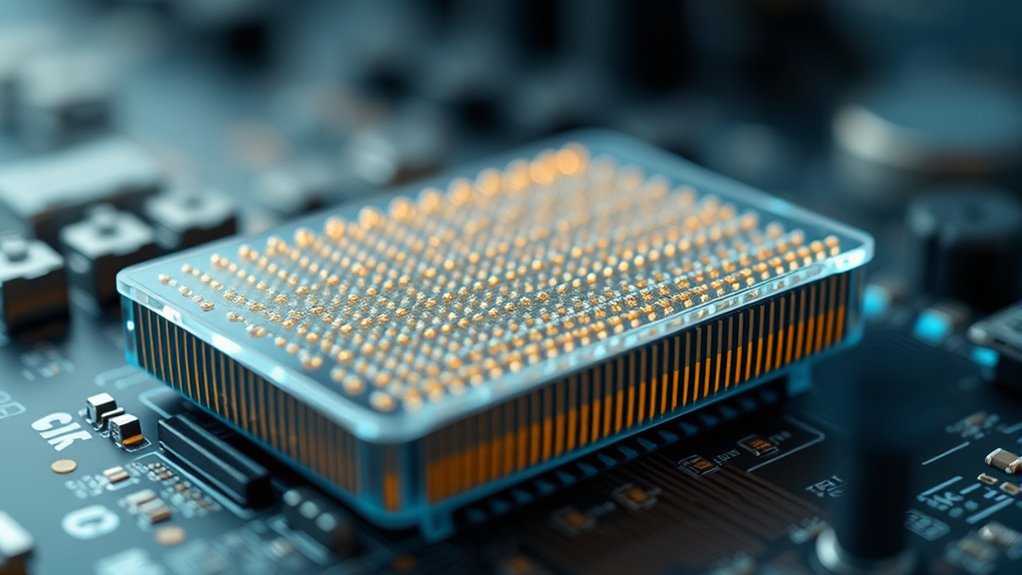
Nanocrystal memory devices offer significant advantages over traditional flash memory, making your data safer and more reliable. You’ll notice better data retention, allowing your information to stay intact longer without power. Additionally, they provide higher storage density and improved endurance, helping you store more data with fewer worries about wear and tear. Moreover, emotional support can play a crucial role in managing the stress associated with transitioning to new technology, ensuring a smoother adoption process.
Enhanced Data Retention
Nanocrystal memory devices offer considerably improved data retention compared to traditional flash memory. This enhancement mainly results from quantum tunneling effects, which reduce leakage currents and minimize charge loss over time. The small size and discrete nature of nanocrystals help improve thermal stability, preventing charge from escaping due to temperature fluctuations. As a result, your stored data remains intact longer, even under harsh conditions. These devices effectively block unwanted charge movement, ensuring reliable long-term storage. By leveraging quantum tunneling control and thermal stability, nanocrystal memories achieve superior retention performance. This means you can trust your data to stay secure and accessible, reducing the need for frequent rewriting or data recovery. Overall, nanocrystal memory offers a significant leap forward in preserving information over extended periods.
Higher Storage Density
Have you ever wondered how nanocrystal memory devices can store more data in the same space? It’s because they leverage quantum tunneling, allowing electrons to pass through ultra-thin barriers efficiently, which enhances data density. Unlike traditional flash memory, nanocrystals enable multiple charge storage points within a small area, substantially boosting capacity. Additionally, their unique dielectric properties reduce the risk of dielectric breakdown, which often limits miniaturization in conventional devices. This means you can pack more information into a smaller footprint without sacrificing reliability. By controlling electron movement precisely, nanocrystal memories achieve higher storage density while maintaining stability. As a result, these devices offer a promising pathway toward more compact, high-capacity storage solutions, surpassing the limitations of traditional flash memory technology.
Improved Endurance
Unlike traditional flash memory, nanocrystal memory devices offer considerably improved endurance, meaning they can withstand more program-erase cycles without performance degradation. This durability stems from the quantum tunneling process, which allows charge to move efficiently through the nanocrystals while minimizing damage to the surrounding dielectric. The small size and isolated nature of nanocrystals enhance thermal stability, preventing charge loss during high-temperature operations and reducing wear over time. As a result, these devices resist the degradation typically caused by repeated cycling, extending their lifespan. This improved endurance ensures reliable data retention and consistent performance, making nanocrystal memories a promising solution for next-generation storage demands. Your data stays secure longer, with less worry about device failure or performance drops.
Challenges in Nanocrystal Memory Development
Developing nanocrystal memory devices presents several significant challenges that researchers must address to realize their full potential. Scalability hurdles stand out, as shrinking device dimensions can lead to difficulties in maintaining uniform nanocrystal distribution and consistent performance. As devices become smaller, controlling the precise placement and size of nanocrystals becomes more complex, risking data integrity. Material stability also poses a major obstacle; nanocrystals must withstand repeated charging cycles without degradation. Variations in material composition or interface quality can cause charge trapping issues, leading to reliability concerns. Additionally, ensuring compatibility with existing fabrication processes and preventing unintended interactions between materials are ongoing challenges. Overcoming these issues requires innovative engineering and material science solutions to enable reliable, scalable nanocrystal memories for future applications. Creativity can be harnessed to develop novel approaches that address these complex challenges effectively.
Recent Advances in Material Engineering
Recent advances in material engineering have considerably enhanced the performance and reliability of nanocrystal memory devices. Researchers have developed novel materials that improve material stability, ensuring long-term data retention and device durability. These improvements also address quantum tunneling issues, reducing unintended charge leakage that can compromise memory integrity. By optimizing dielectric layers and introducing high-quality insulators, engineers minimize quantum tunneling effects, leading to more stable charge storage. Additionally, new material compositions resist degradation over repeated programming cycles, boosting device lifespan. These innovations enable better control of charge confinement within nanocrystals, enhancing data stability and read/write speeds. The integration of advanced insulating materials further contributes to reducing charge loss and improving overall device efficiency. Overall, material engineering breakthroughs are vital in overcoming previous limitations, paving the way for more reliable, efficient, and scalable nanocrystal memory technologies.
Scalability and Integration in Modern Devices
Advancements in material engineering have markedly improved the performance of nanocrystal memory devices, but scaling these technologies for widespread use presents new challenges. As devices shrink, quantum effects become more pronounced, potentially disrupting charge retention and read/write processes. Achieving thermal stability at smaller scales is also critical, as increased heat can cause charge leakage or nanocrystal degradation. To address these issues, careful integration strategies are essential. Below is a comparison highlighting key factors:
| Aspect | Impact on Scalability |
|---|---|
| Quantum effects | May cause unintended charge tunneling |
| Thermal stability | Ensures device longevity at reduced sizes |
| Fabrication complexity | Increases with decreasing feature sizes |
| Material compatibility | Limits integration with existing tech |
| Cost of manufacturing | Rises as precision requirements grow |
Additionally, ongoing research into material compatibility is crucial for developing scalable solutions that integrate well with current technologies.
Reliability and Endurance of Nanocrystal Memories
Ensuring the reliability and endurance of nanocrystal memories is essential for their practical application, as these factors directly influence device lifespan and data integrity. To achieve this, you must focus on enhancing thermal stability, which prevents nanocrystals from agglomerating or drifting under operational temperatures. Proper defect mitigation strategies are crucial to reduce trap states and charge leakage pathways, which can compromise data retention over time. By optimizing fabrication processes and material choices, you can minimize defects that cause degradation. Consistent electrical performance relies on maintaining stable nanocrystal characteristics, ensuring endurance against repeated write and erase cycles. Ultimately, addressing these key aspects guarantees that nanocrystal memories deliver long-term reliability, making them viable contenders for next-generation storage solutions.
Potential Applications and Future Trends
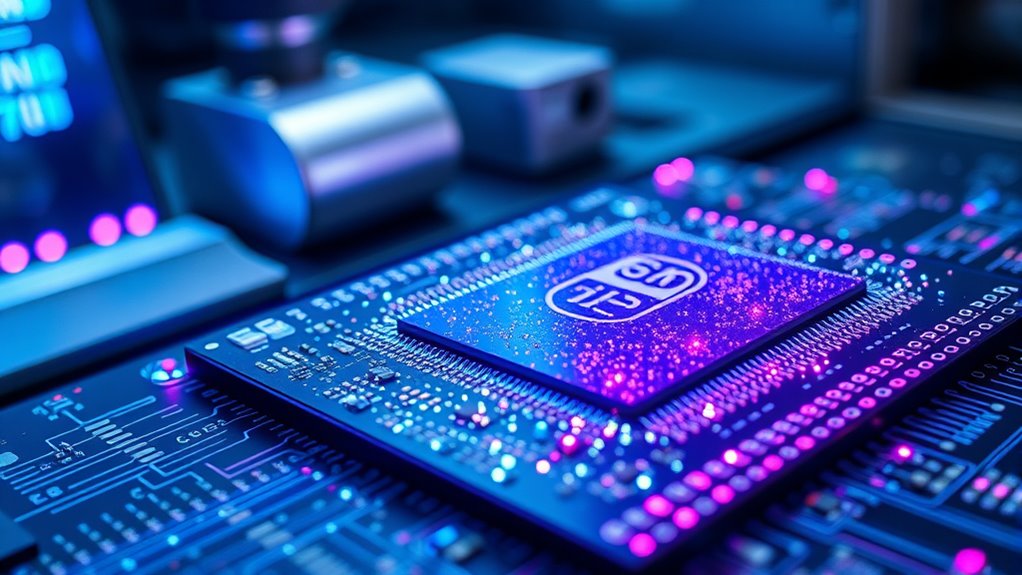
Have nanocrystal memory devices opened their full potential for future technology applications? They hold promise beyond traditional storage, especially in quantum dots and photonic applications. These devices could revolutionize quantum computing, enabling faster, more efficient processing. In photonics, nanocrystals may improve light emission, detection, and signal processing. Their unique size-dependent properties make them ideal for next-generation sensors and displays. Additionally, their material stability could enhance device longevity and performance. Here’s a quick overview of future trends:
| Application Area | Key Benefits | Challenges |
|---|---|---|
| Quantum Computing | High qubit stability | Scalability issues |
| Photonic Devices | Enhanced light manipulation | Integration complexity |
| Data Storage | Increased capacity and speed | Manufacturing consistency |
| Medical Imaging | Improved contrast and resolution | Biocompatibility concerns |
| Sensors and Detectors | Greater sensitivity and selectivity | Cost reduction |
Outlook and Integration Into Next-Generation Storage Systems

Nanocrystal memory devices are steadily advancing toward integration into next-generation storage systems, promising significant improvements in capacity, speed, and energy efficiency. You’ll see quantum tunneling play a critical role in enhancing data retention and access times, enabling faster read/write operations. As these devices evolve, spintronics integration offers exciting prospects by leveraging electron spin to increase stability and reduce power consumption. Combining nanocrystals with spintronic elements could revolutionize storage, making it more durable and scalable. Future systems will likely incorporate these technologies seamlessly, supporting high-density data centers and portable devices alike. The challenge lies in balancing quantum effects with practical manufacturing, but ongoing research indicates that these innovations will pave the way for more reliable, efficient, next-generation storage solutions. Additionally, advancements in nanocrystal fabrication are essential to overcoming current manufacturing challenges and achieving commercial viability.
Frequently Asked Questions
How Do Nanocrystals Affect Data Retention Over Time?
Nanocrystals improve data retention by trapping charges more effectively, reducing quantum tunneling that can cause data loss over time. Their small size creates energy barriers that resist dielectric breakdown, ensuring the stored information remains stable. You’ll notice that devices with nanocrystals maintain data integrity longer because these barriers slow charge leakage, making them a promising solution for next-generation memory storage.
What Environmental Factors Influence Nanocrystal Memory Stability?
Think of nanocrystal memory like a delicate garden; environmental factors can be the harsh weather that harms it. You need to protect against environmental degradation, which affects stability, by controlling humidity, temperature, and radiation exposure. Fabrication safety is vital, too, as improper handling can introduce defects. These factors directly influence how well your nanocrystal memory retains data over time, so maintaining ideal conditions guarantees longevity and reliability.
Are There Health or Safety Concerns During Fabrication?
During fabrication, health and safety concerns arise mainly from exposure to hazardous chemicals used in processes like etching and deposition. You should prioritize strict safety protocols to protect worker safety, including proper ventilation, protective gear, and handling procedures. These measures help minimize risks of chemical burns, inhalation, or long-term health issues, ensuring a safer work environment as you develop advanced nanocrystal memory devices.
How Does Temperature Impact Charge Storage in Nanocrystals?
Think of nanocrystals as tiny reservoirs for charge; temperature dependence plays a vital role here. As temperature increases, charge trapping becomes more active, allowing electrons to escape more easily, which can weaken data retention. Conversely, lower temperatures help maintain charge stability. So, you need to carefully manage operating temperatures to optimize charge storage, ensuring your nanocrystal memory devices function reliably and retain data longer.
What Are the Cost Implications for Commercial Production?
You’ll find that scaling challenges and manufacturing costs considerably impact commercial production of nanocrystal memory devices. As you try to scale up, complex fabrication processes and high-precision materials increase costs. These challenges demand advanced manufacturing techniques, which elevate expenses. While these devices promise next-generation storage, balancing cost efficiency with technological complexity remains a critical hurdle you need to overcome for widespread adoption.
Conclusion
You can leverage nanocrystal memory devices for faster, more reliable, and scalable storage solutions. You’ll benefit from their superior charge retention, improved endurance, and potential for seamless integration into future electronics. As technology advances, you’ll see these devices overcome current challenges, enhance performance, and open new applications. Embrace the future of storage with nanocrystals—where innovation, efficiency, and reliability come together to redefine what’s possible in memory technology.
Flea & tick season Picks
flea and tick prevention
As an affiliate, we earn on qualifying purchases.