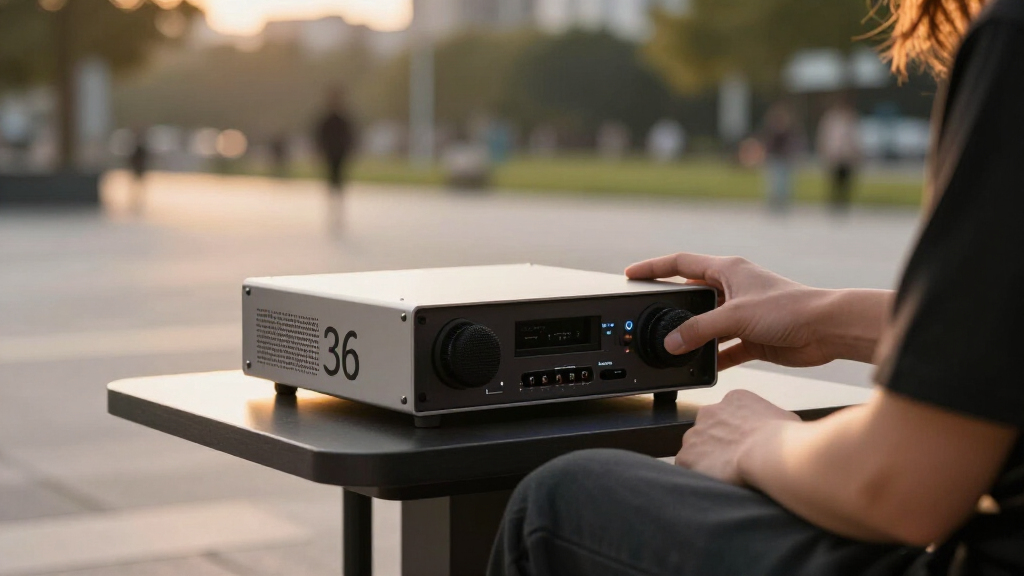

📊 Full opportunity report: Revealing The AI Design Technique Behind Station 36’S Listening Platform on ThorstenMeyerAI.com — validation score, market gap, and execution plan.

Get the latest gadgets delivered free — and shop member deals
- Fast, free delivery on millions of items
- Access to Prime Big Deal Days deals on October 6–7
- Prime Video, Amazon Music and more included
TL;DR
Station 36’s immersive web experience is built entirely with AI-driven design techniques. It features a vintage radio aesthetic and interactive signal tuning, showcasing advanced SVG and audio integration. This development highlights AI’s role in recreating historical interfaces.
Station 36’s web-based shortwave listening post has been crafted entirely using AI-driven design techniques, resulting in a highly authentic vintage radio aesthetic combined with interactive features. This innovative approach demonstrates how AI can be employed to recreate complex, tactile interfaces within a browser environment, blending historical style with modern web technology. Details are available in the original analysis.
The platform employs a restrained color scheme rooted in vintage materials, including deep bakelite brown-black (#191210) for the background and amber (#ffb54a) for hardware accents, enhancing its authentic look. For more on vintage radio aesthetics, see the original analysis. The core visual elements are built with inline SVG embedded directly into the HTML, allowing for crisp, scalable controls that mimic vintage radio hardware. JavaScript functions dynamically generate the dial’s ticks and synchronize interactions such as tuning, spectral waterfall scrolling, and signal visualization.
Audio synthesis is achieved through the Web Audio API, producing static hiss, carrier hum, heterodyne whistles, and Morse code signals. These sounds activate only when the user explicitly switches on the receiver, preserving realism and suspense. The spectral waterfall visualizes signal activity over time, scrolling downward with each frame, overlaying spectral noise, peaks, and Morse bursts. The entire interface is self-contained, with no external dependencies, built solely with HTML, CSS, and JavaScript, following strict design and accessibility guidelines.
Innovative Use of AI in Vintage Web Interface Design
This project exemplifies how AI can be harnessed to create highly detailed, authentic digital recreations of historical interfaces. By integrating AI-driven design techniques, the platform offers an immersive experience that combines tactile visual controls with realistic audio synthesis, pushing the boundaries of web-based historical simulation. It also demonstrates the potential for AI to streamline complex SVG construction and interactive synchronization, making sophisticated interfaces more accessible and customizable.
As an affiliate, we earn on qualifying purchases.
Development of AI-Driven Vintage Interface Techniques
Station 36 is part of a broader series of AI-crafted websites, each representing different historical or conceptual themes. The platform’s design process involved multiple iterative passes, focusing on visual fidelity, interaction quality, and technical robustness. This approach reflects a growing trend in AI-assisted web development, where machine intelligence aids in replicating intricate hardware aesthetics and layered audio-visual effects, traditionally requiring extensive manual coding.
Previous projects in the series, such as Arctic geomagnetic observatories and historic stock exchanges, have similarly employed AI to generate detailed, immersive environments. The current platform’s focus on vintage radio technology showcases how AI can accurately reproduce the tactile and auditory nuances of mid-20th-century communication devices within a browser.
“The AI techniques used here allowed us to generate precise SVG controls and synchronize complex audio-visual layers, creating a deeply authentic vintage experience.”
— an anonymous researcher
web-based shortwave radio receiver
As an affiliate, we earn on qualifying purchases.
As an affiliate, we earn on qualifying purchases.
Unclear Aspects of AI-Generated SVG and Audio Techniques
While the platform’s visual and audio fidelity is impressive, it remains unclear how much of the SVG construction and synchronization was directly automated by AI versus manually refined. Details about the specific AI models or algorithms used in generating the SVG components and managing the audio-visual synchronization are not publicly disclosed. Additionally, the extent to which AI contributed to the iterative design process versus human intervention is still uncertain.
interactive audio synthesis devices
As an affiliate, we earn on qualifying purchases.
As an affiliate, we earn on qualifying purchases.
Future Applications of AI in Interactive Historical Interfaces
Moving forward, developers and historians may explore expanding AI-assisted design to other complex interfaces, such as vintage machinery, scientific instruments, or military equipment. There is also potential for AI to further automate the creation of layered audio-visual environments, making detailed recreations more accessible. The ongoing development of AI tools could lead to more dynamic, customizable digital museums and immersive experiences that preserve and showcase historical technology with high accuracy.
digital spectral waterfall visualization
As an affiliate, we earn on qualifying purchases.
As an affiliate, we earn on qualifying purchases.
Key Questions
How does AI contribute to the design of Station 36’s interface?
AI aids in generating precise SVG controls, synchronizing complex audio-visual layers, and automating the creation of detailed visual and interactive elements, resulting in a highly authentic vintage radio experience.
What technologies are used to create the spectral waterfall and audio synthesis?
The spectral waterfall is rendered using HTML5 Canvas, with spectral data generated programmatically. Audio synthesis employs the Web Audio API to produce static hiss, heterodyne whistles, Morse code signals, and carrier hum, activated through user interaction.
Is AI fully responsible for the platform’s design or is there human input involved?
While AI techniques significantly streamline SVG generation and synchronization, human designers still guide the overall aesthetic, interaction logic, and fine-tuning to ensure authenticity and usability.
Can this AI-driven design approach be applied to other historical interfaces?
Yes, the methods demonstrated here can be adapted to recreate a variety of vintage or complex interfaces, especially those requiring layered visuals and audio, making AI a valuable tool for digital preservation and education.
What are the limitations of AI in creating such interfaces?
Current AI tools may require manual refinement to achieve high fidelity, and there is limited transparency about the specific algorithms used. Fully automating complex, layered designs remains a technical challenge.
Source: ThorstenMeyerAI.com
Fall Picks
fall essentials
As an affiliate, we earn on qualifying purchases.