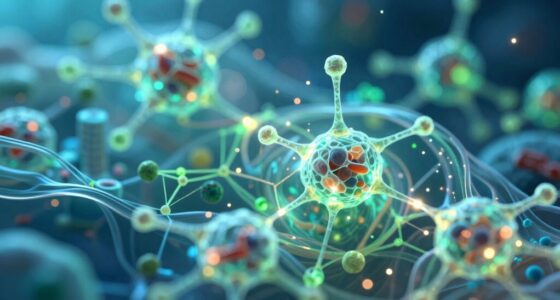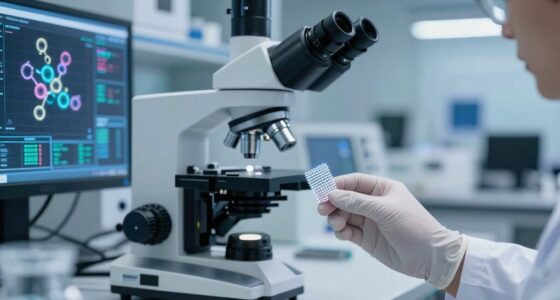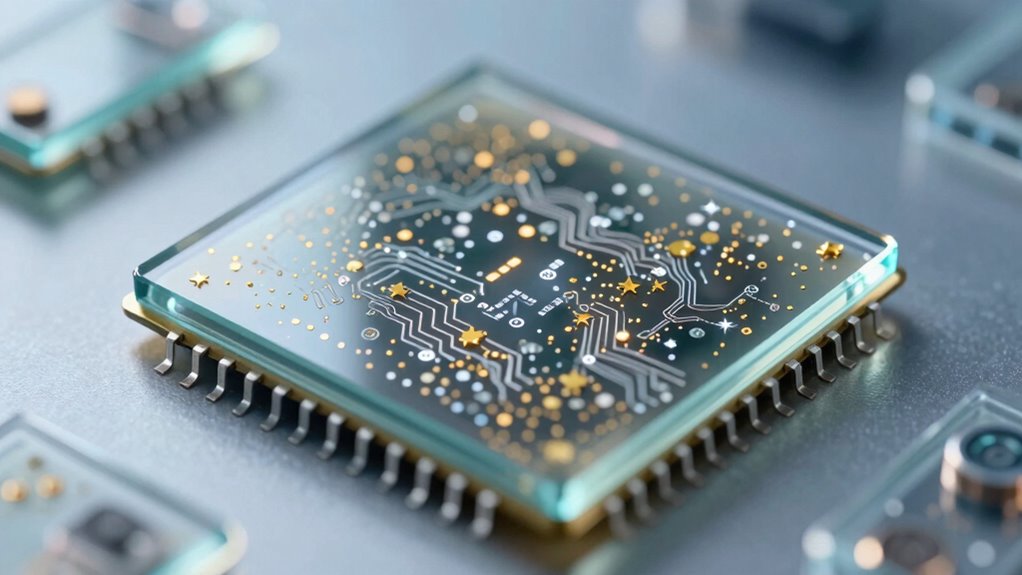

Nanotech accelerates diagnostic platforms by offering ultra-sensitive detection of diseases with high accuracy. You benefit from quantum dots that produce bright, tunable fluorescence to target specific molecules, enabling rapid results from simple samples. These nanomaterials boost stability, support multiplexed testing, and can be integrated into portable devices, making diagnostics faster and more accessible. By harnessing nanotechnology, healthcare becomes more personalized and eco-friendly. Keep exploring to discover how these innovations are shaping the future of disease detection.

Get the latest gadgets delivered free with Prime
- Fast, free delivery on millions of items
- Prime Video, Amazon Music and more included
- Member-only deals all year
Key Takeaways
- Nanotech enables highly sensitive and specific detection of biological molecules through functionalized quantum dots.
- Integration into biosensors allows rapid, real-time diagnostics suitable for point-of-care applications.
- Quantum dots provide stable, multiplexed signals, improving reliability and enabling simultaneous analysis of multiple markers.
- Advances focus on eco-friendly nanomaterials to promote sustainable, affordable diagnostic solutions.
- Nanotech-driven platforms facilitate early disease detection, personalized medicine, and improved healthcare outcomes.
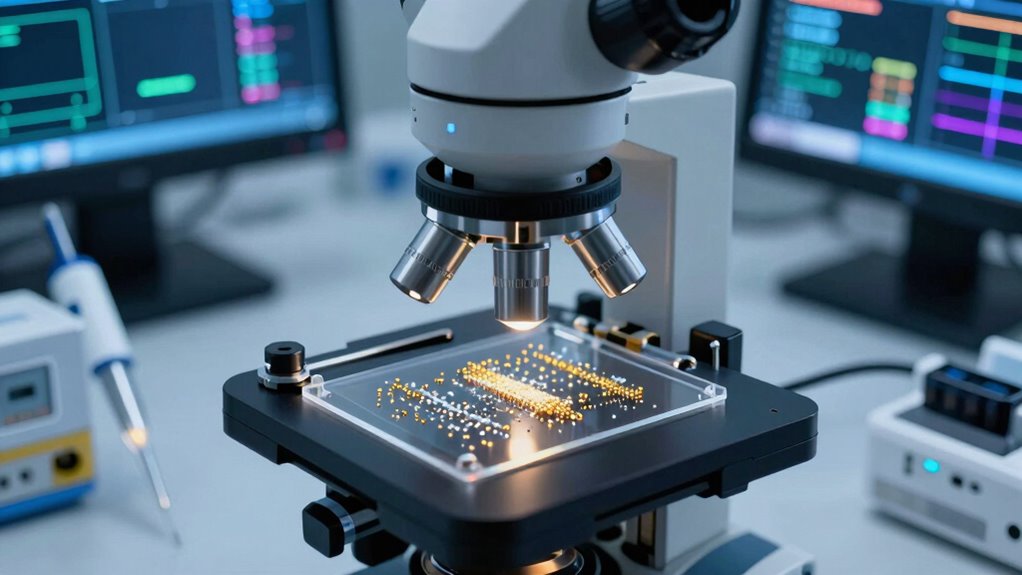
Have you ever wondered how tiny particles can revolutionize disease detection? The answer lies in the remarkable world of nanotechnology, where minuscule particles like quantum dots are transforming diagnostic platforms. Quantum dots are semiconductor nanocrystals that emit bright, tunable fluorescence when excited by light. Their unique optical properties make them ideal for highly sensitive detection of biological molecules. When integrated into biosensors, quantum dots can markedly improve the accuracy and speed of identifying pathogens or disease markers. This biosensor integration allows for real-time monitoring and precise quantification of various biomolecules, providing vital information for early diagnosis and treatment planning.
Tiny particles like quantum dots are revolutionizing disease detection with faster, more precise, real-time biomolecule analysis.
Imagine a diagnostic device that can detect a disease from a simple blood sample within minutes, thanks to the power of quantum dots. These particles can be conjugated with specific antibodies or nucleic acids, enabling them to target and bind to particular molecules associated with diseases. When these quantum dot-labeled probes encounter their targets, they produce a fluorescent signal that can be easily measured with advanced imaging systems. This process not only enhances detection sensitivity but also reduces false positives, making diagnostics more reliable. The integration of quantum dots into biosensors has opened new avenues in personalized medicine, where treatment decisions are based on precise, rapid diagnostic data.
Beyond their optical advantages, quantum dots are highly stable and resistant to photobleaching, unlike traditional dyes. This stability guarantees consistent results during prolonged testing, which is essential for accurate diagnostics. Moreover, their size allows for easy functionalization, meaning you can tailor quantum dots to detect a broad spectrum of biomolecules. This flexibility makes them invaluable in developing multiplexed biosensors capable of simultaneously analyzing multiple disease markers, saving time and resources. Additionally, ongoing research into sustainable nanomaterials aims to make these diagnostic tools more environmentally friendly and economically viable. As research advances, the potential for quantum dots to be incorporated into portable, point-of-care diagnostic devices grows, promising to bring sophisticated testing directly into clinics, homes, or remote areas.
In essence, the fusion of quantum dots with biosensor technology exemplifies how nanotech can drastically enhance disease detection. You benefit from faster, more precise diagnostics that can catch illnesses early, improving treatment outcomes. As these innovations continue to evolve, you’ll see a future where nanotech-driven diagnostic platforms become routine, making healthcare more responsive, personalized, and accessible. The tiny particles of nanotechnology are indeed making a big impact, turning complex laboratory techniques into simple, rapid tests that can save lives. Additionally, incorporating natural materials into nanotech-based diagnostics can further enhance their sustainability and reduce environmental impact, aligning with eco-friendly practices in healthcare technology.
quantum dot biosensor for disease detection
As an affiliate, we earn on qualifying purchases.
As an affiliate, we earn on qualifying purchases.
Frequently Asked Questions
How Cost-Effective Are Nanotech-Based Diagnostic Tools?
Nanotech-based diagnostic tools are quite cost-effective, primarily because they enable significant cost reduction in manufacturing and operation. You’ll find that these tools improve accessibility by being more affordable and easier to distribute, especially in resource-limited settings. Their precision and efficiency reduce the need for expensive reagents and equipment, making advanced diagnostics more affordable and accessible, ultimately benefiting public health efforts and patient outcomes worldwide.
What Are the Main Safety Concerns With Nanomaterials?
You should be aware that nanomaterials pose safety concerns mainly due to nanomaterial toxicity, which can affect human health if inhaled or ingested. Additionally, their environmental impact raises worries about potential pollution and harm to ecosystems. You need to handle nanomaterials carefully, follow safety protocols, and consider their disposal to minimize risks. Ongoing research aims to better understand and mitigate these safety issues for safer nanotech applications.
How Long Does It Take to Develop New Nanotech Diagnostics?
Developing new nanotech diagnostics typically takes several years, depending on the complexity and regulatory hurdles involved. Your focus on nanotech innovation accelerates diagnostic timelines by streamlining design and testing processes, but rigorous validation remains essential. You should expect a timeline of roughly 3 to 7 years, from initial research through clinical trials and regulatory approval. Staying adaptable and collaborative helps shorten these diagnostic timelines effectively.
Are Nanotech Diagnostics Suitable for Home Use?
Ever wonder if nanotech diagnostics are suitable for home use? They absolutely are, thanks to their high sensitivity and rapid results. As technology advances, nanotech-based home testing becomes more user-friendly, increasing accessibility for everyday users. These diagnostics can empower you to monitor health conditions easily without visiting a lab. So, yes, nanotech diagnostics are increasingly designed for user accessibility, making them a practical choice for home testing.
What Regulatory Challenges Exist for Nanotech in Medicine?
You’ll face regulatory approval hurdles because nanotech-based medical products must meet strict safety and efficacy standards. Ethical considerations also come into play, especially regarding potential long-term effects and privacy concerns. Regulators require thorough testing and transparent data before granting approval. Managing these challenges involves demonstrating that nanotech solutions are safe, effective, and ethically sound, ensuring they benefit patients without unforeseen risks.
portable nanotech diagnostic device
As an affiliate, we earn on qualifying purchases.
As an affiliate, we earn on qualifying purchases.
Conclusion
Imagine holding a tiny, powerful magnifying glass that reveals hidden secrets—nanotech does just that for diagnostics. It’s like having a superhero’s toolkit, catching diseases early and saving lives. With rapid, precise detection, you’re part of a future where health crises are caught before they escalate. Just as a small spark can ignite a wildfire, these tiny tech advances ignite big changes in healthcare—making early detection faster, smarter, and more accessible for everyone.
multiplexed biosensor for biomarker analysis
As an affiliate, we earn on qualifying purchases.
As an affiliate, we earn on qualifying purchases.
point-of-care quantum dot testing kit
As an affiliate, we earn on qualifying purchases.
As an affiliate, we earn on qualifying purchases.
Columbus Day / Indigenous Peoples' Day Picks
long weekend sales
As an affiliate, we earn on qualifying purchases.