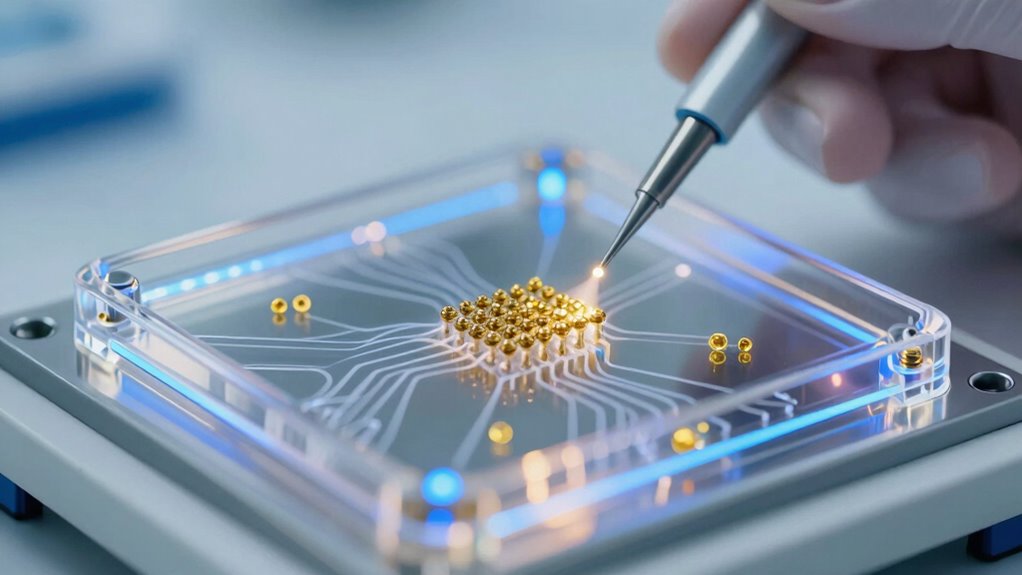
Nanotechnology improves point-of-care diagnostics by enabling tiny sensors that detect biomarkers, pathogens, or chemicals with high precision. These sensors can deliver immediate and accurate results right at the testing site, reducing the need for bulky lab equipment. Their small size allows for portable, user-friendly devices that support rapid, on-the-spot testing with minimal sample volume. If you keep exploring, you’ll discover how these innovations are transforming healthcare and environmental monitoring.
Key Takeaways
- Nanotech sensors enable highly sensitive, rapid detection of biomarkers with minimal sample volumes for immediate diagnosis.
- Miniaturized devices improve portability, allowing on-the-spot testing in clinical and remote settings.
- Integration with smartphones and portable electronics provides instant, user-friendly result visualization.
- Surface functionalization enhances specificity, reducing false positives and negatives in diagnostics.
- Real-time data collection supports quick clinical decisions and timely disease monitoring.
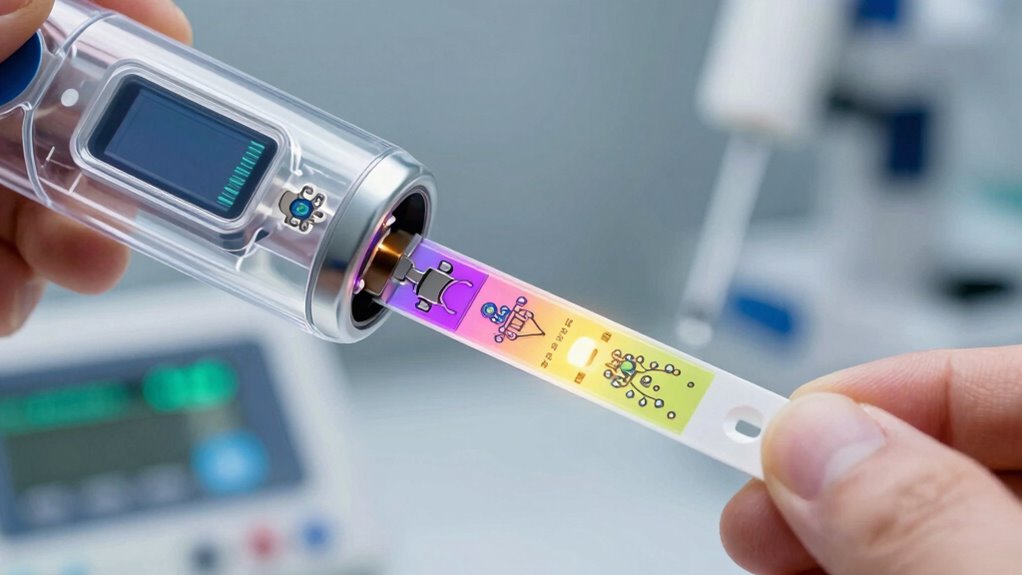
Nanotechnology is revolutionizing point-of-care diagnostics by enabling the development of highly sensitive, rapid, and portable testing devices. These breakthrough devices come largely thanks to nanotech sensors, which can detect minute quantities of biomarkers, pathogens, or chemicals with incredible precision. These sensors are tiny, often just a few nanometers in size, allowing them to interact directly with biological molecules and produce immediate, accurate readings. As a result, you get faster diagnoses, often within minutes, which can be essential for timely treatment decisions. The ability to integrate nanotech sensors into portable devices means you no longer need to rely on bulky labs or centralized testing facilities, making healthcare more accessible, especially in remote or resource-limited settings.
Diagnostic miniaturization plays a key role in this transformation. By shrinking the size of diagnostic components, you can create compact, user-friendly devices that are easy to operate. Miniaturized diagnostic tools fit comfortably in your hand, enabling on-the-spot testing at the patient’s bedside or even in field conditions. This miniaturization also reduces the amount of sample needed, minimizing discomfort and making testing more efficient. With smaller, integrated systems, you can perform multiplexed tests—simultaneously detecting multiple pathogens or biomarkers—without increasing the device’s size or complexity. This efficiency accelerates the diagnostic process, allowing for quicker, more comprehensive assessments. Additionally, advancements in nanotech sensors enhance their ability to deliver highly specific and reliable results. Moreover, the development of highly sensitive detection methods is crucial for identifying low-abundance biomarkers, which further improves diagnostic accuracy. The ongoing refinement of these sensors continues to expand their potential applications across various fields of medicine and environmental monitoring.
Furthermore, nanotech sensors facilitate the development of highly specific assays. Their small size and surface functionalization capabilities mean they can be tailored to target particular molecules with high affinity, reducing false positives and negatives. This specificity is essential for early disease detection and monitoring, where precision can greatly impact outcomes. The rapid response of nanotech sensors also means you get real-time data, enabling immediate clinical decisions. Because these sensors can be integrated into portable electronics, you can visualize results instantly, often through simple readouts or smartphone interfaces, making the entire process user-friendly. Innovations in sensor technology are continually improving the sensitivity and robustness of these diagnostic tools, expanding their potential applications.

Nanobiotechnology in Molecular Diagnostics: Current Techniques and Applications (Horizon Bioscience)
As an affiliate, we earn on qualifying purchases.
As an affiliate, we earn on qualifying purchases.
Frequently Asked Questions
How Cost-Effective Is Nanotechnology for Widespread Diagnostic Use?
Nanotechnology can be cost-effective for widespread diagnostics, but you’ll face some affordability challenges. While the initial cost analysis shows potential savings through rapid, miniaturized testing, setting up nanotech-based systems may require significant upfront investments. Over time, these costs could decrease with technological advances and mass production, making nanotech more accessible. Ultimately, balancing innovation with affordability will be key for its broad adoption in point-of-care diagnostics.
Are There Any Safety Concerns With Nanomaterials in Medical Devices?
You should be aware that nanomaterials in medical devices can pose safety concerns, especially regarding nanomaterial toxicity and environmental impact. There’s ongoing research into how these tiny particles might affect human health and ecosystems. You need to consider potential risks like cellular damage or long-term environmental contamination, and guarantee proper regulatory measures are in place. Addressing these safety issues is vital for the responsible development and deployment of nanotechnology in healthcare.
What Regulatory Hurdles Exist for Nanotech-Based Diagnostics?
You face regulatory hurdles like lengthy approval processes for nanotech-based diagnostics, as agencies require thorough safety and efficacy data. Securing regulatory approval involves demonstrating that these advanced devices meet strict standards. Ethical considerations also come into play, ensuring patient safety and addressing concerns about nanomaterials’ long-term effects. Managing these hurdles requires careful documentation and adherence to evolving guidelines, but overcoming them is essential for bringing innovative, nanotech-powered diagnostics to market.
Can Nanotechnology Improve Diagnostics for Rare Diseases?
You’ll be amazed to learn that nanotechnology can revolutionize diagnostics for rare diseases by enhancing specificity. With nanotech, you can detect rare disease biomarkers at incredibly low concentrations, sometimes even a single molecule. This precision allows for earlier, more accurate diagnoses, which is essential for managing rare conditions. By targeting specific biomarkers, nanotech paves the way for personalized treatments and better patient outcomes.
How Durable Are Nanotechnology-Enhanced Diagnostic Tools?
Nanotechnology-enhanced diagnostic tools are quite durable, thanks to strong nanomaterial stability, which resists wear and tear. You can expect good device longevity because these nanomaterials maintain their function over time, even in varied environments. Proper design and protective coatings further enhance durability, making these tools reliable for repeated use. Overall, their robustness guarantees they stay effective, giving you consistent, accurate results during point-of-care testing.

Point-of-Care Technology for Portable Testing Devices: Nanomaterials-Based Optical Biosensors for Cardiovascular Disease Biomarkers
As an affiliate, we earn on qualifying purchases.
As an affiliate, we earn on qualifying purchases.
Conclusion
As you explore nanotechnology’s potential, you’ll see how it seamlessly transforms point-of-care diagnostics, making them faster and more precise. Coincidentally, as tiny particles revolutionize detection, you realize that your ability to diagnose early and accurately improves, bridging the gap between science and everyday health. With each breakthrough, nanotech brings hope, efficiency, and innovation closer to your fingertips, proving that sometimes, the smallest advancements can lead to the biggest changes in healthcare.

YO Home Sperm Test | #1 FDA Cleared Home Semen Analysis | Tests Sperm Concentration, Motility, Progressive Motility, and More with 97% Accuracy | No Mail-in or Lab Visit | Includes 3 Tests
ACCURATE and DOCTOR RECOMMENDED – This FDA Cleared at-home male fertility test reports results with greater than 97%…
As an affiliate, we earn on qualifying purchases.
As an affiliate, we earn on qualifying purchases.
miniaturized pathogen detection device
As an affiliate, we earn on qualifying purchases.
As an affiliate, we earn on qualifying purchases.