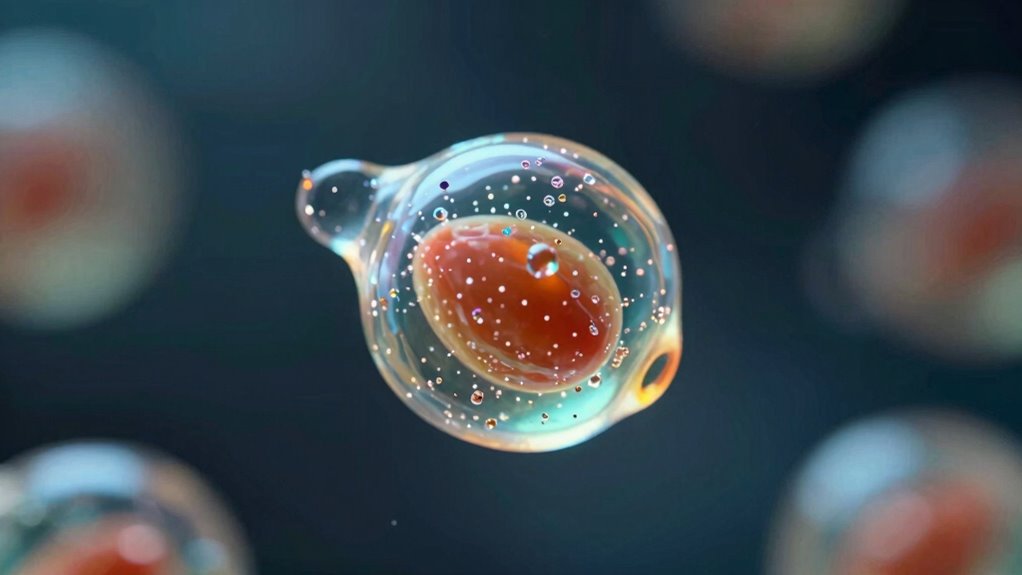

When scientists talk about nanoencapsulation, they mean enclosing active ingredients—like vitamins, drugs, or flavors—inside tiny particles called nanoparticles, which measure in nanometers. This technology improves the stability, protection, and controlled release of these ingredients, making products more effective. By using special techniques, they create stable carriers that prevent premature breakdown or clumping. If you’re curious, you’ll find out how these tiny carriers are made and how they enhance various applications.
Key Takeaways
- Nanoencapsulation involves enclosing active ingredients within tiny nanoparticles to protect and control their release.
- It enhances stability and prevents premature degradation of sensitive compounds like vitamins or drugs.
- The technique improves delivery efficiency in pharmaceuticals, food, and cosmetics through specialized methods.
- Surface modifications and coatings are used to stabilize nanoparticles and extend shelf life.
- This process allows for targeted, sustained release of active substances, increasing their effectiveness.
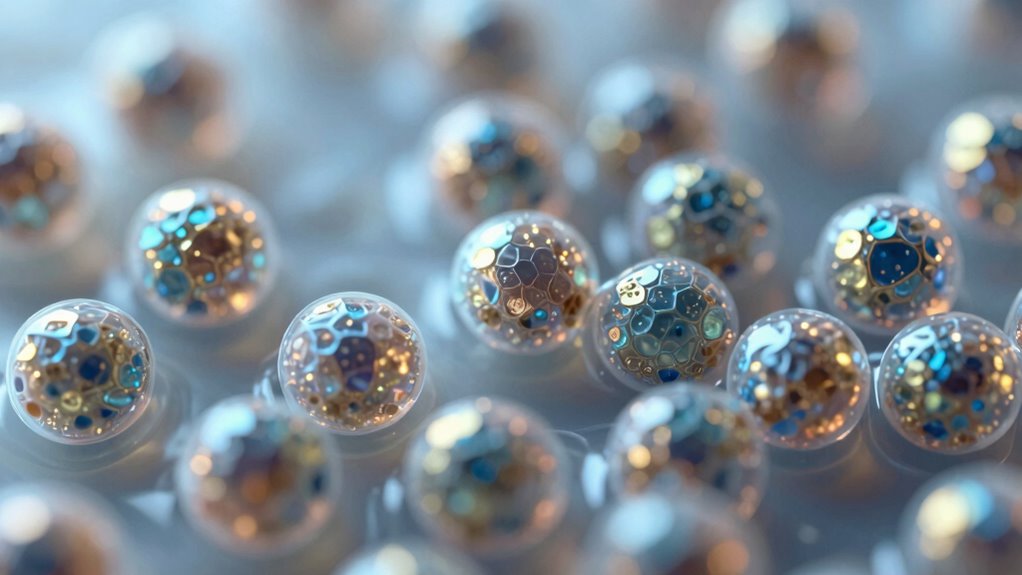
Have you ever wondered how tiny particles can protect and deliver active ingredients more effectively? That’s where nanoencapsulation comes into play. This innovative process involves wrapping active substances—like vitamins, drugs, or flavors—inside microscopic carriers called nanoparticles. These particles are so small that they’re measured in nanometers, which is a millionth of a millimeter. The goal is to improve how these ingredients are protected, transported, and released in the body or in products. When scientists talk about nanoencapsulation, they’re referring to the process that uses sophisticated techniques to encapsulate these active ingredients within nanoparticles, guaranteeing their stability and effectiveness.
One vital aspect of nanoencapsulation is nanoparticle stability. Because these particles are so tiny, they’re prone to aggregation or degradation over time, which can compromise the effectiveness of the encapsulated ingredient. To prevent this, scientists develop ways to enhance nanoparticle stability. They often use specific materials or surface modifications that stabilize the particles in different environments—whether in liquids, gels, or biological systems. This stability guarantees that the active ingredient remains protected during storage and until it reaches its target, where it can be released in a controlled manner. Without stable nanoparticles, the encapsulated ingredients might break down prematurely or clump together, reducing their potency and making the delivery less predictable. Additionally, protective coating techniques are frequently employed to further enhance nanoparticle stability in various conditions. Moreover, understanding the stability of nanoparticles helps improve their effectiveness and shelf life in commercial products. Recognizing the importance of nanoparticle stability allows scientists to customize encapsulation strategies for different applications, ensuring consistent performance. Furthermore, advancements in material science contribute to creating more resilient nanoparticle systems that can withstand diverse conditions.
Ensuring nanoparticle stability is key to protecting active ingredients and achieving controlled, effective delivery.
Encapsulation techniques are the methods scientists employ to create these nano-sized carriers. These techniques vary depending on the nature of the active ingredient and the desired application. Some common methods include emulsification, where the active ingredient is dispersed in a carrier phase and then solidified into nanoparticles, and coacervation, which involves forming a coating around the active substance. Other techniques like liposomal encapsulation or polymeric nanoparticle formation are also popular, each offering different benefits for stability and release profiles. The choice of technique directly impacts the efficiency of encapsulation, the stability of the nanoparticles, and how well the active ingredient is protected and released when needed.
In essence, nanoencapsulation combines advanced materials science and engineering to enhance delivery systems. By focusing on nanoparticle stability and employing precise encapsulation techniques, scientists can develop products that are more effective, longer-lasting, and tailored to specific needs. Whether in pharmaceuticals, food, or cosmetics, this technology opens up new possibilities for protecting and controlling the release of active ingredients, making them work better for you.

Nano Earth Labs Blood Stabilizer Max, 60 Capsules, Herbal Supplement with Vitamins and Minerals (1)
Supports Healthy Blood Balance: Advanced formula featuring Banaba Leaf, Bitter Melon Extract, Juniper Berry, and White Mulberry to…
As an affiliate, we earn on qualifying purchases.
As an affiliate, we earn on qualifying purchases.
Frequently Asked Questions
How Does Nanoencapsulation Differ From Other Delivery Methods?
Nanoencapsulation differs from other delivery methods by enhancing particle stability, ensuring your active ingredients remain effective until release. It uses tiny particles to protect compounds from degradation, enabling precise release mechanisms. This means your nutrients or drugs are delivered more efficiently, with better control over their release timing. Unlike traditional methods, nanoencapsulation offers improved bioavailability and targeted delivery, making it a superior choice for maximizing efficacy and minimizing side effects.
Are There Any Health Risks Associated With Nanoencapsulation?
You might wonder if nanoencapsulation is a ticking time bomb for health, but current research suggests it’s generally safe. Still, long-term safety remains unknown, raising regulatory concerns. Tiny particles could potentially cross biological barriers, causing unforeseen effects. It’s essential for scientists and regulators to closely monitor and thoroughly assess risks, ensuring that this innovative technology doesn’t pose hidden dangers to your health in the future.
What Materials Are Commonly Used in Nanoencapsulation?
You’ll find that common encapsulation materials include lipids, proteins, and polymers, which protect the active ingredients effectively. These materials are chosen for their ability to enhance material stability, preventing degradation and ensuring controlled release. By selecting appropriate encapsulation materials, scientists improve the stability and effectiveness of nanoencapsulated products, making them suitable for applications in food, pharmaceuticals, and cosmetics, while minimizing potential risks associated with unstable or poorly protected substances.
How Scalable Is Nanoencapsulation for Industrial Use?
Nanoencapsulation can be scaled up for industrial use, but you’ll face challenges around cost scalability and manufacturing. Large-scale production requires specialized equipment and processes, which can increase expenses. Ensuring consistent quality and stability at high volumes adds complexity. While advancements are ongoing, you should expect some hurdles in shifting from lab to industry. Careful planning and investment are essential to overcome manufacturing challenges and make nanoencapsulation viable on a commercial scale.
Can Nanoencapsulation Target Specific Cells or Tissues?
Yes, nanoencapsulation can target specific cells or tissues. It enables targeted delivery by attaching ligands that recognize unique cell markers, allowing for precision therapy. This approach guarantees the encapsulated substance reaches only the intended site, reducing side effects and increasing effectiveness. With tailored surface modifications, nanoencapsulation provides a powerful tool for targeted delivery, making treatments more precise, efficient, and personalized.

Advancements in Liposomal Drug Delivery Systems: Liposomal Drug Delivery: from Innovation to Clinic
As an affiliate, we earn on qualifying purchases.
As an affiliate, we earn on qualifying purchases.
Conclusion
In essence, nanoencapsulation lets you protect and deliver substances more efficiently, like encapsulating a drug to target specific cells. Imagine a case where a nutrient is wrapped in a nano-shell, ensuring it survives digestion and reaches your bloodstream intact. This technology could revolutionize medicine, food, and cosmetics by enhancing effectiveness and reducing side effects. As research advances, understanding nanoencapsulation helps you appreciate how tiny innovations can have a profound impact on your health and daily life.
nanoparticle stability enhancers
As an affiliate, we earn on qualifying purchases.
As an affiliate, we earn on qualifying purchases.

Nanoencapsulation of Food Bioactive Ingredients: Principles and Applications
As an affiliate, we earn on qualifying purchases.
As an affiliate, we earn on qualifying purchases.