Using nanotech for drug metabolism studies lets you precisely analyze how drugs are absorbed, distributed, and broken down at the cellular level. You can design nanoparticles to target specific tissues and improve enzyme interactions, enhancing the accuracy of your experiments. Nanoparticles also offer better enzyme stability, higher surface area for reactions, and more reliable in vitro models. Keep exploring—there’s so much more that nanotech can do to advance your understanding of drug metabolism.
Key Takeaways
- Nanoparticles enable targeted drug delivery and detailed study of metabolic pathways, improving ADME analysis accuracy.
- Immobilizing enzymes on nanomaterials stabilizes catalysts and enhances their activity in metabolic assays.
- Surface functionalization of nanocarriers allows precise control over interactions with enzymes and cells, optimizing metabolism studies.
- Nanotech-based models facilitate high-throughput screening and predictive assessments in drug development.
- Combining nanotechnology with advanced data analysis accelerates insight into drug metabolism and safety profiles.
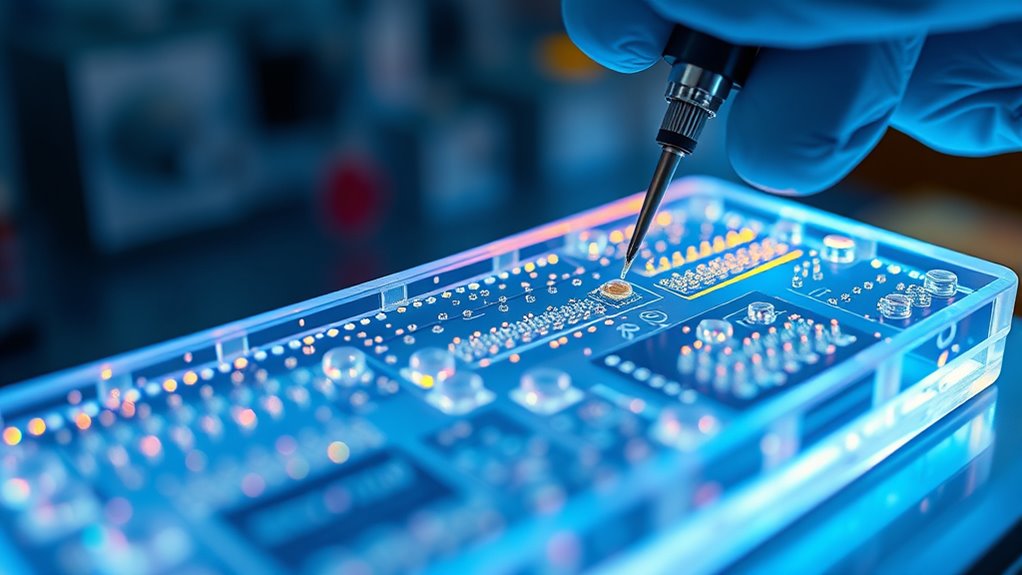
Nanotechnology is transforming how we comprehend and optimize drug metabolism, offering precise control at the cellular and molecular levels. By leveraging advanced tools like nanoparticle synthesis, researchers can create tiny carriers that enhance drug delivery and improve our understanding of how drugs are processed in the body. These nanoparticles can be designed to target specific cells or tissues, enabling detailed studies of drug absorption, distribution, metabolism, and excretion. This level of control allows you to investigate metabolic pathways with greater accuracy, reducing reliance on traditional, less precise methods.
Nanotechnology enhances drug metabolism studies with precise, targeted nanoparticle tools improving accuracy and efficiency.
One of the key innovations in this field involves enzyme immobilization on nanomaterials. By attaching enzymes to nanoparticles, you can stabilize these biological catalysts and improve their activity in various environments. Immobilized enzymes retain their functionality over extended periods, making them ideal for repeated or continuous use in metabolic studies. This approach enables you to simulate enzymatic reactions involved in drug metabolism more effectively, providing insights into how drugs are transformed by liver enzymes or other biological catalysts. The immobilization process also allows for fine-tuning enzyme activity, helping you explore the effects of different conditions on metabolic pathways. Additionally, integrating insights from AI in cybersecurity can help develop smarter data analysis tools for interpreting complex metabolic data, further advancing the field.
In nanoparticle synthesis, you can manipulate size, shape, and surface properties to optimize interactions with biological systems. For example, you might produce gold or silica nanoparticles tailored for specific enzyme immobilization techniques, ensuring maximum stability and activity. These engineered nanomaterials serve as platforms for studying enzyme kinetics, drug interactions, and metabolic stability. By controlling surface chemistry, you can also attach functional groups or targeting ligands, further refining how nanoparticles interact with cells and enzymes involved in drug metabolism.
Using nanotechnology for enzyme immobilization and nanoparticle synthesis offers a powerful way to develop more accurate in vitro models of drug metabolism. These models can mimic the complex environment of human tissues, providing you with predictive data that enhances drug development and safety assessment. Additionally, the high surface area-to-volume ratio of nanoparticles allows for increased enzyme loading, improving the sensitivity and throughput of metabolic assays. This makes it easier for you to screen multiple compounds quickly and efficiently, accelerating the discovery of new drugs and optimizing existing therapies.
Frequently Asked Questions
How Does Nanotech Improve Drug Absorption in Metabolism Studies?
Nanotech improves drug absorption by utilizing nanoparticle delivery systems that enhance bioavailability. You can see better absorption because nanoparticles protect drugs from degradation, allowing more to reach targeted tissues. This method also facilitates crossing cell membranes more efficiently, increasing the rate at which drugs enter the bloodstream. As a result, you get more consistent and effective drug metabolism studies, leading to improved understanding of how drugs are processed in the body.
Are There Any Safety Concerns With Nanotech in Drug Testing?
You should consider safety concerns with nanotech in drug testing, especially regarding environmental impact and long-term toxicity. Nanoparticles might accumulate in ecosystems or human tissues, potentially causing unforeseen health issues over time. While nanotech offers promising benefits, you need to stay cautious about these risks, monitor ongoing research, and guarantee proper regulations are in place to mitigate potential hazards associated with long-term exposure and environmental release.
Can Nanotech Be Used for Personalized Medicine Approaches?
Yes, nanotech can be used for personalized medicine approaches, and it’s an exciting frontier. Imagine nanotech customization enabling you to receive treatments tailored precisely to your unique genetic makeup, maximizing efficacy while minimizing side effects. This technology holds the potential to revolutionize personalized treatments, making them more effective and accessible. As research advances, you might soon benefit from nanotech’s ability to deliver highly individualized therapies designed specifically for you.
What Types of Nanomaterials Are Most Effective in Metabolism Research?
You should focus on nanomaterials with high biocompatibility, like liposomes, dendrimers, and gold nanoparticles, as they minimize toxicity during metabolism research. Surface functionalization enhances their stability and targeting ability, making them more effective. These tailored modifications allow for precise interaction with metabolic pathways, providing clearer insights. Choosing the right nanomaterial with ideal biocompatibility and surface functionalization is key to advancing your drug metabolism studies.
How Cost-Effective Is Nanotech Compared to Traditional Methods?
Nanotech can be more cost-effective than traditional methods, especially in the long run, due to faster analysis times and reduced reagent use. However, you should consider the cost comparison carefully, as initial investments in nanotechnology equipment can be high. Scalability challenges might also affect affordability, making it tricky to implement on a large scale without significant resource allocation. Overall, nanotech offers promising cost savings despite these hurdles.
Conclusion
As you explore nanotech’s role in drug metabolism, remember it’s like a tiny lighthouse guiding your understanding through complex biological waters. Just as a lighthouse symbolizes hope and clarity amid darkness, nanotech illuminates the path toward safer, more effective medicines. Embrace this innovation as your beacon, leading you closer to breakthroughs that can transform healthcare. With each discovery, you’re forging a future where tiny tools unleash big possibilities for human health.