
Precision medicine with nanoparticles lets you benefit from targeted diagnosis and treatment at the cellular level. These tiny particles can deliver drugs directly to disease sites, minimizing damage to healthy tissue and reducing side effects. They can carry multiple therapies, respond to environmental cues, and be customized to your unique biology. By combining advanced technology with personalized approaches, nanoparticles are shaping a future of more effective, individualized care—continue exploring to learn how this breakthrough could impact you.
Key Takeaways
- Nanoparticles enable targeted diagnosis and therapy, delivering treatments precisely to diseased cells while sparing healthy tissue.
- They can carry multiple drugs and respond to environmental triggers for controlled, personalized drug release.
- Nanoparticles recognize disease-specific biomarkers, allowing for highly selective targeting based on molecular profiles.
- Integration with AI and data analysis enhances customization of treatments and early disease detection.
- They facilitate more effective, personalized therapies with fewer side effects, transforming future medical practices.
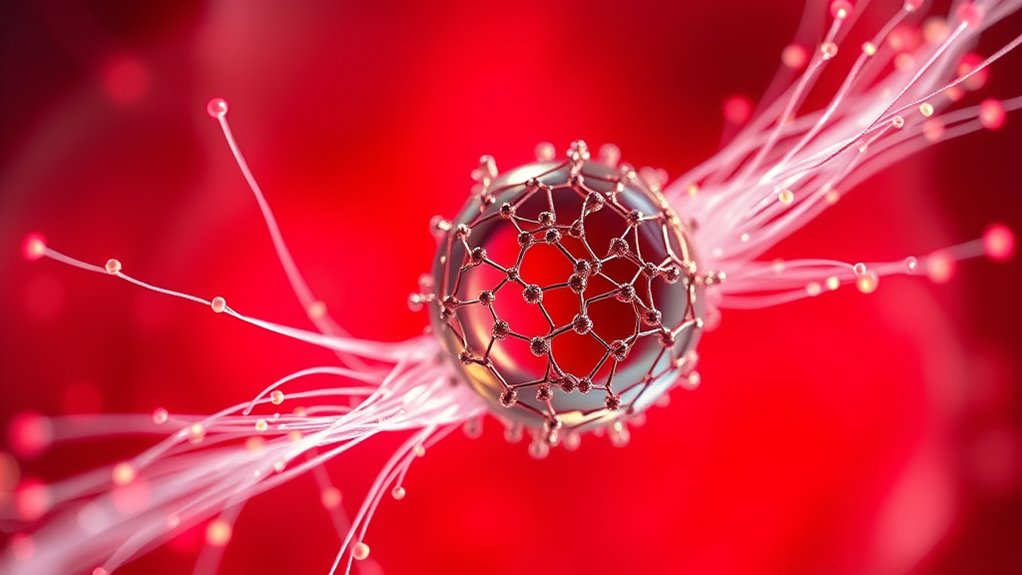
Nanoparticles are transforming precision medicine by enabling targeted diagnosis and treatment at the cellular level. When you look at how these tiny carriers work, you see that nanoparticle targeting allows you to direct therapies precisely where they’re needed, minimizing damage to healthy tissue. This specificity is a game-changer, especially for complex diseases like cancer, where traditional treatments often harm both healthy and diseased cells. By customizing nanoparticles to recognize specific biomarkers on cancer cells, you can guarantee that drugs are delivered exactly where they’re needed, increasing efficacy and reducing side effects. This approach exemplifies personalized drug delivery — tailoring treatments to an individual’s unique biological makeup. It’s like having a smart missile that homes in on its target with precision, instead of dispersing medicine throughout the body indiscriminately.
With nanoparticle targeting, you’re not just improving the accuracy of delivery; you’re also enhancing the way drugs interact with cells. Traditional medications often spread throughout the bloodstream, leading to suboptimal concentrations at the disease site and unwanted systemic effects. Nanoparticles can be engineered to respond to specific environmental triggers, such as pH changes or enzyme presence in diseased tissue. This means your treatment becomes more intelligent, releasing drugs only when the nanoparticle reaches the targeted area. As a result, you experience fewer side effects and better treatment outcomes. Personalized drug delivery via nanoparticles also allows for combination therapies — packing multiple drugs into a single nanoparticle designed to release them sequentially or simultaneously, based on the disease’s needs. This flexibility can improve treatment efficacy and combat resistance.
Advancements in nanoparticle design have made it easier to customize treatments for individual patients, leveraging AI and data analysis to optimize targeting strategies. Researchers are developing nanoparticles that recognize tumor-specific antigens, ensuring that only cancer cells are targeted, sparing healthy tissue. This level of personalization means your therapy can be fine-tuned to your genetic and molecular profile, increasing the chances of success. Furthermore, nanoparticles can be used for early diagnosis, as they can be engineered to detect specific disease markers, offering the possibility of catching illnesses before they progress. The integration of nanoparticle targeting with personalized drug delivery systems puts you at the forefront of a new era in medicine—one where treatments are not only more effective but also tailored uniquely to you, reducing the trial-and-error approach of conventional therapies.

Nanoparticle-Mediated Targeted Drug Delivery Systems
As an affiliate, we earn on qualifying purchases.
As an affiliate, we earn on qualifying purchases.
Frequently Asked Questions
How Do Nanoparticles Target Specific Cells in the Body?
You use targeting mechanisms like ligand or antibody attachment for surface modifications on nanoparticles to direct them precisely to specific cells. These surface modifications recognize and bind to unique markers on target cells, ensuring the nanoparticles deliver their therapeutic payload exactly where needed. This selective targeting minimizes side effects and enhances treatment effectiveness, making nanotechnology a powerful tool in personalized medicine.
Are There Any Long-Term Side Effects of Nanoparticle-Based Treatments?
You might wonder if nanoparticle treatments have long-term side effects. Currently, studies show limited data, but there’s concern about potential long-term toxicity, as some nanoparticles could accumulate in your body over time. Additionally, their environmental impact remains uncertain, raising questions about safety beyond immediate use. Researchers are actively investigating these issues, but it’s wise to stay informed until more conclusive evidence emerges on long-term toxicity and environmental effects.
What Types of Diseases Can Nanoparticles Effectively Treat?
You can use nanoparticles effectively for cancer therapy, targeting tumors precisely and reducing side effects. They also hold promise in infectious disease treatment, delivering drugs directly to infected cells and improving efficacy. Nanoparticles help overcome drug resistance and enhance delivery of therapies. By harnessing these capabilities, you can see significant advancements in personalized medicine, making treatments more effective and tailored to individual patient needs.
How Do Nanoparticles Compare to Traditional Drug Delivery Methods?
You’ll find nanoparticles more precise and targeted than traditional drug delivery methods, which often affect healthy tissues. They offer better cost efficiency by reducing drug waste and side effects, but manufacturing complexity can be higher, requiring advanced technology. Overall, nanoparticles improve treatment efficacy, but you should weigh their benefits against production challenges and costs compared to conventional methods.
What Are the Regulatory Challenges for Nanoparticle-Based Therapies?
You face regulatory hurdles and safety assessments that challenge nanoparticle-based therapies. While these innovations promise targeted treatment, authorities demand rigorous testing for toxicity, stability, and long-term effects. The complexity of nanoparticles complicates standard evaluation processes, requiring new guidelines. Balancing innovation with safety becomes a delicate act, as regulators endeavor to ensure these advanced therapies are safe without stifling progress in this promising field.

EVERLIT CARE Travel Essential Medicine First Aid Kit I Bonus Medical Supplies I TSA Compliant Mini Size Medkit for Traveling Camping Trips Individually Packed 64 Tablets (Refill Pack)
TRAVEL MEDICINE VARIETY PACK for ANY ADVENTURE-Stay ready anywhere with 9 essential OTC medications, expertly chosen for headaches,…
As an affiliate, we earn on qualifying purchases.
As an affiliate, we earn on qualifying purchases.
Conclusion
Imagine nanoparticles as tiny ships sailing through your body’s vast ocean, delivering tailored treasures directly to each island of illness. With each precise delivery, you become the captain steering toward personalized healing, maneuvering past dangerous storms of side effects and one-size-fits-all treatments. As you harness these microscopic vessels, you’re charting a course to a future where health isn’t just generic—it’s a personalized voyage, guided by the invisible but powerful fleet of nanotechnology.

Nanotechnology-Based Precision Tools for the Detection and Treatment of Cancer (Cancer Treatment and Research Book 166)
As an affiliate, we earn on qualifying purchases.
As an affiliate, we earn on qualifying purchases.

Nanoparticles in Analytical and Medical Devices
As an affiliate, we earn on qualifying purchases.
As an affiliate, we earn on qualifying purchases.