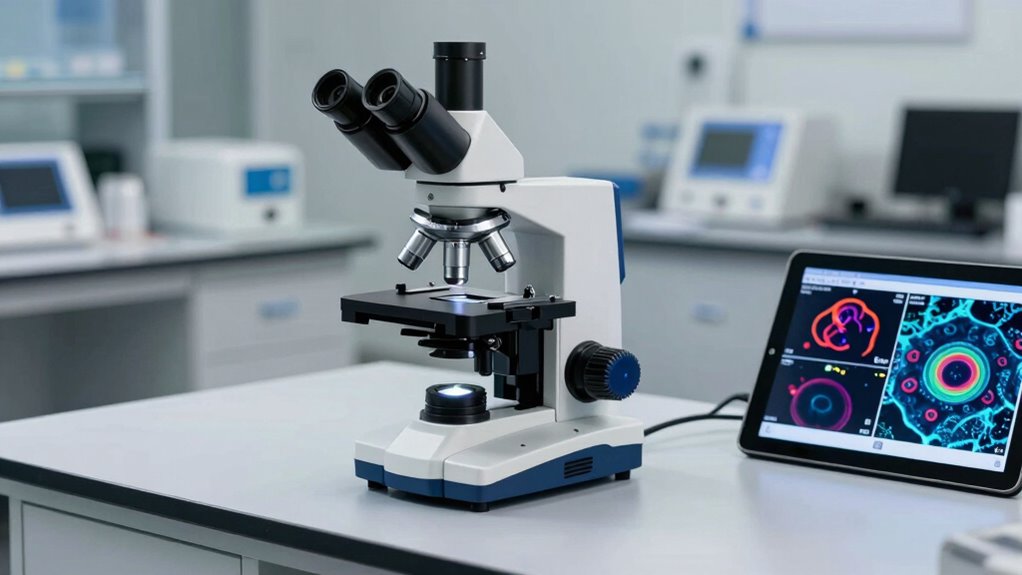

True electron microscopes cost tens of thousands of dollars and require specialized facilities, which is why schools and parents turn to educational electron microscope alternatives: digital, compound, and pocket microscopes that deliver genuine magnified discovery at a classroom-friendly price. My top overall pick is the Elikliv EDM4 LCD Digital Microscope, because its built-in 4.3-inch screen removes the eyepiece learning curve and its 1000x magnification handles everything from leaf cells to circuit boards. For younger children, the Educational Insights GeoSafari Talking Microscope stands out for its guided audio narration, while the Carson MicroBrite Plus is the best ultra-portable option at a fraction of the size of anything else here. The main tradeoff you’ll face is between screen-based digital convenience and traditional optical clarity, and between toy-grade durability for ages 4-8 and real scientific capability for tweens and students. Read on for the full breakdown, including which models to skip depending on your child’s age and curriculum goals.

Get the latest gadgets delivered free with Prime
- Fast, free delivery on millions of items
- Prime Video, Amazon Music and more included
- Member-only deals all year
Complete the kit



Key Takeaways
- Screen-based models (Elikliv EDM4, BEAVERLAB Finder 4.0) dramatically reduce frustration for beginners because kids see results instantly instead of struggling with eyepiece alignment.
- Kit-heavy options like the Uarzt 58-Piece and National Geographic kits trade optical quality for prepared slides and accessories — great for engagement, weaker for serious magnification work.
- The Carson MicroBrite Plus proved that a palm-sized pocket scope can outperform cheap digital cameras for sharpness, but its 120x ceiling limits it to introductory exploration.
- Talking and narrated models (GeoSafari) suit ages 4-8 best, while compound microscopes like the PalliPartners only pay off for students old enough to prepare their own slides.
- Handheld WiFi scopes like the Skybasic add phone-screen sharing for groups, but their focus stability lags behind stand-mounted digital microscopes at the same magnification claims.
| Kids Digital Microscope STEM Kit with 32GB Card, Case & Glass Slides (Ages 4-12) |  | Best Ready-to-Go Field Kit | Recommended age: 4-12 years | Magnification: 200X-1000X; 5 adjustable levels | Storage: 32GB memory card included | VIEW ON AMAZON | See Our Full Breakdown |
| Elikliv EDM4 LCD Digital Microscope, 4.3-Inch Display, 1000x Magnification |  | Best for Shared Screen Viewing | Display: 4.3-inch LCD | Image resolution: 720p HD | Magnification: Up to 1000X; actual magnification varies | VIEW ON AMAZON | See Our Full Breakdown |
| Uarzt 58-Piece Kids Microscope Kit with 100X-1200X Magnification, Metal Body, LED Light & Carrying Box |  | Best for Hands-On Biology | Recommended age: 5-12 years | Magnification: 100X-1200X | Body material: Metal | VIEW ON AMAZON | See Our Full Breakdown |
| Skybasic Wireless Digital Microscope, 50X-1000X Magnification, WiFi Portable Handheld USB Microscope Camera |  | Best for Phone-Based Discovery | Magnification: 50X-1000X | Sensor: 2MP HD CMOS | Resolution: 1920×1080 on smartphones; 720P on computers | VIEW ON AMAZON | See Our Full Breakdown |
| Educational Insights GeoSafari Talking Microscope for Kids | 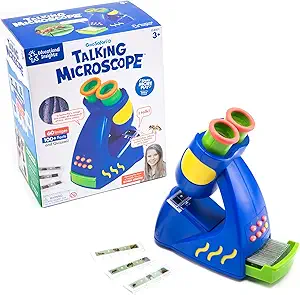 | Best for Preschool Science Play | Age range: 3-5 years | Slides: 20 slides with 60 full-color images | Modes of play: Fact Mode and Quiz Mode | VIEW ON AMAZON | See Our Full Breakdown |
| BMDSAE 1000x Handheld Digital Microscope for Kids with 2.0-Inch Screen |  | Best for On-Device Photo Capture | Magnification: Up to 1000x | Camera: 2MP | Display: 2.0-inch IPS | VIEW ON AMAZON | See Our Full Breakdown |
| PalliPartners Compound Microscope for Adults and Students |  | Best for Classroom-Style Slide Study | Objective lenses: 4X, 10X, and 40X | Eyepiece: WF25X | Additional lens: 2X | VIEW ON AMAZON | See Our Full Breakdown |
| National Geographic Microscope Kit for Kids, Up to 400x Magnification |  | Best Beginner Kit for Younger Kids | Maximum magnification: 400x | Magnification levels: 3 | Lighting: Upper and lower lights | VIEW ON AMAZON | See Our Full Breakdown |
| BEAVERLAB Finder 4.0″ Handheld Digital Microscope for Kids |  | Best for Shared Screen Viewing | Display: 4.0-inch IPS | Magnification: 100X–1600X | Image resolution: 1080P (1920×1080) | VIEW ON AMAZON | See Our Full Breakdown |
| Carson MicroBrite Plus 60x-120x LED Lighted Pocket Microscope (MM-300) |  | Best Compact Field Companion | Magnification: 60x–120x | Illumination: LED | Model: MM-300 | VIEW ON AMAZON | See Our Full Breakdown |
| educational electron microscope alternatife | Magnification | Lighting |
|---|---|---|
| Kids Digital Microscope STEM K | 200X-1000X; 5 adjustable levels | LED |
| Elikliv EDM4 LCD Digital Micro | Up to 1000X; actual magnification varies | 8 adjustable LED lights |
| Uarzt 58-Piece Kids Microscope | 100X-1200X | — |
| Skybasic Wireless Digital Micr | 50X-1000X | — |
| Educational Insights GeoSafari | — | — |
| BMDSAE 1000x Handheld Digital | Up to 1000x | 8 adjustable LEDs with 3 brightness modes |
| PalliPartners Compound Microsc | — | — |
| National Geographic Microscope | — | Upper and lower lights |
| BEAVERLAB Finder 4.0" Handheld | 100X–1600X | 8 adjustable LED lights |
| Carson MicroBrite Plus 60x-120 | 60x–120x | — |
More Details on Our Top Picks
Kids Digital Microscope STEM Kit with 32GB Card, Case & Glass Slides (Ages 4-12)
For children who want to take microscope discoveries outside, this kit pairs a 0.34-pound handheld design with a case, neck strap, rechargeable battery, and included 32GB card. Its five magnification levels and five prepared glass slides give beginners a more hands-on start than the Educational Insights GeoSafari Talking Microscope, which teaches through preloaded images and audio rather than viewing specimens. The screen-based format also makes photos and videos easy to save and share. The tradeoff is that reaching a clear image at higher magnifications takes patient focus and distance adjustments, which can test younger children. Its 1000X ceiling also does not make it a substitute for a full-size optical microscope such as the Uarzt 58-Piece Kids Microscope Kit.
Pros:- Includes a 32GB memory card, glass slides, protective case, and neck strap
- Lightweight handheld format suits indoor and outdoor exploration
- Rechargeable battery provides about 2.5 hours of use
- Photo and video storage can help children revisit discoveries
Cons:- Higher magnifications require careful focus and working-distance adjustments
- Digital magnification up to 1000X is modest compared with full-size microscope kits
Best for: Ages 4-12 who want a portable, ready-equipped microscope for inspecting and recording everyday finds at home or outdoors.
Not ideal for: Children who need simple, immediate viewing or students seeking the hands-on eyepiece experience and lab tools of a full optical kit.
- Recommended age:4-12 years
- Magnification:200X-1000X; 5 adjustable levels
- Storage:32GB memory card included
- Prepared slides:5 real glass specimens
- Weight:0.34 lb
- Battery life:Approximately 2.5 hours per charge
- Charging:Type-C cable included
- Lighting:LED
Our verdict“Choose this for portable digital specimen viewing with useful accessories included, provided a child can manage careful focusing.”
Elikliv EDM4 LCD Digital Microscope, 4.3-Inch Display, 1000x Magnification
The Elikliv EDM4 centers learning around a 4.3-inch 720p display, so children can inspect a coin, leaf, or other object without lining up an eye at an eyepiece. Its adjustable stand keeps the camera positioned over a subject, making it a steadier desk option than the handheld Kids Digital Microscope STEM Kit. Eight adjustable LEDs help tailor illumination, and computer compatibility gives families another way to view the image. That screen-first setup makes group observation easier, but the stated 1000X magnification varies with screen size and camera distance, so it should not be read as consistent optical detail. Unlike the Kids Digital kit, this one does not include a memory card, adding a separate purchase for saving photos or videos.
Pros:- 4.3-inch display supports shared viewing without an eyepiece
- Height-adjustable stand helps keep the camera aligned with specimens
- Eight adjustable LEDs offer control over illumination
- Can connect to Windows PCs and MacBooks for a larger view
Cons:- Memory card for saving photos and videos is not included
- Actual magnification varies with screen size and camera distance
- Stand-based setup is less suited to casual handheld field exploration
Best for: Families and educators who want several children to view small objects together on a built-in screen at a desk.
Not ideal for: Buyers who want an all-in-one recording kit or a pocketable microscope for outdoor use.
- Display:4.3-inch LCD
- Image resolution:720p HD
- Magnification:Up to 1000X; actual magnification varies
- Lighting:8 adjustable LED lights
- PC compatibility:Windows and MacBook
- Battery life:Up to 3 hours
- Stand:Height-adjustable
- Photo and video recording:Supported; memory card not included
Our verdict“Pick the EDM4 for steady, shared screen viewing at home or in a classroom, but budget for separate storage if recording matters.”
Uarzt 58-Piece Kids Microscope Kit with 100X-1200X Magnification, Metal Body, LED Light & Carrying Box
The Uarzt kit is the strongest fit here for children ready to handle specimens rather than just point a camera at objects. Its 13 prepared specimens and 31 blank slides give a beginner both a guided starting point and room to prepare samples, while tools such as tweezers and a dropper support active exploration. That makes it a more traditional biology activity than the digital Elikliv EDM4, whose screen and stand favor viewing objects without slide preparation. The metal body and LED light suit repeated use at home or in a classroom, though the larger assortment also asks children to keep track of many small pieces. It needs two AA batteries, which are not included, and its beginner optics may feel limiting as a young scientist’s skills advance.
Pros:- Includes 13 prepared specimens for immediate guided viewing
- 31 blank slides and lab tools support making new samples
- Metal body and LED illumination suit regular beginner use
- Screen-free optical format encourages direct microscope practice
Cons:- Two AA batteries are required and not included
- Many small pieces may need adult help to organize
- Beginner-level optics may not satisfy older or advanced users
Best for: Ages 5-12 who want a screen-free microscope kit for preparing slides, handling lab tools, and exploring biology at home or school.
Not ideal for: Children who prefer instant digital viewing, or older students who need more advanced optics and controls.
- Recommended age:5-12 years
- Magnification:100X-1200X
- Body material:Metal
- Illumination:LED light
- Pieces included:58
- Prepared specimens:13
- Blank slides:31
- Power:2 AA batteries, not included
Our verdict“Choose Uarzt for a broad, tactile introduction to slide-based biology, especially when preparing specimens matters more than digital recording.”
Skybasic Wireless Digital Microscope, 50X-1000X Magnification, WiFi Portable Handheld USB Microscope Camera
Skybasic suits families who want to put magnified images on a phone or computer and capture them with a button press. WiFi for iOS and Android and USB support for Windows and Mac give it more ways to connect than the screen-equipped Elikliv EDM4, while its compact handheld body is easier to carry outdoors. Eight adjustable LEDs and a 2MP sensor support image and video capture, with 1080P specified on smartphones and 720P on computers. The key compromise is that it behaves more like a fixed-focus digital magnifier than a traditional microscope, so the broad 50X-1000X range does not promise professional specimen analysis. Setup can also be fussy, and the capture buttons work only in WiFi mode, limiting convenience when connected to a computer.
Pros:- Connects wirelessly to iOS and Android devices
- USB connection supports Windows and Mac computers
- Eight adjustable LEDs help illuminate different subjects
- One-button photo and video capture in WiFi mode
Cons:- Functions as a fixed-focus magnifier rather than a professional microscope
- App or software setup may be difficult, with older app versions reported to have connection issues
- Function keys do not work when connected to a computer
Best for: Families who want children to inspect outdoor finds on a phone or computer and save images for later discussion.
Not ideal for: Students who need a traditional optical microscope, dependable app setup, or capture controls while connected to a computer.
- Magnification:50X-1000X
- Sensor:2MP HD CMOS
- Resolution:1920×1080 on smartphones; 720P on computers
- Illumination:8 adjustable LED lights
- Focal length range:3-60 mm
- Connectivity:WiFi for iOS/Android; USB for Windows/Mac
- Included accessories:USB cable, bracket, base, and user manual
- Warranty:One-year replacement service
Our verdict“Choose Skybasic for portable phone-based image sharing, but skip it if you need the controls and optical workflow of a traditional microscope.”
Educational Insights GeoSafari Talking Microscope for Kids
For preschoolers who are not ready to focus a real microscope, the GeoSafari turns science into a guided listening and quiz activity. More than 100 narrated facts and questions, voiced by Bindi Irwin, pair with 20 slides containing 60 full-color images; Fact and Quiz modes let children explore at their own pace. Its English, Spanish, French, and German audio also distinguishes it from specimen-based kits such as the Uarzt 58-Piece Kids Microscope Kit, which asks children to work with slides and lab tools. The main tradeoff is that GeoSafari does not magnify a child’s own samples: it teaches through prepared pictures. That makes it approachable for ages 3-5, but less useful for children ready to investigate actual insects, plants, or other finds.
Pros:- Over 100 narrated facts and quiz questions support guided play
- 20 slides provide 60 full-color educational images
- Audio is available in English, Spanish, French, and German
- Slide storage compartment helps keep the activity organized
Cons:- Uses prepared images instead of magnifying real specimens
- Requires three AAA batteries that are not included
- Limited to the topics and content built into its slides and audio
Best for: Ages 3-5 who enjoy listening and answering questions and need a simple, guided first science activity.
Not ideal for: Children ready to view real specimens or buyers seeking an actual magnifying microscope for experiments.
- Age range:3-5 years
- Slides:20 slides with 60 full-color images
- Modes of play:Fact Mode and Quiz Mode
- Audio languages:English, Spanish, French, German
- Narrator:Bindi Irwin
- Batteries:3 AAA, not included
- Included viewing parts:Two eyepieces and slide storage compartment
Our verdict“Choose GeoSafari as a low-friction science introduction for preschoolers, not as a substitute for specimen viewing.”
BMDSAE 1000x Handheld Digital Microscope for Kids with 2.0-Inch Screen
The BMDSAE is a practical pick for children who want to view and save specimens on the microscope itself. Its 2.0-inch IPS screen, 2MP camera, and onboard storage let a child capture photos or AVI videos without first connecting a computer. Compared with the BEAVERLAB Finder, it has a smaller display and no listed Wi-Fi sharing, but its USB-C connection supports Windows and Mac use. Eight adjustable LEDs help with varied specimens, while manual focus gives children a hands-on way to bring a subject into view. That control takes patience, and the 600mAh battery lasts up to two hours, so it suits short explorations better than long field sessions. Its 200g handheld design and included lanyard make carrying it straightforward.
Pros:- Onboard storage saves photos and AVI videos
- Eight adjustable LEDs offer lighting control
- USB-C connection works with Windows and Mac systems
- Lightweight 200g body includes a lanyard
Cons:- Battery life is listed as up to two hours
- Manual focus takes practice, especially for younger children
- The 2.0-inch screen is smaller than the BEAVERLAB Finder’s 4.0-inch display
Best for: Children and families who want a lightweight microscope that saves photos and videos without needing a phone.
Not ideal for: Families who want a large viewing screen, wireless sharing, or long sessions away from a charger.
- Magnification:Up to 1000x
- Camera:2MP
- Display:2.0-inch IPS
- Lighting:8 adjustable LEDs with 3 brightness modes
- Battery:600mAh; up to 2 hours
- Storage:32M; supports 200+ photos or AVI videos
- Connectivity:USB-C; compatible with Windows XP/Vista/7/8/10/11 and Mac 11.0+
- Weight:200g
- Warranty:1 year
Our verdict“Choose the BMDSAE for portable, self-contained photo capture; choose the BEAVERLAB Finder if a larger screen and Wi-Fi sharing matter more.”
PalliPartners Compound Microscope for Adults and Students
For learners focused on prepared slides and cell-level specimens, the PalliPartners takes a more traditional route than the handheld digital options in this roundup. Its compound optics combine 4X, 10X, and 40X objectives with a WF25X eyepiece and 2X lens, giving a listed range of 100X to 2000X. Coarse and fine focus knobs help users make controlled adjustments as magnification rises. Top and bottom LED illumination lets students view opaque objects as well as translucent slides, a broader specimen mix than a basic transmitted-light setup. The included prepared and blank slides make it more classroom-ready than the Carson MicroBrite Plus, though it is less convenient to carry outdoors and does not include a built-in viewing screen. Its phone adapter and Bluetooth shutter support image capture, but require a compatible phone.
Pros:- Three objective lenses and an additional 2X lens provide a broad listed magnification range
- Top and bottom LEDs accommodate opaque and translucent specimens
- Prepared and blank slides support lessons and follow-up experiments
- Phone adapter and Bluetooth shutter enable phone photography
Cons:- No built-in display for group viewing
- Dimensions and weight are not specified, making storage and portability harder to judge
- Adult supervision is recommended for younger users
Best for: Students, parents, and educators who want a home or classroom microscope for structured slide-based lessons.
Not ideal for: Young children seeking a simple handheld viewer or families prioritizing compact field use and screen-based viewing.
- Objective lenses:4X, 10X, and 40X
- Eyepiece:WF25X
- Additional lens:2X
- Magnification range:100X–2000X
- Illumination:Adjustable top and bottom LED
- Focus:Coarse and fine focus knobs
- Included slides:10 prepared and 18 blank
- Accessories:Phone clip adapter, Bluetooth remote camera shutter, and power adapter
- Safety certification:SGS certified
Our verdict“Choose the PalliPartners for guided slide study and adjustable compound optics, while the Carson MicroBrite Plus is easier to take into the field.”
National Geographic Microscope Kit for Kids, Up to 400x Magnification
This National Geographic kit makes the most sense for a child who needs guided first steps with real specimens, not a digital camera or extreme magnification claims. Three levels up to 400x keep the choices manageable, while the large focus knobs and soft-touch eyepiece are suited to small hands and short learning sessions. Its combination of upper and lower lights lets children try both solid samples and slides. The box adds prepared plant slides, rocks and minerals, blank slides, simple tools, and an activity guide, so there is a clear starting point before a family gathers its own materials. Compared with the PalliPartners compound microscope, this kit favors approachable activities over a higher listed magnification ceiling and detailed focus controls. It lacks digital capture, and the 400x limit makes it less suited to cell-focused study.
Pros:- Three magnification levels offer a simple learning progression
- Upper and lower lights support solid samples and slides
- Prepared specimens and blank slides provide immediate activities
- Large focus knobs and soft-touch eyepiece suit beginner use
Cons:- Maximum magnification is lower than the PalliPartners microscope’s listed range
- No camera or digital display for saving and sharing observations
- The product data does not specify dimensions, weight, or battery details
Best for: Younger children beginning hands-on science with an adult who wants an activity guide and specimens included.
Not ideal for: Older students seeking high magnification, fine-focus controls, or a way to save images digitally.
- Maximum magnification:400x
- Magnification levels:3
- Lighting:Upper and lower lights
- Prepared specimens:6 plant slides and 6 rocks and minerals
- Blank slides:6
- Included tools:Pipette, specimen dish, and tweezers
- Learning materials:Lab guide and merit badge stickers
Our verdict“Choose this kit for a guided, hands-on introduction for younger children; choose PalliPartners for more advanced slide study.”
BEAVERLAB Finder 4.0″ Handheld Digital Microscope for Kids
The Finder’s 4.0-inch IPS display gives children and nearby adults a larger view than the BMDSAE’s 2.0-inch screen, making it easier to inspect specimens together without leaning into an eyepiece. It pairs that screen with a 2MP CMOS sensor, 1080P imaging, and a listed 100X–1600X range. The built-in Wi-Fi hotspot adds a convenient way to share photos and videos to mobile devices, while eight adjustable LEDs help light different surfaces. Compared with the Carson MicroBrite Plus, this is a more screen-centered and capture-friendly tool, but it is also more dependent on its digital display and has no stated battery-life details. Its pocket-sized handheld format favors quick exploration over the steadier, slide-oriented control of a compound microscope. The stated high magnification may not translate to equally useful detail at every setting.
Pros:- Large 4.0-inch IPS display supports shared viewing
- 1080P imaging and 2MP sensor capture photos and videos
- Built-in Wi-Fi hotspot supports mobile sharing
- Eight adjustable LEDs and handheld size suit varied field specimens
Cons:- Battery life is not specified for planning longer outings
- High magnification claims may exceed useful image detail at the upper settings
- Digital screen viewing does not offer the compound microscope’s eyepiece-based slide workflow
Best for: Families who want children and adults to view specimens together on a large built-in screen and share captures to phones.
Not ideal for: Buyers who need documented battery endurance, traditional eyepiece viewing, or stable high-magnification slide work.
- Display:4.0-inch IPS
- Magnification:100X–1600X
- Image resolution:1080P (1920×1080)
- Sensor:2MP CMOS
- Lighting:8 adjustable LED lights
- Connectivity:Built-in Wi-Fi hotspot for mobile sharing
- Form factor:Handheld pocket microscope
Our verdict“Choose the Finder when a large screen and mobile sharing are priorities; choose the PalliPartners for more controlled slide-based study.”
Carson MicroBrite Plus 60x-120x LED Lighted Pocket Microscope (MM-300)
The Carson MicroBrite Plus is the simplest pocket pick here: 60x–120x magnification and LED lighting keep the tool focused on quick observations of slides and everyday objects. Its compact, lightweight form is easier to carry on a walk than the PalliPartners compound microscope, and it avoids the screen, charging, and file-sharing setup of digital models like the BEAVERLAB Finder. That simplicity comes with a clear limit: the MicroBrite offers far less magnification than either digital handheld, and it has no listed camera or onboard image storage. Because focusing at higher power can be unsteady by hand, it is better for brief looks than careful lab-style inspection. The limited lifetime warranty adds reassurance around the physical tool, but it does not expand what its modest magnification range can show.
Pros:- Compact, lightweight body is easy to carry
- 60x–120x range suits quick looks at slides and everyday objects
- LED illumination supports viewing in varied settings
- Limited lifetime warranty is included
Cons:- Magnification range is much lower than the digital handheld options
- High-power focus can be difficult to steady by hand
- Small pocket format is less suitable for sustained lab work
Best for: Families and educators who want a very small microscope for quick outdoor observations and simple classroom demonstrations.
Not ideal for: Students who need high magnification for cell study, image capture, or steady compound-microscope focusing.
- Magnification:60x–120x
- Illumination:LED
- Model:MM-300
- Form factor:Compact pocket microscope
- Manufacturer:Carson Optical, Inc
- Warranty:Limited lifetime warranty
Our verdict“Choose the MicroBrite Plus for simple, highly portable viewing; choose the BEAVERLAB Finder for a screen, saved images, and greater listed magnification.”

How We Picked
I ranked these alternatives to electron microscopes on four factors that matter most for learning outcomes: ease of first success, magnification quality versus claims, durability for the target age group, and educational value beyond the hardware (slides, guides, narration software). A microscope that frustrates a child in the first ten minutes fails as an educational tool no matter its specs, so I weighted the out-of-box experience heavily for younger-age picks. For older students, I prioritized genuine optical performance and slide-preparation capability over bundled accessories.
The ranking order reflects a progression from best all-around classroom tool at the top through age-specific and budget picks in the middle, down to narrow-use pocket scopes at the end. Models with stands and stable focus mechanisms placed above handheld-only designs because stable images matter more for sustained learning than portability. Every product here earned its place by doing one job distinctly better than the others — none is a worse copy of another pick.
Factors to Consider When Choosing Educational Electron Microscope Alternatives
Choosing among these alternatives comes down to matching the tool to the learner’s age, attention span, and curriculum — not chasing the biggest magnification number on the box. These are the factors that actually changed the rankings.Digital Screen Versus Traditional Eyepiece
The single biggest fork in this category is whether the image appears on a built-in screen, a phone, or through an eyepiece. Digital LCD models let groups of kids look at the same image at once, make photography trivial, and eliminate the eye-strain and alignment problems that make young children abandon traditional scopes. Traditional compound microscopes, on the other hand, teach a real lab skill and typically deliver sharper, higher-contrast images at high magnification because they use glass optics rather than small camera sensors. A common mistake is assuming digital always wins: cheap digital sensors often produce grainy images at their advertised maximum magnification, while a modest 400x optical scope can look dramatically clearer. If your goal is classroom demonstration or independent play, go digital; if your goal is preparing a student for biology coursework, go optical.
Magnification Claims Versus Usable Magnification
Nearly every product here advertises 1000x, and almost none of them deliver a genuinely useful image at that level. Digital handheld scopes achieve their top magnification through digital zoom, which enlarges pixels rather than resolving more detail — the result is a blurry, washed-out picture that teaches nothing. Optical compound scopes like the PalliPartners or Uarzt use objective lenses, where magnification comes with genuine added detail. A useful rule: 300x-400x with sharp optics beats a grainy 1000x every time for educational value. When comparing products, look at how the magnification is achieved (objective lenses versus digital zoom) rather than the headline number, and expect usable detail to top out around 400x-600x on most kid-priced instruments.
Age Fit and Frustration Tolerance
More features are not better for young children — independent operation is. A four-year-old cannot focus a compound microscope, prepare a wet-mount slide, or hold a handheld scope steady, which is why narrated, self-guided tools like the GeoSafari Talking Microscope exist. Around ages 8-10, kids develop the fine motor control for coarse focusing and simple slide preparation, opening up compound kits like the National Geographic and Uarzt options. By middle school, students can handle fine focus, immersion-style techniques at high power, and phone-connected scopes like the Skybasic. The most common buying mistake in this category is purchasing ‘for the future’ — an advanced scope given too early often sits in a closet while a simpler tool would have built the interest that justifies upgrading later.
Stand, Stability, and Focus Mechanism
Stand design separates the useful from the frustrating more than any spec sheet line. Stand-mounted scopes with a focus dial (Elikliv, BEAVERLAB, PalliPartners) hold a specimen steady while the child adjusts, producing a usable image within seconds. Handheld-only scopes (Skybasic, BMDSAE, Carson) require the user to hold both the scope and the specimen still simultaneously — feasible for flat objects like fabric or leaves, nearly impossible for slides. If you plan to view prepared slides or anything mounted on glass, a stand with a stage is close to mandatory. Handheld designs still earn their place for field use, bug inspection, and portability, but they should be a second microscope, or a primary one only for a child patient enough to retry shots.
Included Accessories and Consumables
Kits that bundle slides, stains, tweezers, and specimen vials (Uarzt’s 58 pieces, National Geographic’s kit) provide weeks of structured activity out of the box — but the quality varies wildly, and cheap plastic tools can be worse than none. What matters most is prepared slides versus blank slides: prepared slides give immediate wow-moments for beginners, while blank slides plus stain teach the actual skill of microscopy. Storage cases matter more than parents expect, because a microscope without a home gets damaged or lost within months. I’d treat accessory count as a tiebreaker rather than a primary criterion: a great optical instrument with five slides will outlast a mediocre one with fifty pieces, most of which are filler. Budget for a separate slide-refill set if you choose a digital model that ships without them.
Power, Connectivity, and Long-Term Use
Consider how the scope is powered and how images leave it. Rechargeable battery models work for field trips and classrooms without outlets; AA-powered scopes never strand you but cost more over time. WiFi-connected scopes like the Skybasic stream to phones and tablets, which is excellent for group learning and saving images for science-fair projects — but it adds pairing friction that some younger kids can’t manage alone. Built-in screens with SD card slots (Elikliv, the Kids Digital STEM Kit) offer the simplest photo workflow. Also weigh software support: companies that provide an app or narration content effectively add a curriculum, while a bare scope leaves lesson planning entirely to you. If long-term curriculum use is the goal, the content ecosystem can outweigh a modest difference in optics.
Frequently Asked Questions
Can any of these alternatives actually approximate what an electron microscope does?
No — and setting expectations correctly matters here. Electron microscopes resolve nanoscale structures like viruses and cell organelles, and nothing under a few hundred dollars comes close; even the best options here top out at genuinely useful detail around 400x-600x on cells, fibers, and crystals. What these alternatives do deliver is the core learning outcome: the realization that an entire hidden world exists beyond unaided vision, plus the skills of specimen preparation, focusing, and observation. For curriculum purposes, that covers the vast majority of elementary and middle-school science requirements. If a student specifically needs nanoscale imagery, the practical path is using free image libraries from research labs alongside a physical microscope for hands-on work.
Is a digital microscope or a traditional compound microscope better for a classroom?
For group instruction, digital wins almost every time. A model like the Elikliv EDM4 with its built-in screen lets an entire table of students observe the same specimen simultaneously, and photos can be saved for reports or projected discussions. Traditional compound scopes like the PalliPartners are better when each student works individually and needs to develop eyepiece technique for future lab coursework. Some teachers pair the two: a single digital scope at the front of the room for demonstration, and inexpensive compound scopes for individual practice. If budget allows only one, choose based on whether your lessons emphasize shared discovery or individual skill-building.
What age is too young for each type of these microscopes?
Under age 5, only self-contained, narrated tools like the GeoSafari Talking Microscope or the Kids Digital STEM Kit realistically work, because focusing skills and steady hands arrive later. Ages 5-8 do well with low-magnification digital scopes and big-button interfaces, but slide preparation still needs adult help. Around 8-10, compound kits with coarse focus (National Geographic, Uarzt) become age-appropriate, and by 11 or 12 a student can run a full compound microscope with fine focus. Handheld scopes like the Carson MicroBrite Plus are the exception — their simplicity makes them viable from around age 6 with supervision, since there’s nothing to break and only one adjustment to master.
Are the 1000x magnification claims on these microscopes real?
Technically yes, practically no. Digital handheld scopes reach 1000x by combining modest optical magnification with digital zoom, which stretches a limited sensor image until it’s large but blurry — fine for entertainment, poor for learning detail. Optical compound scopes achieve magnification through physical objective lenses, so a true 400x optical image genuinely shows more structure than a digitally zoomed 1000x one. When shopping, check whether the magnification is stated as optical or digital, and expect the sweet spot for kid-priced instruments to sit between 100x and 400x of genuinely sharp detail. Anything promising professional-grade resolution at toy prices is marketing, not microscopy.
Which of these holds up best for a classroom with many kids using it?
Durability in this lineup favors models with metal bodies and enclosed optics — the Uarzt’s metal frame and the PalliPartners compound scope tolerate rough handling far better than plastic handheld units. Screen-based models like the Elikliv survive classroom use well because nothing protrudes, though their LCD panels are the weak point if dropped. Handheld WiFi scopes are the most vulnerable: constant passing between students leads to drops, lens smudges, and loose USB ports. A carrying case (included with the Uarzt and the Kids Digital STEM Kit) measurably extends lifespan in shared settings. For high-traffic classrooms, I’d prioritize a stand-mounted metal design over any handheld, accepting less portability in exchange for surviving the school year.
Conclusion
The right pick here depends almost entirely on the learner, not the spec sheet. For best overall, the Elikliv EDM4 hits the sweet spot of screen-based ease, genuine magnification range, and multi-kid usability, making it my default recommendation for families and most classrooms. The Carson MicroBrite Plus takes best value — sharp optics and pocket portability at a price that makes it an easy first microscope or stocking-stuffer. For best premium, the BEAVERLAB Finder brings the most polished screen-and-stand experience in the lineup for families who want a polished, app-capable tool.
For young beginners ages 4-8, the GeoSafari Talking Microscope is the clear choice because it teaches without requiring any technique, with the National Geographic kit as the step up once a child can focus independently. For older students preparing for lab science, the PalliPartners compound microscope builds real skills that digital toys cannot. And for specific needs: the Skybasic for phone-sharing group work, the Uarzt 58-piece kit for maximum structured activity out of one box, the BMDSAE for on-the-go screen viewing, and the Kids Digital STEM Kit as a complete gift package with storage included. Match the tool to the child, and any of these will open the microscopic world an electron microscope price tag never could.
Halloween Picks
halloween
As an affiliate, we earn on qualifying purchases.