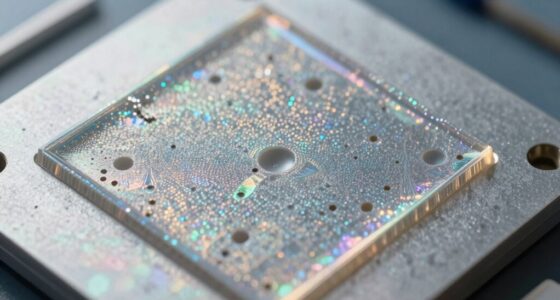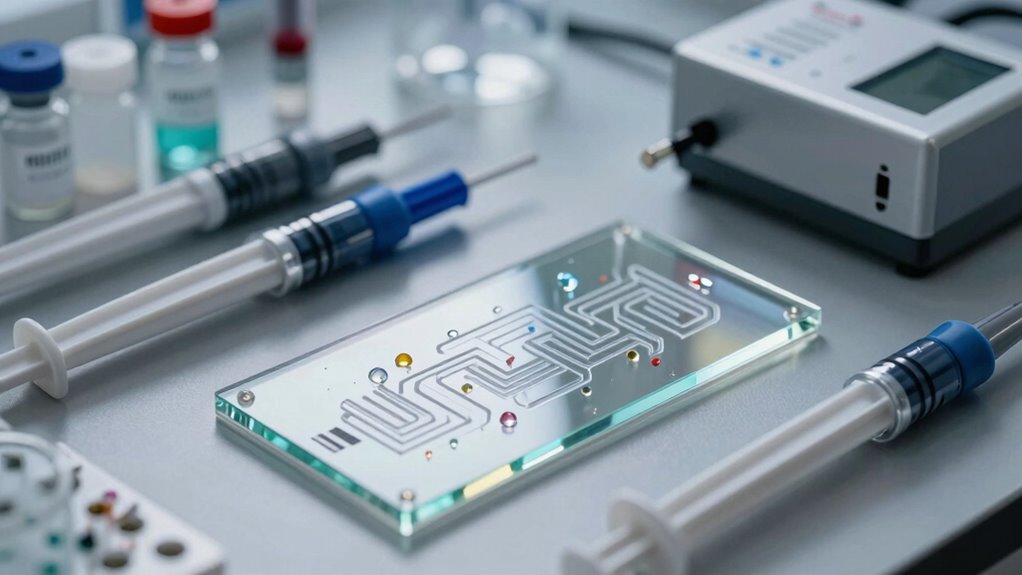
A microfluidics starter kit helps you learn faster by providing hands-on experiments that simplify complex concepts like fluid dynamics and device fabrication. It offers guided steps and troubleshooting tips to build your confidence, while pre-made components make assembly straightforward. Clear explanations of key principles like laminar flow and surface tension connect theory to practice, making advanced ideas approachable. Keep exploring, and you’ll discover even more ways to master microfluidics effectively.
Key Takeaways
- Provides hands-on experience with fluid behavior and device assembly for practical understanding.
- Includes step-by-step guidance and troubleshooting to build confidence and address common issues.
- Simplifies complex concepts like laminar flow and surface tension for easier comprehension.
- Uses pre-made components and tools to accelerate learning and experimentation.
- Connects theoretical principles with real-world applications to deepen conceptual clarity.
If you’re new to the field of microfluidics, a starter kit is the perfect way to get hands-on experience and understand the fundamentals. These kits are designed to simplify complex concepts like fluid dynamics and device fabrication, giving you the practical skills you need to succeed. When you begin working with a microfluidics starter kit, you’ll quickly see how the precise control of fluids at small scales is essential. The fluid dynamics involved in microfluidics are quite different from those in larger systems, and the kit provides clear, guided examples to help you grasp these principles. You’ll learn how fluids behave in tiny channels, how to manipulate flow rates, and how to prevent issues like clogging or air bubbles, all of which are indispensable for designing effective microfluidic devices.
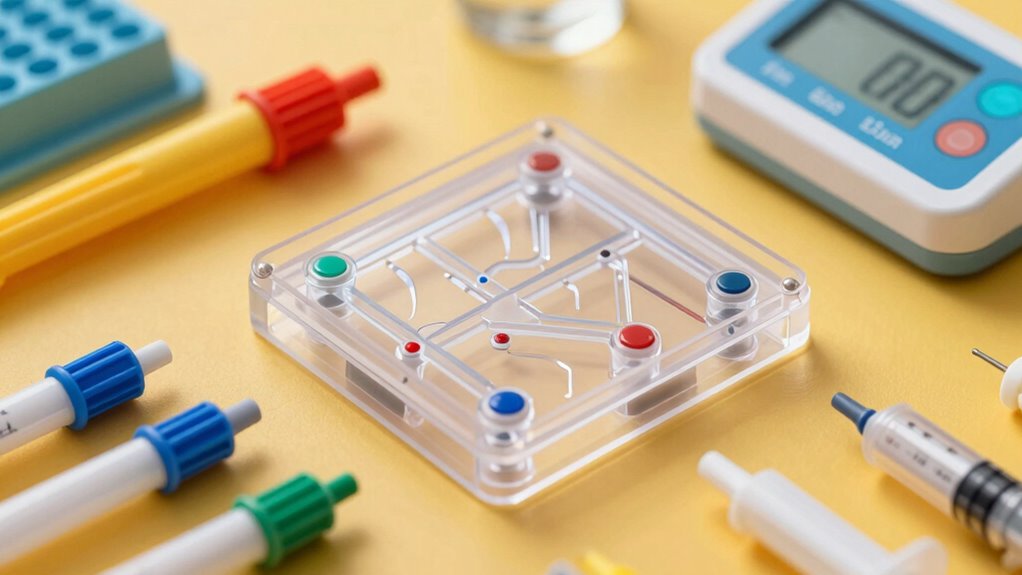
Microfluidics starter kits simplify fluid dynamics and device fabrication, providing essential hands-on skills for beginners.
Device fabrication is another core aspect of microfluidics that the kit emphasizes. Instead of just reading about the process, you get to practice creating your own channels and chambers using simple, safe materials. The kit often includes pre-made components, as well as tools to help you assemble and modify devices. This hands-on approach accelerates your learning curve, letting you see firsthand how small changes in design impact fluid movement. This direct experience highlights the importance of precise device fabrication, which directly influences the reliability and efficiency of your microfluidic systems. Additionally, understanding fluid behavior at microscale helps you troubleshoot and optimize your designs more effectively. Developing a strong foundation in these areas also prepares you to design more complex systems, which is essential for advancing in the field. Gaining familiarity with microfluidic principles early on ensures you can adapt to new challenges as you progress. Moreover, exploring microfluidic design considerations within the kit enables you to think critically about how different parameters affect overall device performance.
Many beginner kits also feature step-by-step instructions that demystify complex procedures. These instructions guide you through the process of setting up experiments, adjusting flow rates, and analyzing results. This structured guidance helps you build confidence and develop an intuitive understanding of fluid behavior at microscale. Plus, by practicing device fabrication and fluid handling, you’ll start recognizing common issues early and learn troubleshooting techniques—skills that are paramount as you move toward more advanced projects.
Furthermore, the best starter kits incorporate educational materials that explain the science behind what you’re doing. They clarify key concepts like laminar flow, Reynolds number, and surface tension, connecting theory with practice. This integrated approach means you don’t just follow steps blindly; you understand why each step matters. As a result, your comprehension of both fluid dynamics and device fabrication deepens quickly, making it easier to progress to more complex microfluidic applications. Overall, these features make microfluidics accessible and engaging, setting you up for success as you explore this innovative technology.
microfluidics starter kit for beginners
As an affiliate, we earn on qualifying purchases.
As an affiliate, we earn on qualifying purchases.
Frequently Asked Questions
What Safety Precautions Should I Follow When Using the Kit?
You should follow safety guidelines and handling precautions carefully when using the kit. Always wear protective gear like gloves and safety goggles to prevent contact with chemicals or fluids. Work in a well-ventilated area, keep your workspace clean, and handle tools gently to avoid spills or breakage. Read all instructions thoroughly before starting, and never bypass safety steps, ensuring you minimize risks and learn efficiently.
Can the Kit Be Expanded for Advanced Microfluidics Projects?
Yes, you can expand your kit for advanced projects with advanced customization and modular components. Think of your starter kit as a blank canvas, ready to be transformed into a complex microfluidic masterpiece. These modular components act like building blocks, allowing you to design intricate networks and experiment with sophisticated applications. This flexibility empowers you to grow your skills, turning beginner experiments into cutting-edge microfluidic innovations.
Are Compatible With Other Lab Equipment or Reagents?
Yes, the kit is compatible with other lab equipment and reagents. Its design emphasizes material compatibility, ensuring it works seamlessly with common lab materials. Equipment integration is straightforward, allowing you to connect it with existing devices like microscopes or pumps. This flexibility helps you expand your experiments without hassle, making it easier to learn and develop with microfluidics. You can confidently incorporate new reagents and tools as your skills grow.
How Long Does It Typically Take to Become Proficient?
It usually takes a few weeks to a couple of months to become proficient with a microfluidics starter kit, depending on your background and the complexity of experiments. The learning curve can be steep initially, but consistent practice accelerates skill development. By dedicating regular time to hands-on experiments and exploring tutorials, you’ll build confidence and mastery more quickly, making your journey into microfluidics both efficient and rewarding.
Is Technical Support Available for Troubleshooting?
You’ll be glad to know that support is readily available with your kit. Over 85% of beginners find troubleshooting easier with the included troubleshooting guide and extensive support resources. These tools help you quickly identify issues and learn solutions on your own. If needed, dedicated technical support is just a call or email away, ensuring you get expert assistance promptly, so your learning journey stays smooth and enjoyable.
microfluidics device fabrication kit
As an affiliate, we earn on qualifying purchases.
As an affiliate, we earn on qualifying purchases.
Conclusion
With a microfluidics starter kit, you’re not just learning—you’re mastering a science that’s revolutionizing technology. The features designed to simplify complex processes make it feel almost effortless to grasp advanced concepts. As you experiment and explore, you’ll discover a universe of innovation faster than you ever imagined—like wielding the power of a scientific wizard. Embrace this kit, and watch your skills soar to heights that could rival the stars themselves.
microfluidics experiment kit with guided instructions
As an affiliate, we earn on qualifying purchases.
As an affiliate, we earn on qualifying purchases.
microfluidics troubleshooting tools
As an affiliate, we earn on qualifying purchases.
As an affiliate, we earn on qualifying purchases.