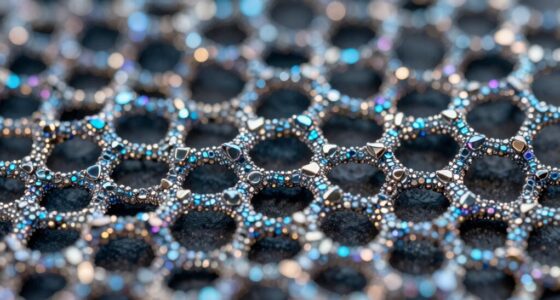

Nanoparticles behave differently from bulk materials mainly because of their high surface area and quantum effects. You’ll notice more atoms are exposed on the surface, which boosts reactivity and makes them excellent for catalysis and sensors. Their tiny size also causes electrons to act more like waves, changing optical and electrical properties. As you explore further, you’ll discover how these unique traits open up new technological possibilities.
Key Takeaways
- Higher surface-to-volume ratio increases surface reactivity and chemical interactions.
- Electron energy levels become quantized, leading to quantum confinement effects.
- Unique optical and electronic properties result from size-dependent quantum effects.
- Lower melting points and enhanced reactivity are due to increased surface area.
- Physical and chemical behaviors are significantly altered at the nanoscale compared to bulk materials.

Have you ever wondered how the size of a material impacts its properties? When you shrink materials down to the nanoscale, you start noticing behaviors that are completely different from their bulk counterparts. One of the main reasons for this shift is the dramatic increase in surface reactivity. In bulk materials, most atoms are buried inside, surrounded by other atoms, which means only a small fraction are available on the surface to interact with external substances. But with nanoparticles, a significant proportion of atoms are on the surface, making the material highly reactive. This heightened surface reactivity means nanoparticles can catalyze reactions more efficiently, bind with other molecules more readily, and exhibit properties that are often unattainable in larger forms. Because of this, nanoparticles find use in catalysis, medicine, and sensors, where surface interactions are crucial.
But surface reactivity isn’t the only factor at play. When you reach the nanoscale, quantum effects start to dominate. In bulk materials, electrons behave more like waves, following classical physics, which results in predictable properties. However, as you reduce the size of particles to nanometers, electrons are confined within tiny spaces, and their energy levels become quantized. This quantum confinement alters how electrons behave, impacting optical, electrical, and magnetic properties. For example, nanoparticles can absorb and emit light at specific wavelengths that don’t exist in larger particles, giving rise to vibrant colors and unique optical behaviors. These quantum effects can also change electrical conductivity, making nanoparticles useful in electronic applications where precise control over electron flow is essential.
Additionally, the quantum confinement effect becomes more pronounced at the nanoscale, further amplifying these unique behaviors. The combination of increased surface reactivity and quantum effects fundamentally changes how nanoparticles behave compared to bulk materials. You might find that a nanoparticle’s melting point is lower, its chemical reactivity is higher, or its optical properties are entirely different from the bulk material. In fact, the increased surface area to volume ratio significantly enhances the reactivity and catalytic efficiency of nanoparticles, which is a key advantage in many technological applications. These differences aren’t just academic; they have practical implications. Researchers exploit these properties in developing new materials for medicine, electronics, energy storage, and environmental cleanup. Understanding these nanoscale phenomena enables scientists to manipulate particles at an atomic level, tailoring their properties for specific needs.

Nanoparticle for Catalysis
As an affiliate, we earn on qualifying purchases.
As an affiliate, we earn on qualifying purchases.
Frequently Asked Questions
How Do Nanoparticles Impact Environmental Toxicity Compared to Bulk Materials?
You should know that nanoparticles can increase environmental toxicity compared to bulk materials because their small size enhances bioaccumulation and alters ecotoxicity mechanisms. Their high surface area allows more interactions with organisms, potentially causing greater toxicity. Consequently, nanoparticles may accumulate more readily in environmental bioaccumulation processes, leading to heightened ecological risks. Understanding these differences helps evaluate their environmental impact more accurately.
Can Nanoparticles Be Recycled or Reused More Efficiently Than Bulk Materials?
Nanoparticles can often be recycled or reused more efficiently than bulk materials due to their high surface area and unique properties. You can achieve better nanoparticle recovery by optimizing collection methods, which enhances reuse efficiency. Their small size allows for easier separation and regeneration, reducing waste and cost. Consequently, focusing on improved recovery techniques makes recycling nanoparticles more practical and sustainable, ultimately maximizing their reuse potential.
How Does Temperature Influence Nanoparticle Behavior Differently From Bulk Materials?
Like Icarus flying too close to the sun, you’ll find nanoparticles respond uniquely to temperature changes. Their high surface area makes them more sensitive, causing their properties to shift at lower temperatures compared to bulk materials. Thermal stability decreases as temperature rises, leading to potential aggregation or sintering. So, you must carefully control temperature to harness nanoparticle benefits without compromising their stability, unlike bulk materials that tolerate higher temperatures more easily.
Are Nanoparticles More Resistant to Corrosion Than Bulk Counterparts?
Yes, nanoparticles are generally more resistant to corrosion than bulk materials due to their high surface area, which allows for better passivation and protective coatings. Additionally, quantum effects influence their chemical stability, often making them less reactive and more durable. Their increased surface area means fewer vulnerable sites for corrosion to initiate, helping them withstand environmental factors better than their bulk counterparts.
What Are the Health Risks Associated With Nanoparticle Exposure?
You face health risks from nanoparticle exposure, including respiratory issues and cellular damage. Occupational safety measures are essential to minimize inhalation and skin contact. Regulatory challenges exist because nanoparticles’ small size complicates safety standards and risk assessments. You should use protective equipment and follow guidelines strictly. Staying informed about evolving regulations helps you mitigate health risks effectively while working with these tiny particles.

Infrared Detectors
As an affiliate, we earn on qualifying purchases.
As an affiliate, we earn on qualifying purchases.
Conclusion
In the world of materials, size shifts the story. Nanoparticles navigate nuances that bulk materials neglect, showcasing striking strength, superior surface reactivity, and surprising stability. By understanding these tiny titans, you discover innovative insights and inspire inventive innovations. Remember, the difference between the enormous and the tiny transforms technology and tackling tomorrow’s challenges. So, seize the science, stay sharp, and see how small shifts shape spectacular solutions!
Gold Nanoparticles for Medical Applications
As an affiliate, we earn on qualifying purchases.
As an affiliate, we earn on qualifying purchases.

United Scientific™ CNDT01, Electric Conductivity Tester
This handheld device provides a qualitative visual indicator of the conductivity of different solutions, acids or salts.
As an affiliate, we earn on qualifying purchases.
As an affiliate, we earn on qualifying purchases.