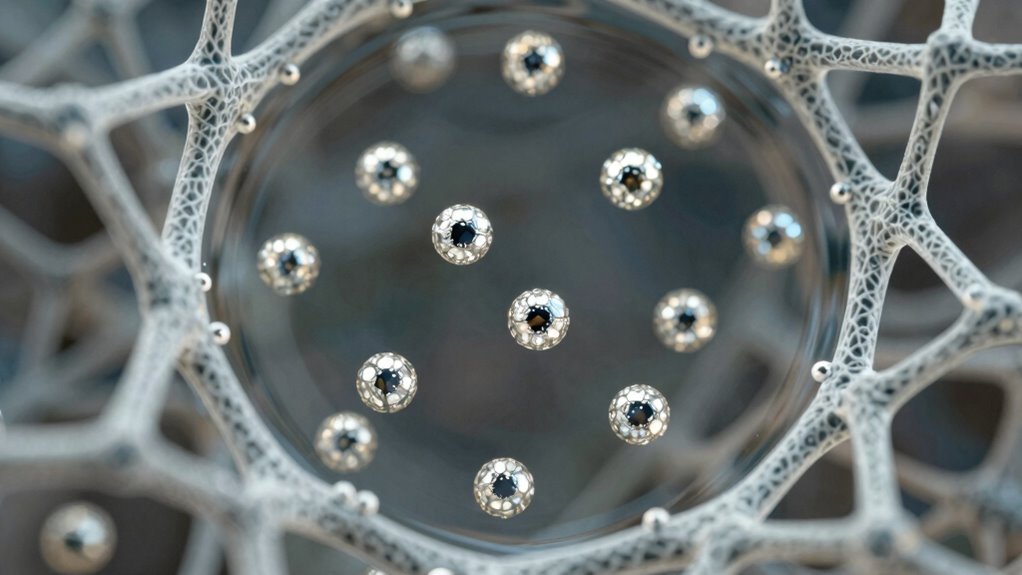

The main difference between nanoparticles and nanostructures is their shape and complexity. Nanoparticles are tiny, usually spherical particles smaller than 100 nm, known for their high surface area and reactivity. In contrast, nanostructures include larger, engineered forms like nanowires, tubes, and layered films, designed for specific functions and properties. Understanding these differences helps you choose the right material for your application—there’s much more to explore about their unique features.

Get the latest gadgets delivered free with Prime
- Fast, free delivery on millions of items
- Prime Video, Amazon Music and more included
- Member-only deals all year
Key Takeaways
- Nanoparticles are small, spherical particles under 100 nm, while nanostructures include complex shapes like wires, tubes, and films.
- Nanoparticles have high surface area and reactivity, whereas nanostructures are designed for specific mechanical and physical properties.
- Nanoparticles are primarily used for catalysis and drug delivery, while nanostructures are engineered for tailored structural functions.
- Shape control is limited in nanoparticles but highly customizable in nanostructures for targeted applications.
- Both operate at the nanoscale but differ in complexity, shape, and application focus.
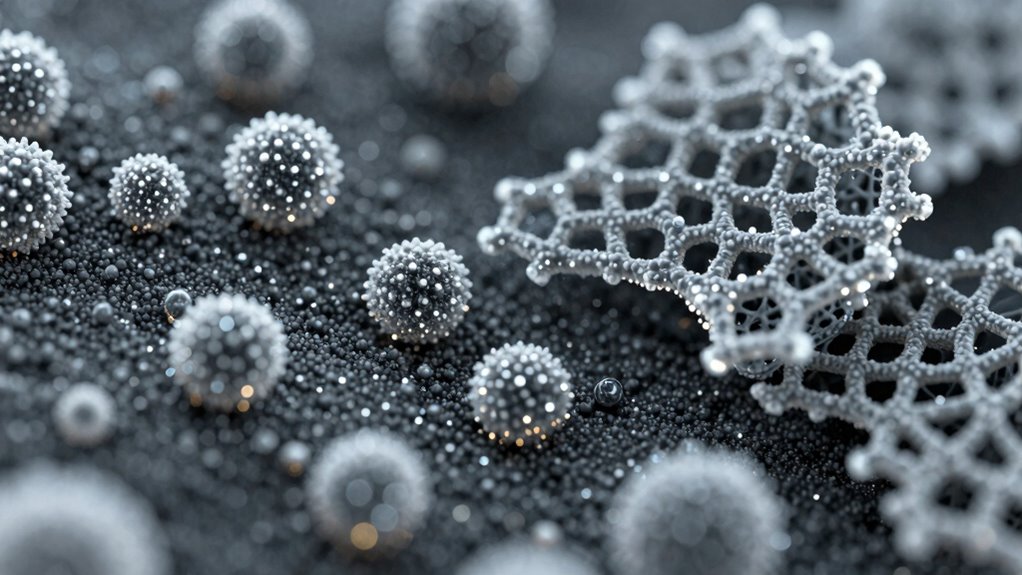
Nanoparticles and nanostructures are often used interchangeably, but they refer to different concepts in nanotechnology. While both involve materials at the nanoscale, their distinctions influence how you work with them and what applications they suit best. Nanoparticles are typically small, roughly spherical particles with dimensions less than 100 nanometers. Because of their tiny size, they boast an incredibly high surface area relative to their volume, which markedly impacts their properties. This elevated surface area makes nanoparticles highly reactive and useful in catalysis, drug delivery, and sensor technologies. On the other hand, nanostructures encompass a broader category, including complex arrangements and architectures like nanowires, nanotubes, or thin films. Their shapes and structures can be engineered to achieve specific functions, often involving multiple dimensions and larger sizes compared to nanoparticles. Understanding nanostructures allows for more precise control over material properties and functionalities. Additionally, nanostructures often involve engineered shapes that can be tailored for particular applications, giving you greater flexibility in design.
When it comes to surface area, nanoparticles excel because their small size dramatically increases the total surface exposed to the environment. This large surface area amplifies effects like reactivity, making nanoparticles more effective in chemical reactions or absorption processes. For you, this means that using nanoparticles can lead to enhanced performance in applications like filtration systems or targeted drug delivery. Their high surface area isn’t just about reactivity; it also influences mechanical strength. In some cases, nanoparticles can reinforce materials, increasing their durability and resistance to wear. Because their small size allows them to fill gaps within a matrix, they can improve a material’s mechanical strength without adding considerable weight. This property is especially valuable in developing lightweight yet strong composites.
Nanostructures, however, give you more control over mechanical properties due to their varied shapes and larger sizes. For example, nanowires or nanotubes can be designed to withstand specific stresses or strain, providing tailored mechanical strength for advanced engineering applications. These structures can be assembled into larger frameworks, creating materials that balance strength and flexibility. The ability to engineer nanostructures means you can optimize surface interactions, mechanical robustness, and other physical properties for particular needs. In essence, nanoparticles provide a high surface area and reactivity, often boosting chemical performance and strengthening materials, while nanostructures offer the advantage of custom-designed architectures that can be fine-tuned for mechanical resilience and functional integration. Understanding their differences helps you select the right nanomaterial for your specific application, whether it’s maximizing surface interactions or designing a resilient, structured system.
Popular right now

Sony WH-1000XM6 Wireless Noise-Canceling Over-Ear Headphones, Blue, Bundle

KitchenAid Artisan 5-Quart Tilt-Head Stand Mixer, KSM150PS, Almond Cream

Dyson V8 Cyclone Cordless Vacuum
As an affiliate, we earn on qualifying purchases.
Frequently Asked Questions
How Are Nanoparticles Synthesized Differently From Nanostructures?
You synthesize nanoparticles using techniques like chemical reduction, sol-gel, or vapor deposition, focusing on controlling size and surface modification to guarantee uniformity. In contrast, creating nanostructures involves more complex methods such as template synthesis, self-assembly, or lithography, which allow for precise control over shape and architecture. Surface modification plays a key role in both, tailoring properties for specific applications, but the techniques differ markedly depending on the desired nanomaterial.
What Industries Primarily Utilize Nanostructures Over Nanoparticles?
You’ll find nanostructures mainly in industries like medical imaging and energy storage, where their complex architectures outperform nanoparticles. They’re the big fish in the pond when it comes to enhancing imaging clarity or improving battery capacity. These industries leverage nanostructures’ unique properties to push technological boundaries, making them indispensable. So, if you’re eyeing advanced applications, nanostructures are where the real magic happens—it’s a case of quality over quantity.
Are Nanostructures More Environmentally Sustainable Than Nanoparticles?
Nanostructures are generally more environmentally sustainable than nanoparticles because they often have a lower environmental impact during production and disposal. Their larger size and stability reduce the risk of harmful environmental release, offering sustainability benefits. By using nanostructures, you can minimize potential toxicity and pollution, making them a more eco-friendly option in various applications. This sustainability focus helps reduce long-term environmental risks associated with nanomaterials.
How Does Surface Area Influence the Properties of Nanostructures?
Imagine you’re in a medieval marketplace—surface area dramatically influences nanostructures’ properties. A larger surface area boosts surface reactivity, making them more reactive and effective in catalysis. This increased exposure enhances catalytic efficiency, allowing nanostructures to facilitate chemical reactions faster and more efficiently. So, by controlling surface area, you can tailor nanostructures for specific applications, maximizing their reactivity and performance in various technological and environmental fields.
Can Nanoparticles Transform Into Nanostructures During Application?
Yes, nanoparticles can transform into nanostructures during application due to their transformational behaviors. Environmental conditions like temperature, pH, or chemical exposure may cause them to reassemble or grow into larger, more ordered nanostructures. However, you should also consider stability concerns, as this transformation might compromise their original properties or functionality. Monitoring these behaviors helps guarantee consistent performance and prevents unwanted structural changes.
Conclusion
So, now you see it clearly—you’re on the brink of discovering the universe’s tiniest secrets. Nanoparticles and nanostructures aren’t just small; they’re the cosmic keys to revolutionary breakthroughs, capable of transforming everything from medicine to materials in ways you’ve only dreamed of. Embrace this knowledge, because understanding these minuscule marvels will propel you into a future where the smallest things hold the power to change everything—truly, the universe is waiting at your fingertips.