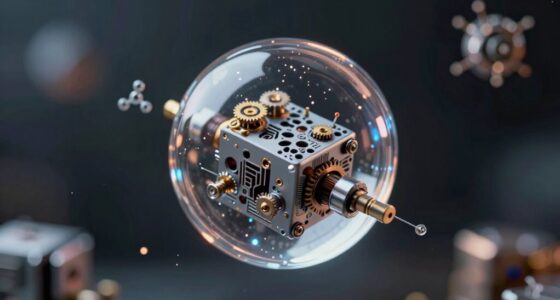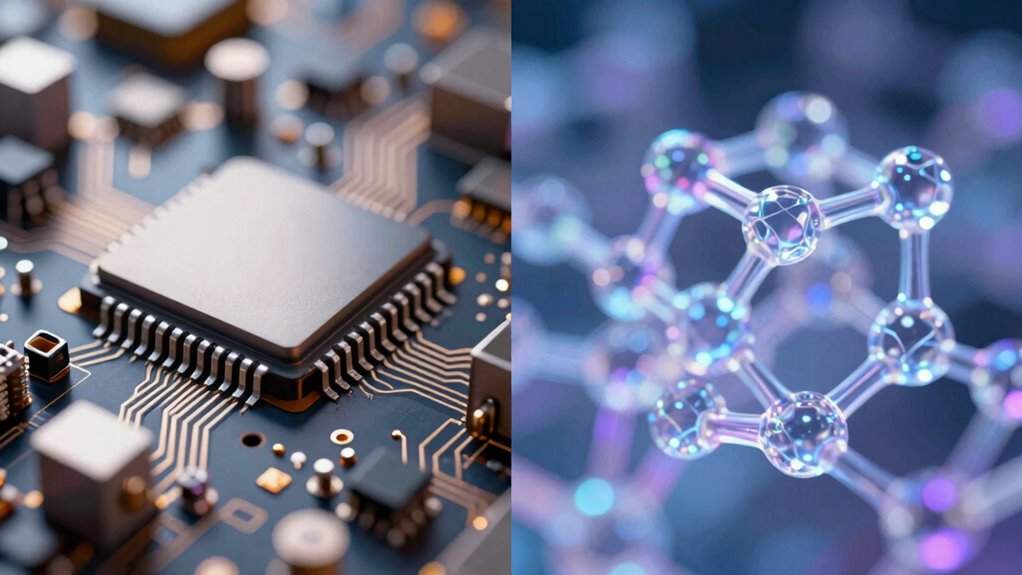

The most important difference between nanotech and microtech is the scale at which they operate, which profoundly affects material behavior and manufacturing challenges. Nanotech works at the nanometer level, where quantum effects, increased reactivity, and surface-to-volume ratios come into play, making processes more complex and less predictable. Microtech, operating at micrometers, benefits from well-understood properties and established methods. Understanding these scale-related challenges can open doors to innovative solutions—keep exploring to discover how these differences impact development.
Key Takeaways
- Nanotech operates at the nanometer scale, while microtech functions at the micrometer scale, resulting in different material behaviors.
- Material properties, such as reactivity and mechanical strength, change significantly at the nanoscale compared to micro-scale.
- Nanotechnology faces greater manufacturing challenges due to the need for extreme precision and control at extremely small dimensions.
- Quantum effects influence nanomaterials, whereas microtech largely relies on classical physics.
- The main distinction lies in the scale: nanotech involves manipulating materials at the atomic or molecular level, unlike microtech.
Have you ever wondered what sets nanotechnology apart from microtechnology? The key difference lies in the scale at which each operates and the unique challenges you face when working at these tiny levels. Nanotech deals with structures measured in nanometers—billionths of a meter—while microtech focuses on micrometers, or millionths of a meter. This difference might seem small, but it has profound implications for how you develop and apply these technologies. As you move into the nanoscale, you encounter significant scalability challenges. Manufacturing processes that work smoothly on a micro level often hit roadblocks when scaled down to nanotech. Techniques like lithography or chemical synthesis require specialized adjustments, and maintaining precision at such tiny dimensions becomes increasingly difficult. These challenges aren’t just about creating small parts; they’re about ensuring consistent, reliable production at an extremely fine scale. Additionally, at the nanoscale, the high pressure involved in some application methods can alter material behavior, making process control even more critical. Material limitations also come into sharp focus when you work with nanotech. At the nanoscale, materials behave differently than they do at larger scales, and this can create unexpected hurdles. For example, many materials exhibit increased reactivity, altered mechanical properties, or quantum effects that aren’t present at the micro level. You’re often limited by what materials can withstand or how they interact with their environment when shrunk to the nanoscale. This can restrict your options or demand innovative solutions that aren’t necessary in microtechnology. Furthermore, the surface-to-volume ratio increases dramatically at the nanoscale, influencing chemical interactions and stability of nanomaterials. Understanding the material behavior at small scales becomes crucial for designing effective nanodevices and overcoming these challenges. Recognizing these scaling issues early in the design process helps prevent costly failures during manufacturing. Moreover, advancements in nanofabrication techniques are continually expanding the possibilities within nanotechnology, despite these hurdles. On the other hand, microtechnology benefits from more established material properties and manufacturing techniques that are better understood and easier to control. When you compare the two, the most important difference becomes clear: the leap from micro to nano isn’t just about making things smaller—it involves overcoming fundamental obstacles related to scalability and material behavior. While microtech relies on well-established methods and materials, nanotech pushes you into uncharted territory, where you must adapt or invent new processes to handle these challenges. The tiny scale amplifies issues like material limitations and manufacturing scalability, which can hinder progress but also open up opportunities for innovation. Understanding this difference helps you appreciate why nanotechnology is often seen as more complex and demanding, yet also more promising for revolutionary advancements. Whether it’s in medicine, electronics, or materials science, recognizing these fundamental distinctions guides your approach to research, development, and application in these rapidly evolving fields.

Introduction to Nanotechnology
As an affiliate, we earn on qualifying purchases.
As an affiliate, we earn on qualifying purchases.
Frequently Asked Questions
How Do Nanotech and Microtech Impact Environmental Sustainability?
Nanotech and microtech boost environmental sustainability by enabling eco-friendly innovations and improving resource efficiency. You benefit from advanced materials that reduce waste and energy use, making products more sustainable. These technologies help develop cleaner manufacturing processes and better pollution control. By adopting nanotech and microtech, you support a greener future, conserving resources, minimizing environmental impact, and fostering sustainable development.
What Industries Benefit Most From Nanotech Versus Microtech?
You’ll find nanotech industries benefiting most from nanomaterials innovation, which enhances electronics, medicine, and energy storage with ultra-small components. Microtech industries, on the other hand, leverage microfabrication techniques, excelling in semiconductor manufacturing, sensors, and medical devices requiring precise, larger-scale structures. Both fields push technological advancements, but nanotech’s focus on manipulating at the atomic level and microtech’s on creating detailed, small-scale parts define their primary applications.
Are There Safety Concerns Unique to Nanotech?
Nanotech safety concerns are like walking a tightrope—you need to stay alert. You should be cautious about potential nano safety risks, such as inhaling tiny particles that can penetrate cells or escape containment. Micro safety is less complex but still important. Always handle nanomaterials with proper protective gear and protocols, because nano safety issues can pose unique health and environmental risks, unlike traditional microtech safety considerations.
How Do Costs Compare for Nanotech and Microtech Manufacturing?
You’ll find that the cost comparison between nanotech and microtech manufacturing varies. Nanotech often has higher initial costs due to advanced equipment and precision requirements, making scalability challenging. Microtech generally benefits from established processes, resulting in lower costs and easier manufacturing scalability. However, as nanotech techniques improve and scale up, costs could decrease, narrowing the gap between the two.
What Are the Future Advancements Expected in Nanotech and Microtech?
Imagine a world where tiny worlds open extraordinary possibilities. In the future, nanotech will harness quantum effects to manipulate material properties at an atomic level, leading to revolutionary drugs, stronger materials, and smarter electronics. Microtech will continue refining precision manufacturing, enabling ultra-compact devices. Together, these advancements will blur boundaries, creating innovations that seem almost magical, transforming industries and daily life with unprecedented control over matter and energy.

Micromachining and Microfabrication Process Technology: 23-24 October, 1995, Austin, Texas (Proceedings of Spie–The International Society of Optical Engineering, V. 2639.)
As an affiliate, we earn on qualifying purchases.
As an affiliate, we earn on qualifying purchases.
Conclusion
Understanding the difference between nanotech and microtech is like seeing the universe in a grain of sand—you realize how much smaller innovations can pack a punch. While both revolutionize technology, it’s the scale that sets them apart: nanotech manipulates atoms and molecules, revealing incredible possibilities, whereas microtech focuses on larger, yet still tiny, components. By grasping this, you hold the key to opening a future where the tiniest details create the biggest impact.
nanotech research kits
As an affiliate, we earn on qualifying purchases.
As an affiliate, we earn on qualifying purchases.

THINKSCALE Milligram Scale, 50g/0.001g Digital Jewelry Scale, Micro Gram Scale for Powder, Medicine, Gold, Gem, Reloading, Mg Scale 6 Units, Tare, Cal Weight Included
50g / 0.001g: Digital milligram scale are equipped with high precision sensors, with a maximum capacity of 50g…
As an affiliate, we earn on qualifying purchases.
As an affiliate, we earn on qualifying purchases.