
Building stable nanomachines is challenging because controlling quantum effects at such tiny scales is complex and prone to disturbances. You must also develop materials durable enough to withstand environmental stresses without losing their quantum properties. External factors like temperature, electromagnetic interference, and corrosion threaten their stability. Overcoming these hurdles involves advanced error correction techniques and innovative materials. If you want to explore how scientists are tackling these issues, keep going to discover the latest solutions.
Key Takeaways
- Quantum decoherence and fluctuations undermine the stability and reliable control of nanomachines at the quantum level.
- Material fragility and corrosion risks increase as components shrink, complicating durability and longevity.
- External environmental factors like temperature, electromagnetic interference, and chemical exposure disrupt nanomachine function.
- Developing durable, resilient materials that preserve quantum properties remains a significant engineering challenge.
- Implementing effective error correction and shielding strategies is essential to maintain stability amidst disturbances.
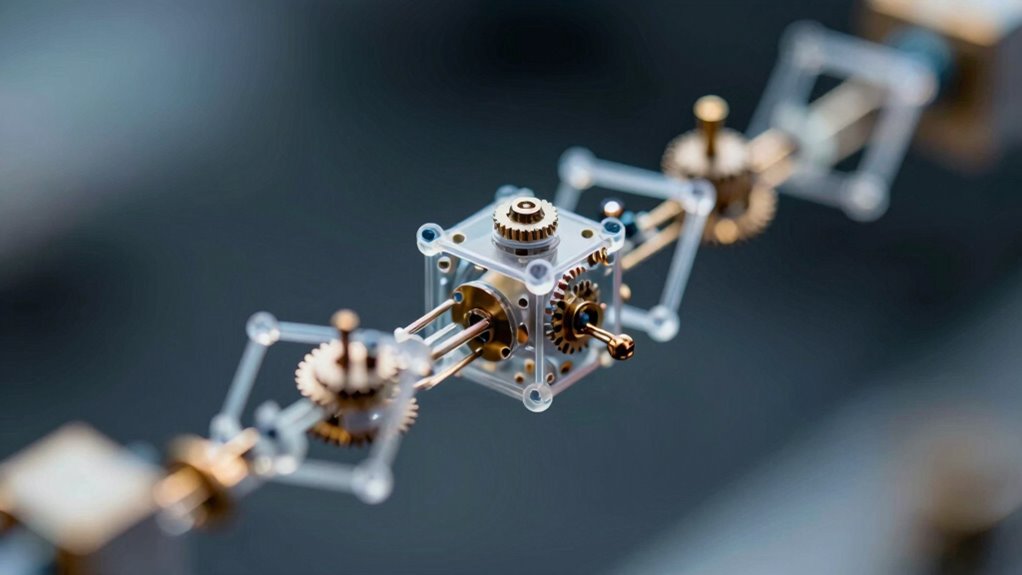
Have you ever wondered why developing reliable nanomachines remains such a formidable challenge? The answer lies in the complex interplay of quantum stability and material durability at an incredibly small scale. When working at the nanoscale, the rules of classical physics give way to quantum mechanics, which introduces a host of unpredictable behaviors. Quantum stability becomes a major concern because even tiny fluctuations can cause nanomachines to lose coherence or malfunction. Unlike larger systems, where environmental disturbances can be absorbed or mitigated, nanomachines are highly susceptible to quantum effects that threaten their stability. Achieving consistent, predictable behavior requires precise control over quantum states, which is difficult given the inherent uncertainty and noise at this scale. Additionally, the quantum effects at play can lead to decoherence, further complicating the stability of these tiny devices. Material durability adds another layer of complexity. Most materials that work well in bulk can’t simply be scaled down to the nanoscale without losing their essential properties. At such a small size, materials tend to become more fragile, prone to corrosion, or susceptible to structural failure. Developing materials that can withstand the stresses and environmental conditions faced by nanomachines demands innovative approaches. Researchers have to find ways to engineer materials that maintain their integrity over time, resisting wear and tear while still being compatible with the delicate quantum states necessary for operation. This balancing act between durability and functionality is a major obstacle because it’s difficult to create materials that are both resilient and capable of supporting quantum coherence. Furthermore, integrating these durable materials into nanomachines that are inherently sensitive to environmental changes complicates the development process. External factors like temperature fluctuations, electromagnetic interference, and chemical exposure can quickly destabilize nanomachines. To build truly reliable devices, you must find ways to shield or stabilize these tiny machines from such disturbances without compromising their functionality. Advances in material science are essential to overcoming these hurdles and achieving stable nanomachines. Understanding the role of environmental disturbances is crucial in developing effective shielding techniques for nanomachines. Additionally, ongoing research into quantum error correction provides promising strategies to mitigate the effects of decoherence and improve stability. Until these hurdles are overcome, the promise of reliable nanomachines will remain just beyond reach.

Fiknonk 2 PCS H11 Canbus Decoder, 50W 6 Ohm LED Anti Flicker Resistor Kit, Error Free Adapter for Turn Signal Fog Lights, Compatible with H11 Bulbs (Black)
Eliminates Common Errors: This canbus decoder kit solves led bulb issues such as hyper-flashing turn signals, dashboard warning…
As an affiliate, we earn on qualifying purchases.
As an affiliate, we earn on qualifying purchases.
Frequently Asked Questions
How Do Nanomachines Communicate With Each Other?
You can think of nanomachines communicating through molecular signaling, where they send and receive chemical signals akin to messages. They often use specific communication protocols, like releasing certain molecules or signals, to coordinate actions. This allows them to work together efficiently, responding to environmental cues or each other’s signals. By mimicking biological systems, nanomachines can achieve precise, reliable communication at a tiny scale.
What Materials Are Safest for Human Applications?
You should prioritize biocompatible materials like certain polymers, ceramics, and metals, which are designed to minimize toxicity concerns. These materials are safer for human applications because they don’t trigger immune responses or introduce harmful substances. While cutting-edge nanomachines push boundaries, selecting materials with proven biocompatibility guarantees safety, stability, and effective integration into biological systems—balancing innovation with the critical need to protect human health.
Can Nanomachines Self-Repair After Damage?
Yes, nanomachines can feature self-repair mechanisms to address damage. These systems enable them to detect and fix issues, maintaining repair durability over time. You’ll find that incorporating self-repair capabilities helps nanomachines stay functional longer and reduces the need for external intervention. By designing with robust self-repair mechanisms, you guarantee their stability and reliability, even after sustaining damage in complex environments.
How Are Nanomachines Powered Sustainably?
Imagine nanomachines in the bloodstream, harnessing energy from glucose molecules through energy harvesting techniques. You can see how power optimization becomes essential for sustained operation. By efficiently converting biological energy sources, these nanomachines can remain active longer without external power supplies. This approach guarantees sustainable operation, allowing nanomachines to perform tasks like targeted drug delivery or diagnostics, demonstrating a promising pathway for powering microscopic devices reliably.
What Are the Environmental Impacts of Nanomachines?
You should consider that nanomachines could impact environmental biosafety and cause unforeseen ecological effects. They might accumulate in ecosystems, potentially harming wildlife or disrupting natural processes. If not carefully designed, nanomachines could introduce toxic materials or interfere with biological systems. It’s essential to evaluate these environmental impacts thoroughly, ensuring safe disposal and monitoring to prevent long-term ecological damage and protect both ecosystems and human health.

Sumsoctober Adjustable Probe Tool Stainless Steel Needle Circuit Board Test Kit 0.8mm Fine Tip Multi-Function Programmer Access Pads Data Repair and Debug for Electronics
Testing Access: Adjustable stainless steel needle allows exact contact with small solder pads on circuit boards, making data…
As an affiliate, we earn on qualifying purchases.
As an affiliate, we earn on qualifying purchases.
Conclusion
Imagine your nanomachines as delicate origami, intricately folded yet fragile against the wind. To keep them stable, you must master the art of balance—like tuning a tiny orchestra where each instrument must play in harmony. The real challenge isn’t just building these minuscule marvels, but ensuring they stand firm amid chaos. With patience and precision, you’ll transform fleeting glimmers of potential into steadfast, functioning nanodevices that can shape the future.

Erthree RF Shielding Fabric, RFID Radiation Shielding Fabric, RF Signal Blocking Material for Smart Meters
【Data Protection】: As an Insert in the wallet or handbag to protect your credit cards from data theft
As an affiliate, we earn on qualifying purchases.
As an affiliate, we earn on qualifying purchases.
quantum coherence stabilization devices
As an affiliate, we earn on qualifying purchases.
As an affiliate, we earn on qualifying purchases.