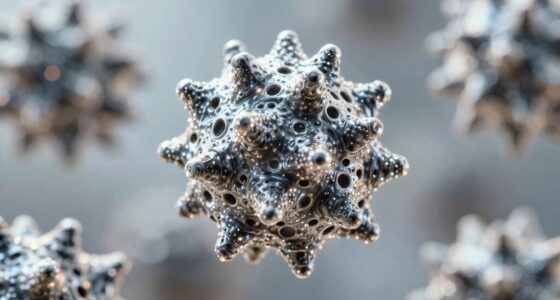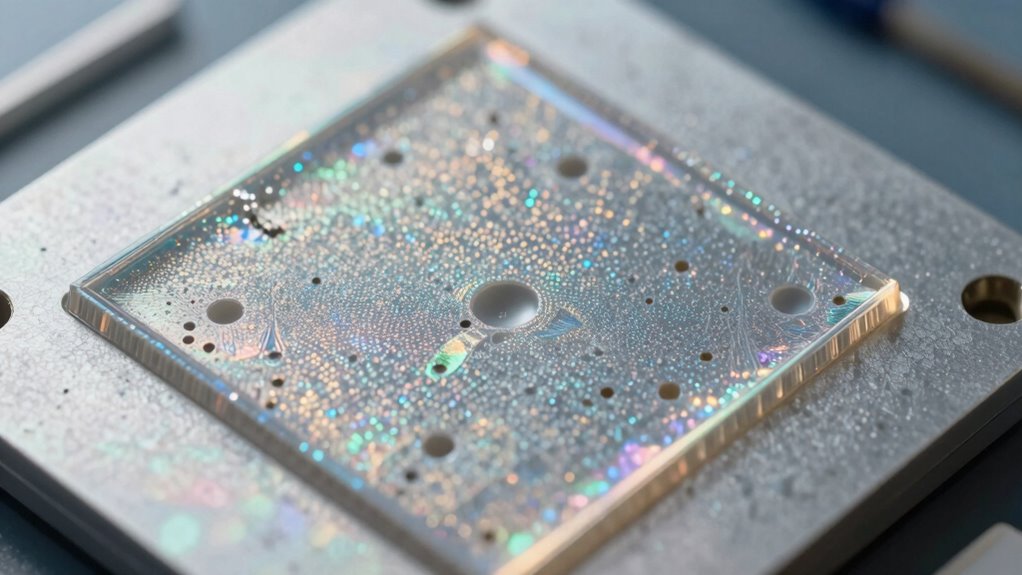

You should care about surface chemistry in nanotech because it controls how nanomaterials interact, assemble, and perform in your applications. With a high surface area to volume ratio, surface properties dominate the behavior of nanomaterials, affecting stability, reactivity, and compatibility. By manipulating surface chemistry, you can tune properties for specific functions, improve durability, and create multifunctional materials. Keep exploring to uncover how surface chemistry reveals the full potential of nanotechnology.

Get the latest gadgets delivered free — and shop member deals
- Fast, free delivery on millions of items
- Access to Prime Big Deal Days deals on October 6–7
- Prime Video, Amazon Music and more included
Key Takeaways
- Surface chemistry controls particle interactions, assembly, and stability at the nanoscale, impacting overall nanomaterial performance.
- It enables precise tuning of electronic, optical, and catalytic properties through quantum effects at surfaces.
- Modifying surface chemistry improves biocompatibility, reactivity, and functionality for diverse applications.
- Surface coatings prevent degradation, enhance durability, and ensure long-term stability in various environments.
- It facilitates integration into complex systems and the development of multifunctional, advanced nanomaterials.

Have you ever wondered how tiny materials can be manipulated at the atomic level? When working in nanotechnology, you quickly realize that at such small scales, surface chemistry becomes everything. The surfaces of nanomaterials aren’t just the outermost layer—they fundamentally influence how particles interact, assemble, and behave. Because of their high surface area to volume ratio, surface chemistry dominates the properties of nanomaterials, dictating their stability, reactivity, and compatibility in various applications. This is where understanding material interactions at the surface level becomes crucial for advancing nanotech innovations.
At the nanoscale, quantum effects come into play, shaping how electrons behave at material surfaces. These effects alter the electronic properties, affecting conductivity, optical behavior, and reactivity. For example, the way electrons are distributed at the surface can determine whether a nanomaterial acts as a catalyst or remains inert. As a researcher, you need to grasp these quantum phenomena because they directly influence how nanomaterials respond to their environment. Precise control over these effects allows you to tailor surface properties for specific functions—whether that’s increasing surface energy for better adhesion or tuning optical responses for sensors. Furthermore, surface chemistry influences how nanomaterials interact with biological systems, which is critical for biomedical applications.
Quantum effects at surfaces shape electronic properties, enabling precise tuning of nanomaterials for catalysts, sensors, and advanced applications.
Material interactions are also heavily influenced by surface chemistry. When you manipulate the surface chemistry, you can control how particles bond, aggregate, or repel each other. This control is essential for designing nanostructures with desired shapes and functionalities. If surfaces are coated or functionalized with particular molecules, you can enhance biocompatibility for medical applications or improve catalytic activity for chemical processes. These interactions depend on the surface’s chemical composition and how it interacts with surrounding molecules, which determines the success of your nanotech design. Understanding surface chemistry is fundamental to developing effective nanomaterials. Additionally, surface chemistry impacts stability and durability. Nanomaterials are often prone to degradation or agglomeration because of their high surface energy. By understanding and controlling surface interactions, you can develop coatings or functional groups that protect the nanoscale structures, extending their lifespan and performance. For example, surface modification can prevent oxidation and other forms of degradation, which is especially important in applications like drug delivery, where stability in biological environments is critical. A deeper understanding of material stability can help in creating more resilient nanomaterials that withstand harsh conditions and long-term use. Moreover, innovative surface chemistry strategies can facilitate the integration of nanomaterials into complex multifunctional systems, broadening their potential uses.
As an affiliate, we earn on qualifying purchases.
Frequently Asked Questions
How Does Surface Chemistry Influence Nanomaterial Stability?
Surface chemistry directly impacts nanomaterial stability by affecting surface energy and chemical passivation. High surface energy can cause particles to agglomerate or react undesirably, reducing stability. Chemical passivation helps by coating or modifying surfaces to lower surface energy and prevent unwanted reactions. By controlling surface chemistry, you enhance the durability and lifespan of nanomaterials, ensuring they stay stable and functional in various applications.
Can Surface Modifications Improve Nanotech Device Performance?
Yes, surface modifications can markedly improve nanotech device performance. By adjusting surface chemistry, you can control surface charge, reducing unwanted quantum tunneling effects that cause energy loss. These modifications enhance stability and optimize electron flow, leading to better device efficiency. Tailoring surface properties allows you to fine-tune interactions at the nanoscale, ultimately boosting the reliability and functionality of your nanotech devices.
What Are Common Methods to Analyze Nanostructure Surfaces?
You analyze nanostructure surfaces using common methods like surface characterization techniques and spectroscopic analysis. Surface characterization includes atomic force microscopy (AFM) and scanning electron microscopy (SEM), which reveal topography and morphology. Spectroscopic analysis, such as X-ray photoelectron spectroscopy (XPS) and Raman spectroscopy, helps identify chemical composition and molecular interactions. These methods give you detailed insights into surface properties, essential for optimizing nanotech device performance.
How Does Surface Chemistry Affect Biocompatibility of Nanomaterials?
Surface chemistry directly impacts the biocompatibility of nanomaterials by influencing surface interactions with biological systems. When you use functionalization techniques, you modify the nanomaterial’s surface, reducing toxicity and enhancing compatibility. These modifications can improve cell attachment, minimize immune responses, and enable targeted interactions. By carefully controlling surface chemistry, you guarantee your nanomaterials are safer and more effective in biomedical applications, ultimately making them more compatible with living tissues.
Are There Environmental Impacts of Surface Chemistry in Nanotech?
Yes, surface chemistry in nanotech can impact the environment by influencing environmental toxicity and increasing the ecological footprint. You might not realize that reactive or poorly understood surface modifications could release harmful substances or disrupt ecosystems. By carefully designing nanomaterials with eco-friendly surface chemistry, you can reduce negative environmental impacts, promote sustainability, and minimize ecological footprint, ensuring safer, more responsible nanotech development.
As an affiliate, we earn on qualifying purchases.
Conclusion
Understanding surface chemistry is like having the key to a secret garden—you uncover endless possibilities in nanotechnology. By mastering how surfaces interact at the atomic level, you can design smarter materials, improve drug delivery, or create more efficient sensors. Without this knowledge, you’re like a sailor lost at sea—directionless. So, dive deep into surface chemistry; it’s the compass that guides your innovations and transforms tiny particles into groundbreaking solutions.
nanoparticle functionalization tools
As an affiliate, we earn on qualifying purchases.
As an affiliate, we earn on qualifying purchases.
nanomaterials for biomedical applications
As an affiliate, we earn on qualifying purchases.
As an affiliate, we earn on qualifying purchases.
Fall Picks
fall essentials
As an affiliate, we earn on qualifying purchases.