
Molecular computing uses biological molecules like DNA and proteins to process information, offering a promising alternative to traditional electronics. You can harness DNA’s specific base-pairing to create logic gates, circuits, and even quantum bits, enabling highly parallel and miniaturized computation. This field combines biology and computer science to develop faster, energy-efficient devices. If you explore further, you’ll discover how scientists are pushing the boundaries of technology with these innovative systems.
Key Takeaways
- Molecular computing uses molecules, especially DNA, to perform logic operations and data processing at a nanoscale level.
- DNA-based logic gates respond to specific inputs through hybridization, producing detectable signals for computational functions.
- Molecular computing offers high parallelism, miniaturization, and specificity, enabling complex and scalable biological circuits.
- Quantum molecular computing leverages molecules’ quantum states, such as spin, to implement qubits for advanced quantum information processing.
- Integration of DNA logic and molecular qubits aims to create hybrid systems for innovative computing, sensing, and data storage applications.
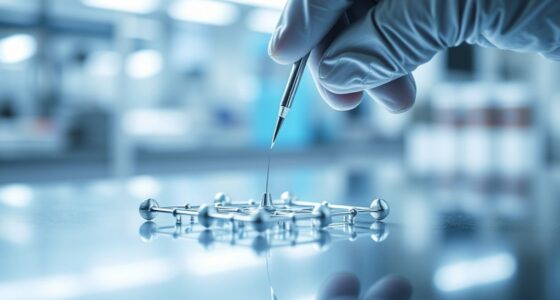
Have you ever wondered how molecules can perform computations? It’s a fascinating area where chemistry meets computer science, enabling new forms of processing information at a microscopic scale. One key concept in molecular computing involves DNA logic gates, which are designed to mimic the functions of traditional electronic logic gates but operate using biological molecules. These gates use strands of DNA that can undergo specific reactions in response to certain inputs, producing a predictable output. For example, when particular DNA strands are present, they can trigger a series of hybridization events that lead to a detectable signal, effectively performing logical operations like AND, OR, and NOT. These DNA logic gates are not only programmable but also highly specific, thanks to the unique base-pairing rules of DNA. This specificity allows for complex circuits to be built at the molecular level, opening doors to highly parallel and miniaturized computation. Additionally, advances in high-throughput techniques enable the rapid screening and optimization of these molecular systems, accelerating their practical applications.
Now, imagine taking this concept further, into the domain of quantum mechanics, with molecular qubits. Unlike classical bits, which are either 0 or 1, qubits can exist in superpositions, enabling a quantum computer to process multiple possibilities simultaneously. Molecular qubits are tiny quantum bits embedded within molecules, often involving spin states of electrons or nuclei. These molecules can be manipulated with external fields to perform quantum operations, making them promising candidates for quantum information processing. Because molecules naturally have well-defined quantum states, they can serve as stable, scalable qubits in future quantum computers. Integrating DNA logic gates with molecular qubits could lead to hybrid systems that leverage both classical biological information processing and quantum computing capabilities, potentially revolutionizing how we handle complex computations.
As you explore molecular computing, it’s clear that the intersection of DNA logic gates and molecular qubits represents a cutting-edge frontier. DNA logic gates provide a biocompatible, programmable platform for classical logic, while molecular qubits introduce the possibility of quantum-enhanced processing at the molecular scale. Together, these technologies push the boundaries of miniaturization and efficiency in computation, promising devices that are faster, more energy-efficient, and capable of solving problems beyond the reach of traditional computers. Whether for biological sensing, data storage, or quantum algorithms, understanding and harnessing these molecular tools can give you a glimpse into the future of computing—where the smallest units of life and quantum physics work hand-in-hand to perform incredible tasks.
DNA logic gate kit
As an affiliate, we earn on qualifying purchases.
As an affiliate, we earn on qualifying purchases.
Frequently Asked Questions
How Does Molecular Computing Compare to Traditional Silicon-Based Computers?
You’ll find molecular computing differs from traditional silicon-based computers by leveraging quantum effects, which enable it to perform complex calculations at a smaller scale. It’s more energy-efficient because it requires less power to operate, making it potentially faster and more sustainable. While silicon chips rely on electronic circuits, molecular computing uses molecules to process information, opening new possibilities for miniaturization and advanced applications in technology.
What Are the Main Challenges in Developing Molecular Computing Devices?
You face significant hurdles in developing molecular computing devices, with scalability issues and stability concerns at the forefront. Unlike traditional silicon chips, molecules can be unpredictable and hard to govern, making it tough to scale up. Stability problems arise because molecules may degrade or react unexpectedly over time. Overcoming these challenges requires innovative techniques to guarantee reliable, scalable, and durable molecular systems that can compete with conventional computers.
Can Molecular Computing Be Integrated With Existing Technology?
You can integrate molecular computing with existing technology by developing biocompatible interfaces that connect molecular systems to traditional electronic devices. This allows seamless data transfer and control. Quantum integration also plays a role, enabling faster, more secure processing. While challenges remain, such as ensuring compatibility and stability, advancing these interfaces can markedly enhance hybrid systems, opening new possibilities for biomedical devices, sensors, and computing architectures.
What Are Potential Real-World Applications of Molecular Computing?
You could revolutionize the world with molecular computing, transforming biomedical diagnostics and environmental sensing beyond your wildest dreams. Imagine detecting diseases at the molecular level instantly or monitoring pollutants in real-time with unimaginable precision. This technology could make current methods look like outdated relics, offering ultra-sensitive, portable solutions. You’d have the power to save lives, protect ecosystems, and uncover mysteries of biology, all through the tiny, incredible world of molecules working seamlessly together.
How Long Will It Take for Molecular Computing to Become Commercially Available?
It’s difficult to predict exactly when molecular computing will be commercially available, as scalability hurdles and ethical considerations slow progress. You might see early applications within the next decade, but widespread use could take longer. Researchers are working to overcome these challenges, ensuring safety and feasibility. Stay informed about advancements, as breakthroughs could accelerate development, bringing molecular computing closer to everyday use sooner than expected.
molecular computing DNA strands
As an affiliate, we earn on qualifying purchases.
As an affiliate, we earn on qualifying purchases.
Conclusion
Imagine molecules acting as tiny computers, weaving complex calculations at a scale invisible to the naked eye. With each reaction, you can picture a molecular dance, where atoms swap information and solve problems faster than traditional chips. This isn’t just science fiction—it’s a glimpse into a future where your world is powered by these microscopic masterminds, transforming technology into a breathtaking dance of atoms. The theory may be true, and the possibilities are endless.
quantum molecular qubits
As an affiliate, we earn on qualifying purchases.
As an affiliate, we earn on qualifying purchases.
biological quantum computing devices
As an affiliate, we earn on qualifying purchases.
As an affiliate, we earn on qualifying purchases.